Bronco Webinar 800x100 1

Design Data Intelligence

Design Data Intelligence
by Bernard Murphy on 11-02-2017 at 7:00 am

We have an urge to categorize companies, and when our limited perspective is of a company that helps with design, we categorize it as an EDA company. That was my view of Magillem, but I have commented before that my view is changing. I’m now more inclined to see them more as the design equivalent of a business intelligence organization – an Oracle or SAP or SalesForce, something along those lines – kind of a design intelligence company. I’m not suggesting Magillem has the scale or reach of those business organizations but it does seem to have a similar mission, within the world of system design.


I was at the Magillem user group meeting recently to understand where they are headed and what users think of what they are doing. Isabelle Pesquie-Geday, the CEO, opened with a business summary, always useful to check reality is headed in the right direction to support the vision. Last year revenues grew 24%, strategic projects are growing (unsurprising when they are in this line of business), they now have a branch in Shanghai, a subsidiary in Korea and have added staff in the US. Business today is geographically split quite evenly between the US, Europe and Asia and is predominantly today with semiconductor companies, with a smaller component in systems companies and a still smaller component in publishing (remember that one).

Back to technology. To leverage design intelligence, you have to start with a common core format. Magillem is best known for their support of XML-based tools, in the design domain supporting the IEEE-1685 (IP-XACT) standard for design representation. This standard data representation is the core of how they manage linkages between components in a system, certainly for blocks/IPs and the connectivity between these but also between system level dependencies – hardware and software views, different levels of abstraction from requirements to architecture, to implementation, documentation, specifications and traceability.

An important point to understand is that the IEEE standard doesn’t aim to replace existing representations of design (eg RTL) or documentation which are already well-handled in existing formats. Rather the goal is to package and link these representations to support easy interoperability between different levels of abstraction in design data models, connections between hardware and software characteristics and, thanks to an open-standard format, to encourage high levels of automation in assembly and verification / validation of these systems. The standard replaces or encapsulates many of these total system design objectives (otherwise described in proprietary side-files) through standard XML schemas.

So what’s the ground truth; how is the standard working out in active SoC design today? At the user-group meeting there were presentations from NXP, Bosch and Renesas and there were attendees from multiple other companies including, interestingly, a well-known supplier of PCB software. In deference to confidentially expectations at these organizations, I won’t detail who said what but I will mention what for me were some important takeaways.

It should be pretty obvious that there is active use among companies working in automotive supply chains, and it’s not difficult to imagine why they might want to pursue this direction. A common standard, auditable format between suppliers should be appealing to show advantages in certification over suppliers with less structured and proprietary data formats. Also I can imagine traceability above the chip level can be challenging if suppliers aren’t using common formats. Through an open standard it should be easier to demonstrate traceability of requirements and impact of changes. Magillem already has a track-record in working with aerospace organizations in Europe where this type of consideration is extremely important.

For all the presenters, these flows have been in production for multiple years. Usage varies from fast and reliable assembly of the SoC top-level with easy configurability to drive multiple verification flows from simulation to RTL prototypes, register / memory-map validation, document generation and update, all the way to all of these plus configurable modeling with mixed views (TLM, RTL, gate).


These are the “classic” applications of IP-XACT-based flows, but where can this lead next? An obvious next step is into traceability. Magillem has already made progress in this direction with their Magillem Link Tracer (MLT). They continue to evolve their traceability goals, moving closer to bi-directional support for linkages between multiple different “documents” in the system definition from specification and requirements to documentation, design representation and verification / validation views. Here the trick is how many of these linkages must be defined manually and how many can be inferred automatically. The IEEE standard takes care of some of this. Connections to documentation for example are still challenging, but read on.

This is where Magillem’s interest in AI starts. They are quite modest about their goals in this area – to develop assistants to help in the system development task rather than any high-flown “robot designer” kind of vision. Dr. Eric Mazeran (IBM) gave a very good background to this area which I hope to summarize sometime in a separate blog. Eric has been in the AI field for 25 years (largely in AI applications to business intelligence) and, when not working his full-time job with IBM, consults with Magillem. Here I’ll touch on just a couple of Magillem applications areas he introduced with Isabelle.


The first is in support of legal publishing – updating legal documents to reflect daily updates based on decrees and other official sources of changes. This is not even remotely in the design domain but is has an interesting adjacency. Briefly, the legal solution combines natural language processing (NLP), deep learning and a references-indexing engine to tag (eg. insert or edit) required changes, compare this to mountains of legal documents to which these changes might apply, then generate suggested edits to appropriate documents. Note “suggested”. The tool doesn’t make the changes itself; there is still a human editor in the loop to check the proposed changes. The tool acts as an assistant to the editor, solving the massive combinational part of the problems – millions of comparisons – to boil down a limited set of changes the editor must consider.

A similar application could help build links between ad-hoc documents and design representations, which then can be tracked in traceability analyses. Magillem is also exploring decision-tree-based expert systems to capture common types of expert knowledge within an organization. These are often problematic because there are too few experts who need to work with too many product teams and there is significant risk when an expert leaves the company. Eric showed a manufacturing example in his talk where a production supervisor walked through a Q&A with such an assistant to diagnose a problem and explore possible corrective actions. Again, the assistant helped the supervisor to get to a workable set of options, from which she could recommend next actions. You could imagine all kinds of hard-earned expertise in production design flows being captured in a similar way.

Quite an ambitious reach, starting from something as seemingly mundane as an industry-standard XML data format for system integration data. You can learn more about Magillem solutions HERE.


Synopsys discusses the challenges of embedded vision processing

Synopsys discusses the challenges of embedded vision processing
by Tom Simon on 11-01-2017 at 12:00 pm

Before the advent of convolutional neural networks (CNN), image processing was done with algorithms like HOG, SIFT and SURF. This kind of work was frequently done in data centers and server farms. To facilitate mobile and embedded processing a new class of processors was developed – the vision processor. In addition to doing a fair job of recognition, they were good at matrix math and pixel operations to filter and clean up image data or identify areas of interest. However, the real transformation for computer vision occurred when CNN won the ImageNet Large Scale Visual Recognition Challenge in 2012. The year before a the winning non-CCN approach achieved an error rate of 25.8%, which was considered quite good at the time. In 2012 the CNN called AlexNet came in first with an error rate of 16.4%.

Just three years later by 2015, CNN moved up to an error rate of 3.57%, exceeding the human error rate of 5.1% on this particular task. The main force behind ImageNet is Stanford’s Fei-Fei Li, who pioneered the ImageNet image database. Its size exceeded by many orders of magnitude any previous classified image database. In many ways, it laid the foundation for the acceleration of CNN by providing a comprehensive source of training and testing data.

In the years since 2012 we have seen tremendous growth in the applications for CNN and image processing in general. A big part of this growth has taken computer vision out the server farm and moved it closer to where image processing is needed. At the same time the need for speed and power efficiency has increased. Computer vision is used in factories, cars, research, security system, drones, mobile phones, augmented reality, and many other applications.

At the Linley Processor Conference in Santa Clara in October Gordon Cooper, embedded vision product marketing manager at Synopsys, talked about the evolution of their vision processors to meet the rigorous demands of embedded computer vision applications. What he calls embedded vision (EV) is different than traditional computer vision. EV combines computer vision with machine learning and embedded systems. However, EV performance is affected by increasing image size and frame rates. Also, power and area constraints need to be dealt with. Finally, technology is rapidly advancing. If you look at the ImageNet competition, you will see that each year the core algorithm has changed dramatically.

Indeed, approaches for CNN have evolved rapidly. The number of layers has increased from ~ 8 to over 150. At the same time hybrid approaches are becoming more prominent by using a fusion of computer vision and CNN techniques. To assist in these newer approaches, Synopsys is offering heterogeneous processing units in their EV DesignWare® IP. These consist of scalar, vector and CNN processors in one integrated SOC IP. The Synopsys DesignWare® EV6x family offers from 1 to 4 scalar and vector processors combined with a CNN engine. This IP is supported by a standards-based software toolset with OpenCV libraries, OpenVX framework, OpenCL C compiler, C++ compiler and a CNN mapping tool.

The processing units are all connected by high speed interconnect so operations can be pipelined to increase efficiency and parallelism during frame processing. The EV6x family supplies a DMA Streaming Transfer Unit that facilitates data transfers to speed up processing. Here is the system block diagram for the vision CPU’s.

The EV6x IP is completed with the addition of the CNN880 engine. It is programmable to support a full range of CNN graphs. It can be configured to support 880, 1760 or 3520 MAC’s. Implemented in 16nm running at 1.28GHz it is capable of 4.5 TMAC/s under typical conditions. As for power efficiency, it delivers better than 2000 GMAC/s/W.

By combining the capabilities of traditional vision CPU’s with a CNN processor, the EV6x processors can achieve much higher efficiency than either alone. For instance, traditional vision processors can remove noise and perform adjustments on the input stream, improving the efficiency of the CNN processor. Also, the vision processors can help with area-of-interest identification. Finally, because these systems operate in a real-time environment, the additional processing capabilities of the EV6x can be used for taking action on the image processing results. In autonomous driving scenarios, immediate higher level real-time action may be required, such as actuating steering, braking or other emergency systems.

Embedded vision is an exciting area right now and will continue to evolve rapidly. It’s not enough to have recognition or in some cases even training done in a server farm. All the activities related to computer vision will need to be mobile. This requires hybrid architectures and computational flexibility. Any system fielded today will probably see major software updates as training and recognition algorithms evolve. Having a platform that can adapt and is easy to develop on will be essential. Synopsys certainly has taken major steps in accommodating today’s approaches and future-proofing their solutions. For more information on Synopsys computer vision IP and related development tools, please look at their website.


Electronic Design for Self-Driving Cars Center-Stage at DVCon India

Electronic Design for Self-Driving Cars Center-Stage at DVCon India
by Lauro Rizzatti on 11-01-2017 at 7:00 am

The fourth installment of DVCon India took place in Bangalore, September 14-15. As customary, it was hosted in the Leela Palace, a luxurious and tranquil resort in the center of Bangalore, and an excellent venue to host the popular event.

As reported in my previous DVCon India trip reports, the daily and evening traffic in Bangalore is horrible, and a dramatic contrast to the empty roads in the middle of the night when overseas travelers arrive or leave the country. Congested roadways forced conference management to delay the beginning of the event by 30 minutes to accommodate the slow arrivals of the participants.

The mornings of the two-day conference included keynotes and panels. The two-day afternoons were packed with 13 tutorials, 39 papers, and nine posters. Sessions covered various aspects of the design verification processes, from electronic system level (ESL) to design verification (DV), the majority focused on UVM, formal, and low power with an eye on safety in automotive chip design. Hardware/software co-verification and portable stimulus were also covered.

The conference kicked off with a keynote address by Chris Tice, vice president of Verification Continuum Solutions at Synopsys, titled “The Peta Cycle Challenge.” For the mathematically challenged, probably none among the highly educated Indian engineers, it equates to 10^15, or a quadrillion cycles. The presentation started with a set of case studies from different segments of the electronic industry that proved the need for peta cycles for thorough design verification/validation. Rather interesting stuff. Unfortunately, the presentation turned into a sales pitch for the Synopsys’ Verification Continuum with emphasis on emulation and FPGA prototyping that did not belong to a keynote. By the way, I wonder why Synopsys has not supported Chris’ statement “emulators based on commercial FPGAs have a refresh rate of two years versus the four/five years of the custom-hardware-based counterparts.” After all, the yet-to-be announced next generation of the Synopsys’ ZeBu emulator based on commercial FPGAs lags already almost four years behind the launch of the Xilinx UltraScale in December 2013.

Mr. Tice’s keynote was followed by an invited keynote titled, “Re-emergence of Artificial Intelligence Based on Deep Learning Algorithm,” delivered by Vishal Dhupar from NVIDIA. Mr. Dhupar traced the similarities in the evolution of self-driving cars, drones and robots as the result of deep learning, a fast growing field in artificial intelligence.

Following Mr. Dhupar’s insightful comments were two more invited keynotes. Manish Goel from Qualcomm India discussed “System-level Design Challenges for Mobile Chipsets,” and Apurva Kalia reviewed the evolution of the self-driving car in his “Would you Send Your Child to School in an Autonomous Car?” presentation.

Two panels, one on ESL and the other on DV, concluded the first morning. I moderated the DV panel, titled “Hardware Emulation’s Starring Role in SoC Verification.” Panelists included Sundararajan Haran of Microsemi; Ashok Natarajan from Qualcomm; Ravindra Babu of Cypress; and Hanns Windele from Mentor, a Siemens Business. All shared their views on the evolution of emulation in the design verification flow. A write-up summarizing the experiences and opinions of the panelists will follow shortly.

The keynote on the second day was delivered by Ravi Subramanian of Mentor and titled “Innovations in Computing, Networking, and Communications: Driving the Next Big Wave In Verification.” First, Mr. Subramanian using several data points pointed out that recent semiconductor industry structural changes are about specialization, not consolidation. He then showed that a growing captive semiconductor market is emerging in system houses. For example, MEA (More Electrical Aircraft) is disrupting the aircraft industry via electrification and automation of the entire airplanes. This was followed by an analysis of the convergence of, and key trends in computing, networking and communications. According to Mr. Subramanian, convergence is posing a big challenge in functional verification, forcing the industry to rethink its approach.
As a nice touch, Mr. Subramanian complimented the Indian engineering community, said to lead the worldwide adoption of the SystemVerilog design language and the UVM design methodology.

An invited keynote titled, “Disruptive Technology That Will Transform The Auto Industry,” was presented by Sanjay Gupta, vice president and country manager at NXP. It was an impressive talk supported by lots of interesting data. Unfortunately, keynotes’ slides were not made available to the attendees. I would kindly ask the DVCon/India committee to make them available in future events.

On the exhibit floor 15 EDA companies demonstrated their verification tools and methodologies. The vendors list included the big three –– Cadence, Mentor and Synopsys ––as well as Aldec, Breker, Chipware, Circuit Sutra, Coverify, Doulos, SmartDV, TVS, Thruechip, Verifast, Verific, and Verifyter.

DVCon India 2017 was a successful conference, crammed with useful information, and a great networking opportunity. As usual, the Indian hosts were cordial and humorous.

The 2017 round of DVCon conferences organized by Accellera will conclude with DVCon Europe in Munich, Germany, October 19-20.


1st Annual International Conference, Semiconductors ISO 26262

1st Annual International Conference, Semiconductors ISO 26262
by Daniel Payne on 10-31-2017 at 12:00 pm

When we talk about the promise of ADAS and autonomous cars then along the way we also hear about this functional safety standard called ISO 26262 which semiconductor companies all pay close attention to. I recently learned about a new conference called Semiconductors ISO 26262, scheduled for December 5-7 in Munich, Germany. The conference chairman is Riccardo Mariana, Intel Fellow, Functional Safety.

The aim of the conference is to help semiconductor companies meet the automotive safety challenges by:

  • Sharing the latest updates on ISO/DIS 26262:11 for competitive edge in functional safety.
  • Discussing improvements of the semiconductor usage in safety-critical systems for higher integrity level.
  • Discovering innovations in highly automated driving that the semiconductor sector can benefit from.
  • Addressing confidence issues in the use of software tools specifically designed for semiconductors challenges.
  • Analyzing fault injection tools to support safety analysis.
  • Finding diverse approaches to handle the safety of multicore.

There are 20 speakers lined up for this conference (Intel, NVIDIA, Renesas, Melexis, NXP Semi, Xilinx, ST Micro, TI, Toshiba, Qualcomm, Resiltech, Arteris, Robert Bosch, SGS-TUV, Brose Fahrzeugteile, ARM, Infineon, Harman International, Sensata Technologies, NetSpeed Systems, Jama Software) and one of them is from my locale in Portland, Oregon: Adrian Rolufs, Senior Consultant at Jama Software. I was able to correspond with Trevor Smith of Jama Software to get the big picture of ISO 26262 and how Jama Software is used by automotive engineers for product definition, change management and functional safety verification.

Q&A

What makes Jama software stand out from competitors?

Our customers choose Jama for a number of reasons but the key factors typically include our extremely easy to use interface which drives high adoption rates among product development teams. Additionally that ease of use allows teams to build the solution around and along with their development process and not completely change their process to use a specific type of tool. This leads teams to quickly adopt Jama in both the regulated industries like automotive and the non-regulated industries like mobile phones. Companies can unify their development process across the entire company and not have silo’d development within each product line.

Based on your point of view, what challenges are semiconductor companies facing in order to comply with ISO 26262?

With the unprecedented growth that is forecasted for semiconductor suppliers in the automotive market, it has brought new players to the space who in the past have not been responsible for the stringent regulations that the automotive market demands. These new players are still facing the extremely competitive market that semi companies typically face but now require them to add more rigor to their entire product development process in order to support this market. And this isn’t only for new players, older automotive suppliers are seeing increased competition because of the projected growth, these existing players also need to step up their game to deliver products on time but still keeping a close eye to the functional safety regulations that ISO 26262 places on them.

How can Jama help solve the above challenges?

At Jama we keep a very close eye on the trends that are facing not only semiconductor designers and manufacturers, but also many of the markets that they are servicing, automakers and Tier 1 suppliers are Jama customers as well. By staying close to these markets we can quickly make improvements in Jama that have immediate benefits on the companies that utilize our solution. In addition we forge key partnerships with other tools that semiconductor companies are using in order to create a robust ecosystem to help our customers deliver better products faster and comply with standards and regulatory challenges.

Why is Jama attending the Semiconductor ISO 26262 conference in Munich?

The first reason ties to our answer above, where we are constantly watching the key trends within our target segments like semiconductor to better understand the challenges and then make improvements in Jama to help our customers succeed with their products. As the elements of Part 11 begin to take hold we want to ensure that Jama has already accounted for these elements as part of our product development.

Second, we want to ensure that all of the participants at the conference see Jama as a partner who can help them design and build the absolute best products they can through the use of our solution.

Lastly, we look forward to hearing from others at the conference who are leading the charge on Part 11 implementation and how it is affecting the industry.


Functional Safety Verification | Jama for Automotive Industries | Jama Software

Where can I go to learn more?

Check out our latest case study: Driving compliance with Functional Safety Standards for Software-based Automotive Components

Related Blogs


ARM Security Update for the IoT

ARM Security Update for the IoT
by Bernard Murphy on 10-31-2017 at 7:00 am

Despite all the enthusiastic discussion about security in the IoT and a healthy market in providers of solutions for the same, it is difficult to believe that we are doing more than falling further behind an accelerating problem. Simon Segars echoed this in his keynote speech at ARM TechCon this year. The issue may not be so much in the big, new and high-profile applications. It’s in the lower-profile, cheaper and legacy devices. You can’t blame the manufacturers; we ourselves, from consumers up to utilities prioritize convenience and cost far ahead of security concerns we don’t seem to understand. And what we don’t prioritize for will certainly not get fixed in products.


The infamous Mirai botnet provided one of the first wide-scale examples of just how exposed we are. Specifically targeting IoT devices as launch-points for bots, this DDoS attack brought down GitHub, Reddit, Twitter, PayPal, Spotify, Netflix, AirBnb and others. Much more recently, the Reaper botnet has evolved from simple DDoS to actively attempting to break into secure devices. Concern about vulnerabilities in critical infrastructure (the grid and power generation plants) is growing sufficiently rapidly that a bi-partisan group of senators are floating legislation to regulate in light of “an obvious market failure” (their view) to self-regulate. When the government steps in to regulate, you know you’re in trouble.

It’s not clear to me yet that there are solutions for dealing with legacy devices (though it seems something should be possible in choking off network access for “uncertified” devices through router enhancements), and the legacy problem may solve itself over time as these devices stop working. But surely we can do more to certify that new devices, whether built by internet giants or garage-shop entrepreneurs, should automatically be guaranteed to follow the highest state-of-the art security standards? This is what ARM aims to ensure through their just-announced Platform Security Architecture (PSA), which they tout as a method to ensure that IoT devices are “born secure”.

It looks like PSA builds on their TechCon announcement of a year ago, also security focused, but now going further. As I read it, their view is that:
· We need a standard architecture for security so that compliance/non-compliance can be assessed easily.
· Becoming compliant with this architecture should be as easy and as inexpensive as possible (carrot).
· Not being compliant with the architecture will shut you out of cloud access / services / a growing ecosystem available to everyone who is compliant (stick).
· And quite likely it will ensure you can never sell your product to the US government or companies who work with the US government (more stick). Not that the government is likely to legislate for ARM-based solutions, but no reason they wouldn’t legislate for security expectations exhibiting similar characteristics to those offered by PSA.

There are three parts to PSA:
· A detailed analysis of IoT threat models
· Hardware and firmware architecture specifications, built on security principles addressing these threat models, to define a best practice for building endpoint devices
· A reference open-source implementation of the firmware specification, called Trusted Firmware-M.

Incidentally, this standard is built for an expectation of deployment on Cortex-M class devices. ARM’s view is that Cortex-A architectures are already well covered with security solutions, the M devices will be most widely deployed in the IoT and are already highest volume and these are potentially most vulnerable for all the reasons covered earlier. Source code (initially for Armv8-M devices) will be released in early 2018.

ARM are also releasing two new IPs – TrustZone CryptoIsland and CoreSight SDC-600 secure debug channel. For the first, security works best when the attack surface is as small as possible. Secure islands are a way to ensure this by minimizing potential for intruding on secure operations like access to keys and the encryption/decryption process, along with provisioning for software updates (a key component in making sure that devices born secure will remain secure). For the second, debug is a famously insecure channel. ARM has integrated a dedicated authentication mechanism to control debug access.


ARM has signed up a bunch of industry partners, from silicon providers (NXP, Renesas, ST, ..), OS providers (Linaro, Micrium, Mentor, ..), security experts (Symantec, Trustonic, ..), systems/network companies (Cisco, Sprint, Vodaphone, ..) and cloud providers (Azure, Amazon, …). Security in the IoT is an ecosystem problem, needing an ecosystem compliance solution; if anything can force IoT makers onto a security straight and narrow (and get them ready for impending regulation), this kind of backing should.

You can learn more about PSA HERE.


The perfect pairing of SOCs and embedded FPGA IP

The perfect pairing of SOCs and embedded FPGA IP
by Tom Simon on 10-30-2017 at 12:00 pm

In life, there are some things that just go together. Imagine the world without peanut butter and jelly, eggs and potatoes, telephones and voicemail, or the internet and search engines. In the world of computing there are many such examples – UARTS and FIFO’s, processor cores and GPU’s, etc. Another trait all these things have is in common is inevitability – they just were going to happen sooner or later. In hindsight they seem obvious. At the Linley Processor Conference just held in Santa Clara, Achronix presented something new that has “meant to go together” written all over it.

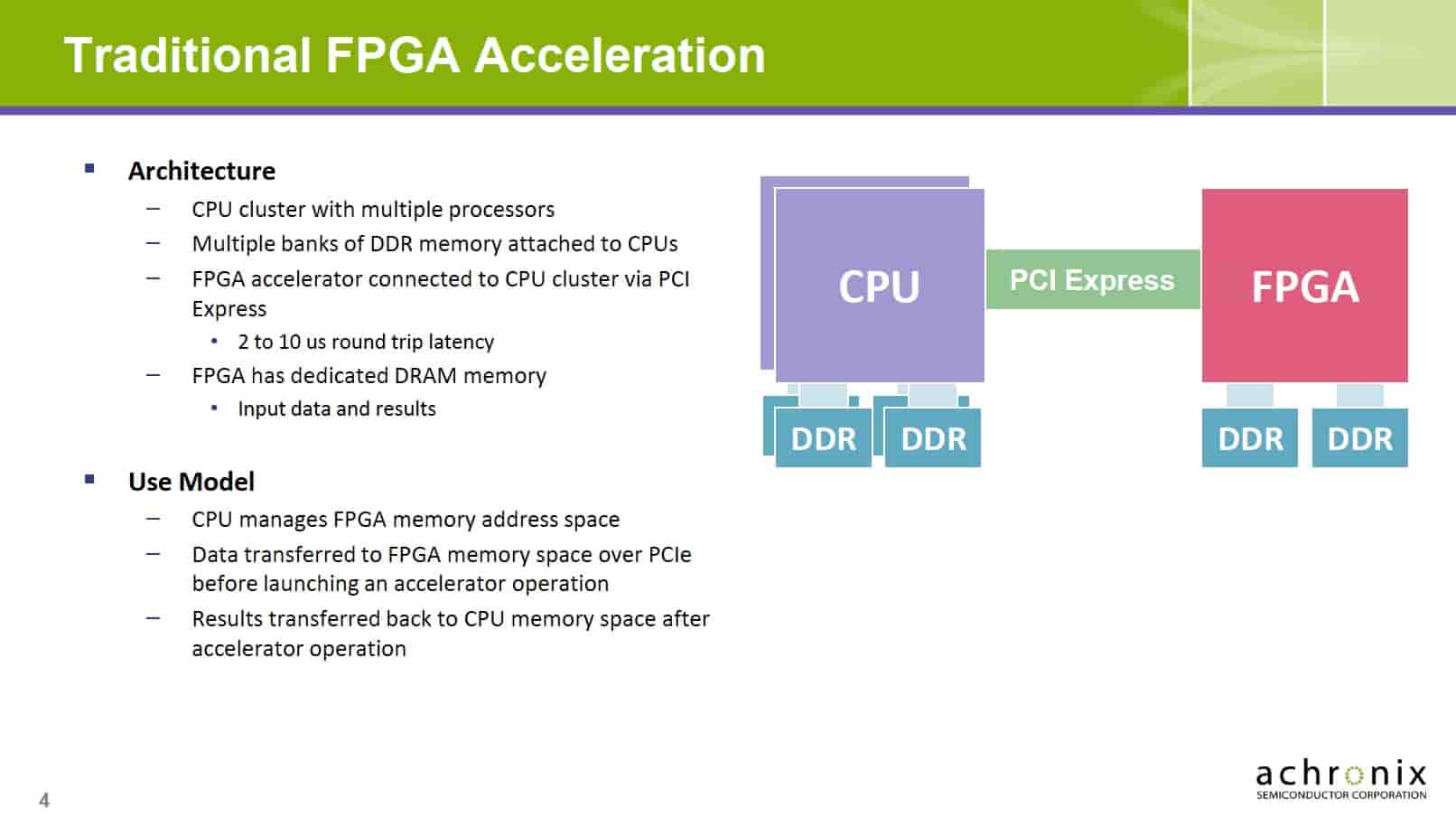
CPU’s are flexible, but are relatively slow compared to ASIC’s. However, ASIC’s lack flexibility – they are built to perform one task. FPGA’s have resided in a sweet spot between the two with many of the advantages of each, but with a number of drawbacks. They aren’t as fast as ASIC’s, but aren’t as flexible as CPU’s. For the purposes of this discussion, I am putting GPU’s in the same camp as CPU’s. Of course, there are many FPGA’s that come with embedded processors, but these are usually smaller embedded processors and not always suitable for high throughput applications like networking or servers

Designers of SOC’s, especially those that are created to differentiate products, frequently include FPGA’s at the system or board level. This comes with a price however. A lot of real estate on commercial FPGA’s is for multi-purpose IO’s. Also, system designers have to live with the supplied on-chip resources on commercial FPGA’s, like clocks, RAM, DSP’s, etc., even If some are over or under utilized. Standalone FPGA’s need their own DDR memory, which brings with it coherency issues with the CPU DRAM. Perhaps the biggest penalty is the time and power required to move data from the system SOC to the FPGA and back again.

Achronix’s position is that configurable embedded FPGA cores are the solution. An ideal pairing, that allows system architects to take advantage of the benefits of FPGA’s and avoid the drawbacks that would otherwise hurt performance, power and cost. They have announced their Speedcore™ eFPGA, embedded FPGA that can be configured specifically to the requirements of any particular design. Speedcore eFPGA offers up to 2 million LUT’s. The number of LUT’s and FF’s are completely configurable and up to the user. Also, BRAM, LRAM and DSP density are configurable. The same goes for LRAM and BRAM widths and depths. They offer customizable DSP functionality too.

The real benefits come from high speed on-chip interfaces that are highly parallel. For instance, 2 x 128b interfaces running at 600MHz offer throughput of 153Gb/s. Just as importantly, this comes with extremely low latency – ~10ns for round trip. As many interfaces as needed can be added for higher throughput. With Speedcore eFPGA’s AXI/ACE-Lite interfaces, integration just as with any other IP core is possible. This saves time and complexity in moving data to and from the FPGA.

The FPGA is now a peer in the system and can work much more effectively in off loading the CPU’s. The Accelerator Coherency Port (ACP) lets the eFPGA access the memory via L2 and L3 cache. This lowers latency significantly. Also the eFPGA can issue interrupts to the CPU. The eFPGA can play a major role in interrupt handling. IRQ’s can be handled in the FPGA and only forwarded to the CPU if needed.

For configuration Speedcore eFPGA offers half-DMA for rapid initialization. Speeds of ~2 ms per 100K LUT’s are available. The configuration can be made secure with the built-in encryption engine. There are other significant security benefits as well. Beyond the obvious added security of not having the FPGA data stream going off chip, the Speedcore eFPGA accesses memory through the Trustzone controller.

The presentation also went into details on specific example use cases. One of them was network and protocol acceleration. The FPGA can work hand in hand with the system CPU to accelerate packet processing. Packets can be inspected rapidly without throttling memory performance. Also the eFPGA can place flagged packet headers into the CPU cache so the CPU can service them. Similar kinds of speed ups were covered in use cases for Storage and SQL operations.

Some unexpected benefits come from the additional observability that an on-chip FPGA offers. Due to its ability to access the system memory bus, the FPGA can be configured to monitor and collect statistics about on-chip traffic. Extremely detailed information can be gathered with extensive filtering capabilities. Furthermore, during debug and bring up the eFPGA can serve as a programmable traffic generator. The eFPGA also makes possible at-speed testing at manufacturing and at power on.

Because eFPGA needs less support silicon when placed in an SOC, there are savings in overall silicon area. This advantage extends to BOM reduction, a reduction on board real estate and reduced pin counts on the SOC. In some scenarios, the programmability could also help SOC providers reduce respins on their chips – new functionality or ECO’s could be implemented with a bitstream change.

The Achronix presentation went into more detail than I can provide here. But, by now it should be pretty clear that pulling a programmable FPGA core into an SOC is a big win from almost every perspective. We can safely assume that embedded FPGA’s and SOC’s will soon to be famous pairing, right up there with coffee and cream. For more details about Achronix Speedcore™ eFPGA please look at their website.


Capex Driving Overcapacity?

Capex Driving Overcapacity?
by Bill Jewell on 10-29-2017 at 12:00 pm

Semiconductor capital expenditures (cap ex) in 2017 will increase significantly from 2016. In August, Gartner forecast 2017 cap ex growth of 10.2% and IC Insights projected 20.2% growth. SEMI expects spending on semiconductor fabrication equipment will increase 37%. Cap ex growth is primarily driven by increased capacity for DRAM and flash memory. Of the three major memory companies, Samsung’s cap ex for 2017 could range from $15 billion (up 32%) to $22 billion (up 94%), according to IC Insights. The mid-range of IC Insights’ forecast for Samsung cap ex is $18.5 billion, up 63% and accounting for 23% of total industry cap ex. SK Hynix in July estimated 2017 cap ex of $8.4 billion, up 58%. Micron Technology spent $5.1 billion in its fiscal year ended August 2017, down 6%. However, Micron’s guidance for fiscal 2018 cap ex is $7.5 billion, up 47%.


Of the major non-memory spenders, Intel plans $12.0 billion in 2017 cap ex, up 25%. TSMC, the largest foundry company, only expect 6% growth in cap ex to $10.8 billion. The top five companies will account for about two-thirds of 2017 cap ex. The remaining companies should see cap ex growth of about 3%.

The history of the semiconductor industry has been high growth rates in capital spending leading to excess capacity. Eventually the excess capacity results in rising inventories and companies cutting prices in attempts to increase demand. When the excess capacity is combined with a decline in end market demand for semiconductors, the semiconductor market collapses. However, the current projections for 2017 cap ex are nowhere near the growth rates which have historically led to overcapacity and market downturns.

The table below shows periods of high cap ex growth over the last 34 years. High cap ex growth coincides with high semiconductor market growth – strong demand driving increased capacity investment. Since 1984, cap ex growth has been 75% or higher in four different years (1984, 1995, 2000 and 2010 – marked in red). The years in red are analogous to a red traffic light – indicating a stop or danger. In three of the cases (1984, 1995 and 2000), the following year saw a decline in the semiconductor market. In 2010 cap ex grew 118%. The market did not decline in 2011 but growth decelerated 31 percentage points from 32% in 2010 to 0.4% in 2011. The market declined 3% the following year in 2012.

In three other years cap ex growth has been below 75% but above 40% (1988, 1994 and 2004 – marked in yellow). The years in yellow are like a yellow traffic light – advising caution. In 1988-1989 the semiconductor market decelerated 30 points (from 38% to 8%) and in 2004-2005 the market decelerated 21 points (28% to 7%). 1994-1995 was an exception to the typical trend with cap ex growing 54% in 1994 and 75% in 1995. The semiconductor market grew 32% in 1994 and 42% in 1995. The collapse hit in 1996, with a 9% decline in the market, a 50-point deceleration.


Semiconductor market downturns are not always driven by overcapacity. The market declined in 1998, 2008, 2009, 2012 and 2015 due to economic factors and slowing end equipment demand.

High growth in semiconductor capital expenditures can be a warning sign of potential overcapacity. However, the current situation is not close to a caution or danger signal. The highest cap ex forecast of 20.2% from IC Insights is only half of the caution growth rate of 40%. Our Semiconductor Intelligence forecast in September was 18.5% semiconductor market growth in 2017 and 10% in 2018. The forecast assumes no overcapacity and no fall off in end market demand. There is a chance of high cap ex growth in 2018 leading to excess capacity in 2019, but we are not currently projecting this scenario.


Nvidia’s Pegasus Putsch!

Nvidia’s Pegasus Putsch!
by Roger C. Lanctot on 10-29-2017 at 7:00 am

There hasn’t been this much excitement in Munich since the 1920’s. Nvidia’s great pivot was on display at the GPU Technology Conference Munich 2017. Digital dashboards are out and robotaxis are in as Nvidia narrows its focus on the tip of the automotive industry disruption spear.

To be clear, Nvidia is triangulating on the automotive industry from a number of different angles ranging from augmented and virtual reality design tools (Holodeck) to server technology implemented across the spectrum of cloud service providers. It just so happens that Nvidia is also trying to reduce the “supercomputer-in-the-trunk” phenomenon of self-driving cars down to a device the size of a license plate.

Notes Nvidia: “Of the 225 partners developing on the Nvidia Drive PX platform, more than 25 are developing fully autonomous robotaxis using Nvidia Cuda GPUs. Today, their trunks resemble small data centers, loaded with racks of computers with server-class Nvidia GPUs running deep learning, computer vision and parallel computing algorithms. Their size, power demands and cost make them impractical for production vehicles.”

The significance and manifestation of Nvidia’s Pegasus pivot was the introduction at the GTC event in Munich of a license-plate sized device capable of displacing all that trunk-hogging hardware in self-driving cars. Setting aside the cost and performance conversation, the shift of focus at Nvidia to so-called robotaxi startups is a massive turning point for the industry.

Intel, too, has turned away from its prior fixation on infotainment in automotive dashboards. Intel’s tie up with BMW and acquisition of Mobileye was an equally tectonic shift in focus on safety and autonomy.

Nvidia prides itself on being the coolest kid on the technology block – from Jensen’s signature keynote leather jacket (did he borrow that from GM CEO Mary Barra or did she mimic him?) to the whooping and chanting Nvidia fan-boys (at least in Silicon Valley) when the company talks about petaflops and such at press events. But robotaxis? Nvidia? Really?

The big news out of Munich is that Nvidia is seeking to confer its uber-coolness upon robotaxis, by which the company clearly means Uber and Lyft judging by the slide image (pictured above). Of course Nvidia is conflating definitions and business models by using the term robotaxis along with the super-frothy Goldman Sachs forecast of $285B.

The real change that is coming along to blindside the entire transportation industry is multipassenger shared and autonomous transportation vehicles. The mass of startups emerging across the planet is primarily focused on luring consumers out of their individually owned and operated vehicles into shared public transportation resources.

But somehow, announcing to the world that Nvidia was pushing pods and shoving shuttles likely didn’t have the same “Total Recall,” Philip K. Dick sizzle of launching a robotaxi assault on people moving. It doesn’t matter. The bottom line is that Nvidia has taken the first step toward making shared, public transportation cool. What’s not to like?

So, Jensen, bring on the petaflops and let’s save some lives, reduce some emissions and congestion and feel uber-cool in the process. Hail Nvidia! Hail shared vehicles! Hail disruption!


Software Defined Networks (on Chip) – NetSpeed Systems and UltraSoC Team Up to Use Embedded Analytics to Enable Next Generation SoCs

Software Defined Networks (on Chip) – NetSpeed Systems and UltraSoC Team Up to Use Embedded Analytics to Enable Next Generation SoCs
by Mitch Heins on 10-28-2017 at 7:00 am

NetSpeed Systems is known for their network-on-chip (NoC) IP that enables complex heterogeneous SoC architectures. NetSpeed IP supports both non-coherent and coherent memory and I/O schemes as well as configurable, customized last level cache optimization through their Orion, Gemini and Pegasus IP respectively. They are also known for their NoCStudio software which uses artificial intelligence (AI) techniques to synthesize and analyze a NoC based on different security, power, performance, area and quality of service (QoS) requirements.

NoCStudio works exceptionally well, assuming you have good estimations of the types of network traffic that will be seen between various master-slave combinations of the SoC. The better the understanding of the expected network traffic, the better job NoCStudio can do to come up with an optimized NoC solution for your SoC. Depending on the end application however, this can be more complex than it first sounds. Obviously, designers can simulate the system but keeping track of the myriad of interactions going on between master-slave combinations while accounting for factors such as dynamically changing traffic profiles and varying workloads is not trivial. This approach requires greater insight into the interactions among the various subsystems and components on the chip itself.

NetSpeed addressed this challenge by announcing that they have teamed up with UltraSoC, a technology startup based in Cambridge, UK that specializes in embedded analytics IP. UtraSoC and NetSpeed have integrated UltraSoC’s monitors, debug ports, and analytical reporting to work seamlessly with NetSpeed’s IP and NoCStudio software. UltraSoC’s IP lets designers intelligently monitor and control the activity of on-chip structures such as custom logic, buses and CPU cores. This data can be used to better understand the system interactions within the SoC, revealing hard-to-find bugs, increasing quality and removing development risks and potential liability costs.

UltraSoC’s IP is modular, hierarchical and scalable and consists of three classes of IP. The first being made up of analytic modules that enable monitoring and control of system components. The second being a dedicated messaging infrastructure fabric that connects all the UltraSoC components. The third being a communicators interface module that connects the UltraSoC system to on-chip or external systems. Because UltraSoC’s IP is modular and scalable, it is an exceptionally good fit with NoCStudio as it has the degrees of freedom required to allow NoCStudio’s synthesis engine to be able to make the necessary system level trade-offs.

A key feature of the joint solution is that the UltraSoC IP provides the SoC designers with an unprecedented capability to help designers with post-silicon validation and debug of the SoC when it is first coming off the manufacturing line. The IP gives the engineers the ability to get a much better insight into how the system and NoC is really behaving when running the SoC for the first time. Designers can monitor a plethora of different traffic patterns through the system and get real time data on system performance by having the embedded monitors reporting data through the communicators module to either embedded software or to the outside world through different types of interfaces.

While the partnering companies are not necessarily advertising the capability, you’ve got to wonder how long it will be before a clever designer uses the joint solution to parameterize the NoC and system at design time and then use the embedded monitors and analytics to configure the system at run time through the UltraSoC messaging infrastructure. Imagine a system that can be monitoring itself using the analytic data and then adjusting its NoC setup to achieve software defined requirements based upon the application being handled by the SoC. Embedded software could be monitoring the SoC’s performance for things such as how long it is taking to make DMA transfers, or looking for mismatches between processors and dedicated hardware accelerators during certain compute intensive tasks and then take action to temporarily optimize the network traffic paths, all the while ensuring that QoS of other paths is being maintained.

Combining UltraSoC’s IP with NetSpeed Systems’ NoCStudio and NoC IP is a very complimentary and smart connection. It enables the SoC designers to embed structures that will enable them to more quickly bring-up the SoC and then integrate the chip into various systems by looking at data from the chip itself. And, as eluded to earlier, the system has legs to enable some truly unique capabilities in the future for software defined NoCs (SDNoCs). While UltraSoC’s IP is scalable and parameterized, what better way to make use of those features than to have NoCStudio’s synthesis engines use them during its trade-offs. Add the capability to synthesize in flexibility based on embedded system monitors and you’ve got a system that can literally tune itself to its work load. Very impressive.

If you want to find out more about this new approach, NetSpeed Systems and UltraSoC will be hosting a joint webinar to discuss this solution in more detail. The webinar entitled: Debug, Analytics, NoC, and beyond… Exploring uncharted galaxies of interconnects!Will take place on November 2, at 17:00 GMT (UK time). To see more details of the webinar and to register for the event use this link.

See also:
NetSpeed Systems offerings
UltraSoC offerings


Arm 2017 TechCon Keynote Simon Segar!

Arm 2017 TechCon Keynote Simon Segar!
by Daniel Nenni on 10-27-2017 at 7:00 am

Now that the dust has settled with the Softbank acquisition I must say that Arm is truly a different company. There are now a lot of new faces from outside the semiconductor industry, which is a good thing, and a lot less stress from Wall Street which is an even better thing. Simon can now wear whatever he wants without the worry of lowering the stock price…

Simon’s keynote “Humanizing Technology” was very interesting and the panel session with Cyber Psychologist Dr. Mary Aiken is definitely worth your time when it goes up for replay. Simon mentioned that October is National Cyber Security Awareness Month (NSCAM) which I did not know. In fact nobody else in the audience seemed to know either so that is a problem. NSCAM is sponsored by Homeland Security, our tax dollars at work…


Simon also covered the new Arm IoT Security Manifesto which you can download:

A battle is raging to keep systems secure as we race to realize the immense value data insights can bring. As part of this battle, technology companies have a responsibility to society that extends beyond just delivering products. In our Manifesto document, we describe how the threat to the data-driven world is increasing and detail technical directions we can follow to confront that risk. Beyond that, we explore the nature of that responsibility as guardians of the Information Revolution and discuss the Social Contract all technology providers need to rally behind.

It is a quick but important read especially if you have children or grandchildren coming. The foreword is by Mary and that led me to her book “The Cyber Effect” which is now in my Kindle library. Unfortunately, my children are oversharing millennials and a lost cause when it comes to privacy and security so I will focus on my grandchildren.

Dr Mary Aiken is the world’s leading expert in forensic cyberpsychology – a discipline that combines psychology, criminology and technology to investigate the intersection between technology and human behaviour. In this, her first book, Aiken has created a starting point for all future conversations about how the Internet is shaping our perception of the world, development and behaviour, societal norms and values, children, safety and security…

Security was mentioned in every one of the keynotes I attended and I would say it was the most popular topic of discussion on the show floor. It really is daunting when you think about a trillion devices on the internet just waiting to be hacked. Even if you are diligent about security (as I am) you may still fall prey to one of your inner circle (friends and family) who got hacked.

The other big concern is bandwidth. Not only are more devices being added to the internet everyday, much more data per device is being generated. When AI starts to hit our silicon the amount of data will increase exponentially causing data jams of epic proportions.

If you put these two things together:

“Cybersecurity is a mess and the bad news is unless we do something it’s going to get worse.” Simon Sagers, Arm TechCon, 2017.

Absolutely.