You are currently viewing SemiWiki as a guest which gives you limited access to the site. To view blog comments and experience other SemiWiki features you must be a registered member. Registration is fast, simple, and absolutely free so please,
join our community today!
Dan is joined by Priyank Shukla of Synopsys and Kent Lusted of Intel.
Priyank Shukla is a Sr. Staff Product Manager for the Synopsys High-Speed SerDes IP portfolio. He has broad experience in analog, mixed-signal design with strong focus on high performance compute, mobile and automotive SoCs.
Kent Lusted is a Principal Engineer… Read More
The need for speed is a never-ending story when it comes to data communications. Currently there are a number of trends such as cloud computing, artificial intelligence, Internet of Things (IoT), multimedia applications and consumer expectations driving this demand. All of these trends are accelerating the growth in high-performance-computing… Read More
There were quite a few announcements at the TSMC Technical Symposium last week but the most important, in my opinion, were based on TSMC N3 tape-outs. Not only is N3 the leading 3nm process it is the only one in mass production which is why all of the top tier semiconductor companies are using it. TSMC N3 will be the most successful node… Read More
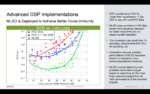
As digital transmission speeds increase, designers use various techniques to improve the signal-to-noise ratio at the receiver output. One such technique is the Decision Feedback Equalizer (DFE) scheme, commonly used in high-speed Serializer-Deserializer (SerDes) circuits to mitigate the effects of channel noise and … Read More
Dan is joined by Priyank Shukla, Staff Product Manager for the Synopsys High Speed SerDes IP portfolio. He has broad experience in analog, mixed-signal design with strong focus on high performance compute, mobile and automotive SoCs and he has a US patent on low power RTC design.
Dan explores the use of high-speed SerDes with Priyank.… Read More
Over the last couple of decades, the electronics communications industry has been a significant driver behind the growth of the FPGA market and continues on. A major reason behind this is the many different high-speed interfaces built into FPGAs to support a variety of communications standards/protocols. The underlying input-output… Read More
Introduction:
The advancements in deep submicron technology and adding multiple functionalities to reduce costs combined with scaling existing operations means that SoC designs become ever more complex. The biggest driving factors to go below the 16nm process node are the decrease in power and the increase in performance … Read More
In the world of financial trading, nanoseconds count. The faster a trade can be accomplished, the more money a trader can make. Getting a trade in before a competitor also results in improved profits. What does this have to do with the partnership deal recently inked between Silicon Creations and Achronix? Plenty. The two companies… Read More
…and support the creation of successful Chiplet business
The One-Stop-Shop model has allowed IP vendors of the 2000’s to create a successful IP business, mostly driven by consumer application, smartphone or Set-Top-Box. The industry has dramatically changed, and in 2020 is now driven by data-centric application (datacenter,… Read More
Given the recent acquisitions the ASIC business is coming full circle as a critical part of the fabless semiconductor ecosystem. The most recent one being the SEMIFIVE acquisition of IP industry stalworth Analog Bits. These two companies came to the industry from opposite directions which make them a perfect match, absolutely.… Read More