


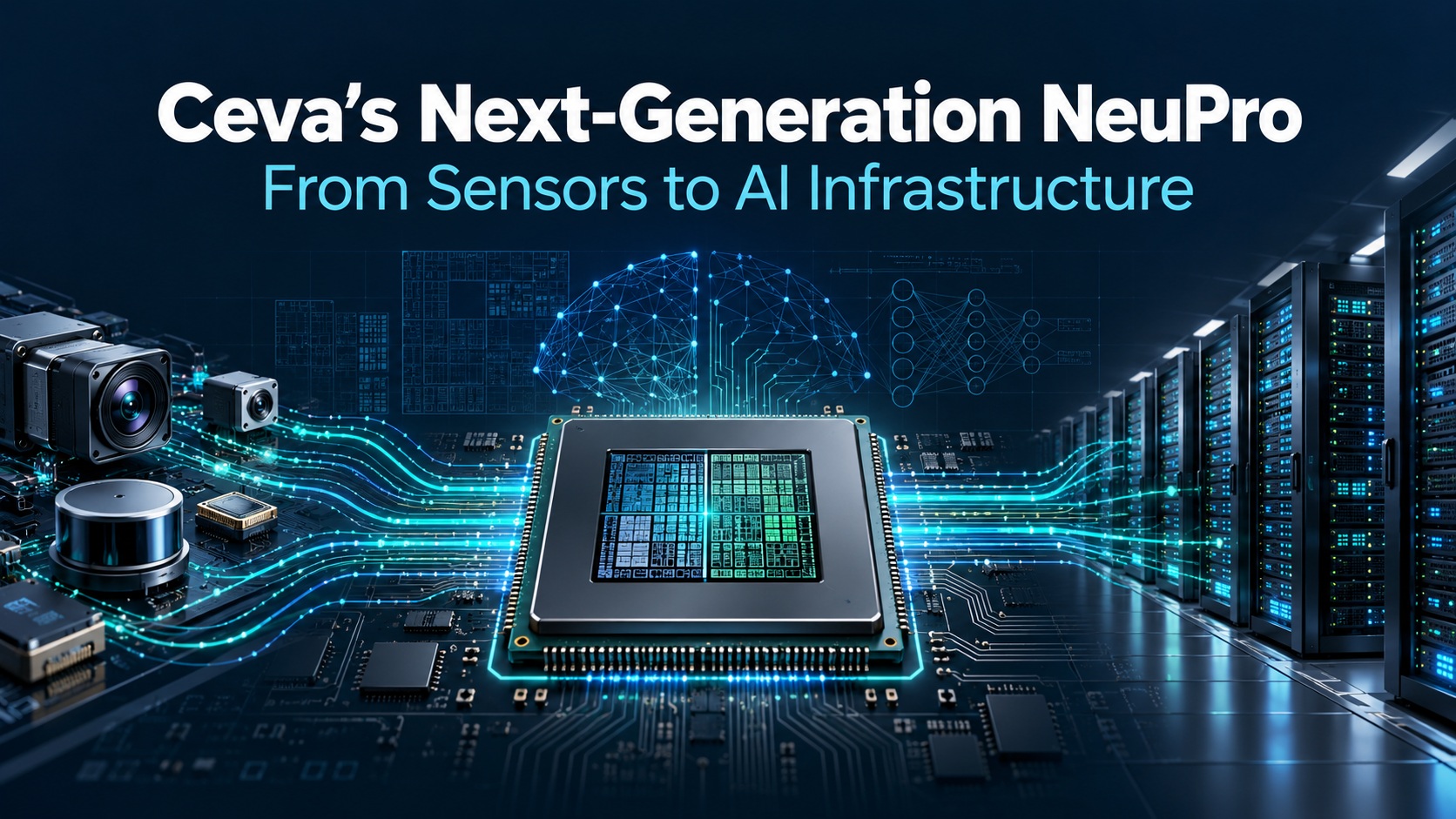

Ceva is expanding the reach of its neural processing technology with a next-generation NeuPro portfolio designed to serve everything from always-on sensors to AI infrastructure. The announcement introduces four NPU families sharing a common architecture and unified software stack, giving semiconductor developers a consistent foundation for increasingly sophisticated AI products.
Ceva reports up to twice the AI throughput per square millimeter and a 50% improvement in energy efficiency compared with the first generation. Those gains address two priorities across the semiconductor industry: delivering more intelligence within constrained silicon budgets and keeping the energy cost of inference manageable.
A Portfolio Built for AI’s Expanding Reach
The four NeuPro families establish a progression across application requirements. NeuPro Nano targets always-on sensing and entry-level perception, where compact implementations and low power consumption are essential. NeuPro Prime supports mainstream convolutional neural network and transformer workloads.
NeuPro Max extends the architecture into advanced edge applications, including high-resolution perception, multimodal models, robotics and on-device assistants. NeuPro Ultra takes the platform into AI infrastructure, supporting complex language model inference and integration into intelligent memory, connectivity and data-processing silicon.
The breadth matters because AI is becoming a coordinated system capability. A physical AI product may combine continuous sensing, visual recognition, language interaction and higher-level reasoning. Providing engines sized for these different tasks gives developers more flexibility to place intelligence where it delivers the greatest value.
Software Continuity as a Competitive Advantage
One of the portfolio’s strongest features is its unified development environment. A single SDK spans all four families, allowing customers to preserve tools, development practices and software investment as they move between performance levels.
Designers can also combine multiple NeuPro engines within one system-on-chip, assigning workloads to suitable processing resources. That creates opportunities to balance responsiveness, power and cost without adopting unrelated development platforms.
For semiconductor companies pursuing several AI markets, this continuity could become an advantage. Engineering teams can build expertise around one foundation and apply it across successive products, helping reduce integration complexity and accelerate development.
Architecture That Reflects Modern AI
The next-generation architecture addresses the changing demands of multimodal, generative and agentic workloads. Support for FP4, FP8 and mixed precision gives developers additional ways to improve inference efficiency while reducing memory requirements and data movement.
Higher memory bandwidth, dynamic shapes and paged key-value caching support increasingly demanding transformer applications. Mixture-of-Experts and linear attention support expand the architecture’s relevance to emerging model designs.
Ceva also emphasizes improved utilization of compute resources through optimized tensor reshaping, alongside compression, quantization and pruning. Together, these capabilities focus on extracting more useful work from available silicon.
Support for pre-quantized models offers another practical benefit: compatible published checkpoints can be deployed without a separate quantization and calibration step. Simplifying that path can help developers move more efficiently from model selection to product implementation.
Why the Infrastructure Expansion Matters
NeuPro Ultra broadens Ceva’s opportunity beyond edge devices. Its support for multi-core processing, multiple users, high memory bandwidth and advanced memory management positions it for demanding inference deployments.
Equally significant is its potential integration into memory and connectivity subsystems. Bringing neural processing closer to data creates another avenue for improving overall system efficiency, complementing the processors that execute the models themselves.
This gives silicon developers more options for addressing bandwidth pressure and unnecessary data transfers through licensable IP.
A Stronger Foundation for What Comes Next
Ceva says lessons from more than 15 first-generation NeuPro licensees helped shape the new portfolio. That customer experience provides a grounding for its emphasis on balancing compute, memory, bandwidth, power and cost.
Bottom line: The strategic direction is compelling: a scalable architecture that connects diverse AI markets through shared software and engineering investment. With selected customers already receiving early access and general availability planned for the second quarter of 2027, NeuPro gives Ceva a broader platform for participating in AI’s next phase of growth.
Also Read:
UWB Without the Integration Headache: Ceva and LG Bring Precision to More Chips
2026 Ceva Edge Symposium: Building Intelligence Beyond the Cloud
New Audio SoCs Combine Bluetooth HDT with Dual-RF Technology
Share this post via:


Comments
There are no comments yet.
You must register or log in to view/post comments.