







The continued evolution of semiconductor technologies has created a growing demand for devices capable of operating reliably under extreme conditions, particularly high temperatures. Among the most promising candidates for such applications are gallium nitride (GaN)-based high electron mobility transistors (HEMTs). These devices offer significant advantages over traditional silicon-based technologies, including higher breakdown voltage, faster electron transport, and greater power efficiency. As a result, GaN HEMTs are increasingly being explored for use in high-frequency communication systems, power electronics, and harsh-environment applications. However, ensuring their long-term reliability under elevated temperatures remains a critical challenge.
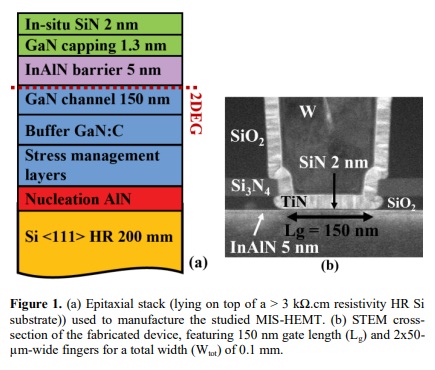
A key area of research focuses on the thermal robustness of GaN-on-silicon (GaN-on-Si) MIS-HEMTs fabricated using CMOS-compatible processes. This approach is particularly important because it allows integration with existing silicon manufacturing infrastructure, enabling cost-effective large-scale production. The use of gold-free processes and refractory metal gate materials further enhances compatibility with standard semiconductor fabrication while also improving device stability at high temperatures. These design choices reflect a broader industry trend toward scalable, reliable, and manufacturable advanced semiconductor technologies.
To evaluate thermal reliability, devices are subjected to long-duration storage tests at temperatures as high as 375°C. These tests are conducted without electrical bias to isolate the effects of temperature alone. Over extended periods—on the order of thousands of hours—researchers monitor key electrical parameters such as threshold voltage, drain current, transconductance, and on-resistance. These measurements provide insight into how the device performance evolves under sustained thermal stress.
The results of such studies demonstrate that GaN-on-Si MIS-HEMTs exhibit strong resistance to thermal degradation. Although some changes in electrical characteristics are observed, they are relatively modest given the severity of the test conditions. One of the most noticeable effects is a slight negative shift in the threshold voltage. This shift indicates changes in the charge distribution within the device, which may be linked to variations in carrier density or subtle modifications in the material interfaces. Despite this shift, the overall device operation remains stable.
In addition to threshold voltage changes, small reductions in drain current and transconductance are observed. These variations suggest that carrier mobility within the channel may be affected by thermal stress. At the same time, an increase in contact resistance contributes to overall performance degradation. This increase can be attributed to changes at the metal-semiconductor interface, which may experience minor structural or chemical alterations under prolonged exposure to high temperatures. However, these effects remain limited in magnitude, indicating that the device retains a high level of functionality.
A deeper analysis reveals that the observed electrical degradations are likely the result of a combination of factors. Slight increases in carrier density and decreases in mobility work together to influence device behavior. These changes are consistent with the interplay between material properties and thermal effects in semiconductor systems. Importantly, the degradations tend to stabilize over time, suggesting that the devices reach a new equilibrium state rather than continuing to deteriorate indefinitely.
Reliability modeling plays a crucial role in understanding long-term performance. By analyzing degradation trends and applying statistical models, researchers can estimate the time to failure under typical operating conditions. These models often incorporate temperature-dependent acceleration factors, allowing extrapolation from high-temperature test data to more moderate real-world environments. The results indicate that GaN-on-Si MIS-HEMTs can achieve extremely long lifetimes, even when operating at elevated temperatures. This level of reliability makes them strong candidates for applications where durability and stability are essential.
Another important aspect of thermal reliability is the behavior of defects and trapping phenomena. In many semiconductor devices, high temperatures can lead to the formation of new defects or the activation of existing ones, which can degrade performance. However, studies show that trapping effects in these GaN devices remain largely unchanged after thermal stress. This suggests that the material system is inherently stable and resistant to defect generation under the tested conditions. Such stability is critical for maintaining consistent performance, especially in high-frequency applications where signal integrity is paramount.
Structural analyses further support the conclusion of strong thermal robustness. Advanced characterization techniques reveal that the internal structure of the devices remains largely intact after prolonged exposure to high temperatures. Interfaces between different layers retain their integrity, and there is no significant evidence of common failure mechanisms such as cracking or interdiffusion. This resilience is largely attributed to the use of thermally stable materials, including the InAlN/GaN heterostructure and refractory metal gate electrodes.
Despite these positive results, some aspects of degradation are not yet fully understood. The exact mechanisms responsible for threshold voltage shifts and resistance increases require further investigation. Potential contributors include changes in material properties, diffusion of light elements, or variations in mechanical strain due to differences in thermal expansion. Addressing these questions will require more detailed studies using advanced analytical techniques.
Bottom line: CMOS-compatible GaN-on-Si MIS-HEMT technology demonstrates excellent thermal stability and reliability under extreme conditions. While minor performance degradations occur, they are well within acceptable limits for most applications. The combination of robust materials, optimized device architecture, and scalable manufacturing processes positions these devices as a key enabler for future high-performance electronics. As research continues to refine our understanding of degradation mechanisms, GaN-based technologies are expected to play an increasingly important role in next-generation semiconductor systems.
11B.5 – Thermal Robustness of a CMOS-compatible GaN-on-Si MIS-HEMT Technology
Also Read:
Siemens EDA Expands AI and Advanced Packaging Collaboration with TSMC
From the Selfie to Samantha: The Next Trillion-Dollar Behavior
#DAC2026 Marks Another Pivotal Moment for the Semiconductor Industry
Share this post via:



Hyper-NA EUV: The Next Frontier in Chipmaking Could Arrive in 2036