




The Linley Mobile and Wearable Conference is coming up so let’s take a look at what is in store for us. Bernard Murphy, Tom Simon, and I will be covering the event live for SemiWiki and we will also be doing a book giveaway/signing for our new “Prototypical” book (compliments of S2C Inc.) during the networking event on Tuesday evening.… Read More

Semiconductor Intellectual Property
Webinar alert – Hybrid prototyping for ARMv8
All the talk about ARM server SoCs has been focused on who will come up with the breakthrough chip design. Watching trends like OPNFV develop suggests the big breakthrough is more likely to come on the ARMv8 software side. How do you quickly validate ARMv8 software when you don’t have the exact ARMv8 SoC target?… Read More
CEVA Launch CDNN2, Embedded Ready Neural Network
Convolutional Neural Network (CNN) recognition algorithm is generating very high interest in the semi industry. At first, because CNN provides best recognition quality when compared with alternative recognition algorithms. CEVA Deep Neural Network (CDNN) software framework, implemented with CEVA-XM4 imaging & vision… Read More
RISC-V opens for business with SiFive Freedom
When we talk about open source, free usually comes in the context of “freedom”, not as in “free beer”, and open IP often serves as a base layer of value add for commercialization. The creators of the RISC-V instruction set, now working at startup SiFive, have released specifications for their aptly-named Freedom processor IP cores… Read More
How to Bring Coherency to the World of Cache Memory
As the size and complexity of System On Chip design has rapidly expanded in recent years, the need to use cache memory to improve throughput and reduce power has increased as well. Originally, cache memory was used to prevent what was then a single processor from making expensive off chip access for program or data memory. With the… Read More
Artificial Intelligence is Everything!
My first brush with AI was a LISP class for my undergraduate degree. LISP, originated from MIT in 1958, was the language of choice for AI research and spawned a new class of computer hardware called LISP Machines in the 1980s. My first personal experience with AI was the HAL 9000 system from the 2001 Stanley Kubrik movie Space Odyssey.… Read More
STT-MRAM – Coming soon to an SoC near you
An increasing percentage of SoC die area is being allocated to memory arrays, as applications require more data/instruction storage and boot firmware. Indeed, foundries invest considerable R&D resources into optimizing their array technology IP offerings, often with more aggressive device features than used for other… Read More
Dilbert Flopped – But We Still Laugh
This tile is about an old timer talking with a smart ass that questions why experience is relevant in todays “fast paced” technology industry. It has shown up so much on LinkedIn that I thought I should make a separate post and copy my responses into it and just link in next time.… Read More
21 months lining up OPNFV-on-ARM for telecom
Telecom infrastructure is one area where X86 architecture hasn’t dominated historically. Infrastructure gear is spread across MIPS, Power, and SPARC architectures, with some X86, and a relative newcomer: ARM, already claiming 15% share. That’s a stunning figure considering only a bit less than 5 years ago… Read More
Synopsys Launch EV6x Vision Processor… Challenging the Competition!
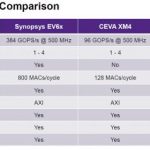
When Synopsys bought Virage Logic in 2010, ARC processor IP was in the basket, but at that time ARC processor core was not the most powerful on the market, and by far. The launch of EV6x vision processor sounds like Synopsys has moved ARC processor core by several orders of magnitude in term of processing power. EV6x deliver up to 100X… Read More
ChipAgent Raises $134Million and Why it Matters