





Semiconductor designers today face a critical hurdle: how to smoothly transition from an open-source hardware blueprint to a commercially hardened, production-ready silicon implementation. As semiconductors play an increasingly essential role in powering the AI era, safeguarding these hardware foundations has become a paramount priority. While open architectures offer unmatched flexibility, bridging the gap between a conceptual standard and deployment-ready security remains a major challenge. Addressing this exact friction point, Rambus Inc. issued a press announcement leading up to the recent AI Infra Summit detailing its new security IP offering designed to strengthen silicon defenses. The company was present at the summit to spotlight the solution, showcasing its new production-ready CryptoManager Root of Trust supporting the Caliptra specification. The solution introduces hardware-level security orchestration built directly around the unmodified open-source core.
Let’s look into what is behind this announcement, and what it means for chip designers and semiconductors security.
The AI Infrastructure Shift: A New Era of Hardware Vulnerability
The rapid expansion of AI infrastructure and heterogeneous data centers has completely shifted the baseline for hardware security. Modern data center environments no longer rely on single, uniform processors. Instead, complex systems are built on an interconnected web of custom accelerators, GPUs, and distinct processing units. Because of this architectural shift, securing the underlying silicon has become foundational.
In response to this challenge, the tech industry has increasingly leaned on Caliptra. This open-source specification was built to standardize the silicon Root of Trust (RoT) architecture across cloud and data center environments. It represents a massive step forward for industry alignment. But while open standards provide an excellent structural blueprint, a massive gap remains between an open-source specification and production-ready, commercially deployable silicon.
The Production Reality: Why Specifications Aren’t Plug-and-Play
Translating a conceptual open standard into commercial silicon is a leap filled with hidden friction. This reality highlights a critical rule in chip design: standardization establishes a baseline, but implementation requires hardening.
Chip designers attempting to integrate pure open-source specifications often run into severe operational headwinds. First, an open core typically lacks platform-wide security orchestration; it knows its own boundary but lacks visibility into the broader system. Second, moving from a shared GitHub repository to formal cryptographic certifications is a grueling, resource-intensive process. Without specialized commercial layers, chip vendors shoulder all the integration and schedule risks alone.
Bridging the Gap: Commercial Hardening for Open Standards
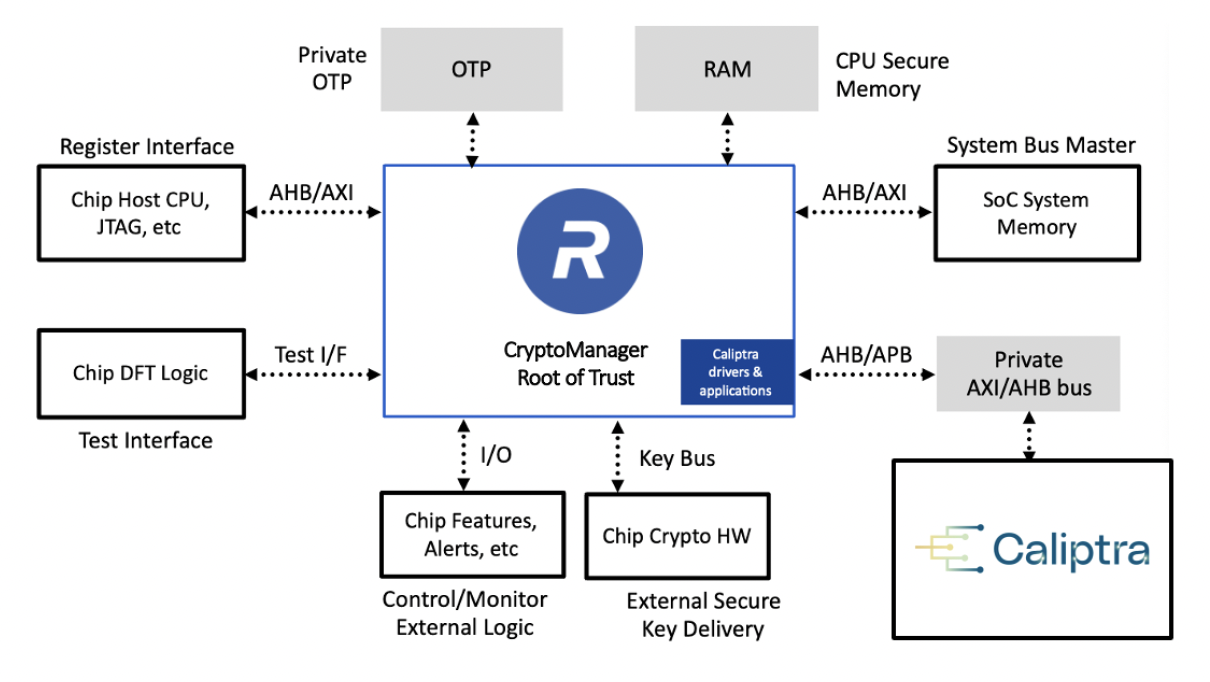
Recognizing this operational hurdle, Rambus recently introduced its CryptoManager Root of Trust tailored specifically for use with the Caliptra specification. Rather than replacing the open framework, this production-ready hardware subsystem acts as a security orchestrator that wraps around the unmodified Caliptra core.
By integrating a secure RISC-V processor, protected memory, and dedicated cryptographic accelerators alongside specialized drivers, it expands security visibility across the entire System-on-Chip (SoC). As detailed in the Rambus CryptoManager Product Brief, this design takes the open blueprint and layers on the complete enterprise-grade protection, architecture layouts, and direct vendor support required to make commercial silicon deployments viable.
Three Foundational Pillars of Enterprise Deployment
Moving from a standard specification to an enterprise-grade commercial deployment typically requires addressing three distinct pillars:
Physical Vulnerability Defense: Open standards rarely dictate the exact physical countermeasures required to survive localized hardware attacks. In real-world data center environments, silicon must be resilient against sophisticated physical manipulation. This requires proven side-channel analysis and fault injection attack countermeasures. Hardware-enforced isolation must keep sensitive assets protected within a trusted boundary to prevent unauthorized access.
Future-Proof Cryptographic Agility: Cryptography is a moving target. With quantum computing threatening the mathematical foundations of modern encryption, infrastructure deployed today must be prepared for tomorrow’s standards. Commercial architectures must seamlessly blend classical algorithms like AES, SHA, and RSA with emerging Post-Quantum Cryptography (PQC) standards—such as ML-KEM and ML-DSA.
Regulatory Compliance and Certification Readiness: High-security environments demand verified proof of resilience. Silicon vendors must achieve recognized benchmarks like FIPS 140-3, PSA, or SESIP compliance. Forging this path with unassisted open-source blocks introduces massive schedule risks. Utilizing an implementation that comes pre-packaged with complete verification test benches and reference designs vastly accelerates time-to-market.
Summary
The industry’s shift toward open security standards like Caliptra is a massive win for ecosystem compatibility and transparency. However, theory must be paired with execution. By combining collaborative open architectures with robust, commercially backed security subsystems, semiconductor designers can successfully defend next-generation AI infrastructure without sacrificing engineering velocity.
You can read the press announcement here.
Also Read:
PCIe 7 Switch IP with Time Division Multiplexing: Powering the Next Generation of AI Connectivity
How SOCAMM2 Could Reshape Server Memory for AI
PCIe 7 Switch IP with Time Division Multiplexing: Powering the Next Generation of AI Connectivity
Share this post via:



Comments
There are no comments yet.
You must register or log in to view/post comments.