Bronco Webinar 800x100 1

Don’t miss this Panel! Platform & Subsystem IP: Trends and Realities

Don’t miss this Panel! Platform & Subsystem IP: Trends and Realities
by Eric Esteve on 12-03-2012 at 10:01 am

If you pass by Grenoble tomorrow (Tuesday 4th Dec.) and go to IP-SoC 2012, then you should attend this panel at 4pm in the Auditorium (you can’t miss it, it’s the larger room at the registration level).

If you are Designer, Architect, Project Manager, Marketing… working for a chip maker, please prepare questions! The topic is hot, but the success of the panel will come at least at 50% from questions from “customers”…

… the remaining 50% or less, we (Hal Barbour, CAST CEO, Peter Hirt, Director IP Procurement & Partnership at STM, Martin Lund, Senior VP, Research and Development, SoC Realization Group at Cadence, Jack Browne, Senior VP Marketing, Sonics, Bill Finch, CAST and I) are working on it, dropping some ideas to start the discussion!

Panel: Platform & Subsystem IP: Trends and Realities Since the mid-1990s when the concept of reusable IP cores first came into being, the proposal has always been that it was more economical to use and reuse IP than to always design chips from a clean start. It was also faster to market and more resource efficient. Many 3rd party IP companies came into being to supply IP that could be considered standard or that was so complex to design that doing the same function over and over was simply not practical. An example of the former would be a function like an Ethernet MAC and the latter would be something like a processor. Over the years this has proven to be a very successful practice for both chip designers and IP vendors and is one of the cornerstones of today’s business.

In the last few years with the exponential growth in gates available from the silicon suppliers, the pressure to use those gates to provide much more advanced functionality on a per chip basis has grown more and more intense. Functionality that is common in today’s smart phones, for example, was out of reach only a few short years ago. Getting to market in only a few months at price points that are astoundingly low is necessary for success. Many believe that this is the result of a shift to designing around reusable platforms and whole subsystems which gives entirely new meaning to the reusable IP concept. The idea of building a platform around which several different sets of functionality could be brought to market was viewed as something only the largest companies could engineer. Lately, there has been much hype about the 3rd party vendors expanding their offerings to at least the subsystem, if not the platform, level. The idea is to bring to the general market the advantages of higher levels of design reuse in effect recreating the success of IP cores at the next level. Is this really coming to pass or just industry hype and clever marketing? Do customers really want this and can the industry really deliver the kinds of flexibility customers will demand?

This panel attempts to examine the trend and discuss the realities of today’s platform IP market in addressing the requirements of both ASIC and FPGA designers.

Arteris answer to Sonics: should compare actual NoC (in Silicon proven SoC) performance, instead of potential, unproven NoC performances!

Arteris answer to Sonics: should compare actual NoC (in Silicon proven SoC) performance, instead of potential, unproven NoC performances!
by Eric Esteve on 12-02-2012 at 5:06 am

It seems that Ateris vs. Sonics war, initiated by Sonics in 2010 on the legal battle field, is now continuing on the marketing field, as far as I am concerned, I prefer the latter, as I am an engineer and not a lawyer, and I must say that playing in the marketing allow both companies to extract the most attractive features of their products. Such a battle is good for design engineers and decision makers, as they can learn about the state of the art for products like Crossbar, Silicon fabric and Network on Chip (NoC).

A couple of weeks ago, Sonics board member Jim Hogan has used deepchip.com as a marketing battle field to develop quite a strong offensive: not less than 6 articles posted to describe the Network-on-Chip (NoC) market, commons definitions terms about it, Make-or-Buy decision; and more, including an article dedicated to comparison of Sonics SGN vs. Arteris Flex NOC vs. ARM NIC 400. Today, we will focus on this comparison table, as Kurt Shuler (VP of Marketing with Arteris) has proposed an answer to this specific article. Kurt has reviewed the comparison table, and provided some point by point corrections, when needed… in fact on almost every table entry. I strongly suggest you to take a deep look at Kurt’ answer and the corrected table here, so you can make your mind by yourself. I can give you a summary of the key points that Kurt has highlighted in his article.

The first, and probably sounding like a killing argument is that “Jim Hogan NoC table compares silicon-proven Arteris FlexNoC to unproven Sonics SGN”. If you consider that Arteris FlexNoC has been integrated in System on Chip (SoC) developed by Texas Instruments, Qualcomm or Samsung (to name just a few of the long list of Arteris customers, see here), that these SoC are now in production, when Sonics SGN, although a promising product, is still in the pre-adoption phase, or in evaluation by potential customers, that means that the comparison is made between potential performances (Sonics SGN) and actual performances (Arteris FlexNoC). If you prefer, Jim Hogan is building a comparison table using performances coming from a slide show on one hand, and from Silicon in production on the other hand…

Then, Kurt explains “that NoC technology is now being adopted by all semiconductor makers creating SoCs with sufficient complexity. And it’s even clearer that Arteris FlexNoC is the gold standard for NoC interconnect fabric IP.”
And finally, he ask the right question

“Why have Samsung, Qualcomm, TI and Freescale adopted Arteris FlexNoC as their corporate-standard interconnect fabric IP for their most important chips?”

The answer should not surprise SoC design engineers or project managers: “Innovative technology, excellent engineering, a robust product roadmap and customer satisfaction always speak louder than marketing!” May I add my two cents? Even if a company can legitimately claim that they are selling the best product, with the best in class technical support, marketing can be useful to share these facts with the rest of the world, on not let competition being the only one to occupy the field. Moreover, a good marketing campaign is always better than any kind of legal battle, a lot cheaper for the company, and definitely more useful, as it allows educating and finally convincing your potential customers…

Eric Esteve


ST Microelectronics: Strategic Options

ST Microelectronics: Strategic Options
by Paul McLellan on 12-01-2012 at 5:11 pm

ST Microelectronics announced yesterday that it would have a conference call on December 10th to announce its strategy going forward. ST has been struggling the last couple of years, with revenues down year to year. From 2010-2012 (the last an estimate of course) it did $10.3B, $9.6B and $8.4B so it has shrunk nearly 20% in 3 years. Last quarter alone it lost $500M. In September they announced planned production stoppages at their Crolles fab (just outside Grenoble) and their Catenia fab (in Sicily).

ST has two big problems. The first is that its stronghold market is Europe and Europe has been an especially weak market for the last few years. There is not a lot that ST can do about that. They are not entirely European, with an international business, but they are perceived as the European semiconductor champion.

The second problem that they have is ST-Ericsson. This was a combination of Ericsson Mobile Platforms, Ericsson’s unsuccessful attempt to build a cellular IP licensing company, with ST’s own wireless business and Philips/NXP’s wireless business (some of which was the old VLSI Technology wireless business that I used to work with, absorbed into Philips Semiconductors when they bought VLSI). There has been a huge investment in this business since it was created a few years ago but it continues to be a big drain on profitability for the parent company.

As the CEO Bozotti said recently, announcing Q3 results:”Our Wireless segment delivered strong progress during the third quarter; however, the segment’s operating loss and negative cash flows still remain significant.”

Tied up with the European aspect is that ST (and presumably ST-Ericsson) had major customers in Nokia and Sony-Ericsson. To put it mildly, Nokia has not been doing well lately. And Ericsson bailed out of Sony-Ericsson and now it is pure Sony, so no inside track there.

The other problem with the wireless business in general is that the merchant part of the market is not that attractive. Apple designs their own baseband chips and gets the wireless interface chips from Qualcomm. Samsung largely designs their own chips too. The remaining part of the market, smartphones from second tier suppliers and non smart phones (so-called feature phones) is not generating a lot of profit and so is likely to be hard to make good margins. It is a commodity business. Texas Instruments recently announced layoffs in their equivalent part of the business and they are refocusing their OMAP strategy on other embedded markets such as automotive, industrial and medical.


The received wisdom seems to be that ST is going to put ST-Ericsson up for sale, although who would buy it is an interesting question. Simply changing the owner doesn’t change the fact that it is in a low-margin market with intense competition and a flawed lead customer. Maybe they bite the bullet and just shut it down. At least that would soon stop it hemorrhaging money and probably the markets would give ST instant credit for doing so. As the CFO of VLSI put it to me when I was running Compass and trying to find a buyer for the business: “Wall Street will give me credit just for shutting you guys down. If we get some money too that is icing on the cake.”


Variation-Aware Design: A Hands-on Field Guide

Variation-Aware Design: A Hands-on Field Guide
by Daniel Payne on 12-01-2012 at 2:57 pm

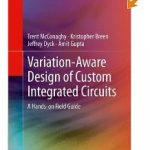
IC designers using advanced nodes are acutely aware of how variation effects in the silicon itself are causing increased analysis and design efforts in order to yield chips at acceptable levels. Four authors from Solidoare so passionate about this topic that they combined their years of experience into a book that I had a chance to read and review. Analog, AMS and even high-speed digital designers would benefit from the design ideas suggested in this book. I will give away one free copy of this book (retail value $120.00) to the person who comments on the blog with the best request.

Continue reading “Variation-Aware Design: A Hands-on Field Guide”


Accelera Technical Excellence Award

Accelera Technical Excellence Award
by Paul McLellan on 11-30-2012 at 3:46 pm

The Accellera Systems Initiative, most well-known for driving the standardization of various aspects of Verilog and SystemVerilog before handing the standards off to the IEEE, has announced that nominations are open for the 2013 Technical Excellence Award. This recognizes outstanding contributions in the creation of EDA and IP standards by a member of an Accellera technical committee. Nominations will be accepted through January 18th.

More details of the nomination process are here, including a link to the online form for nominations. Any individual who is a member of an Accellera technical committee is eligible.

The Technical Excellence Award will be presented during a lunch at Accellera Systems Initiative day, a featured part of DVCon 2013 taking place February 25-28, 2013 at the DoubleTree Hotel in San Jose, California.

Current technical standarization work by Accelera includes:

  • Analog/Mixed-Signal extensions to Verilog (Verilog-AMS)
  • Analog/Mixed-Signal extensions to SystemC™ (SystemC-AMS)
  • Configuration, Control and Inspection (CCI) standards for SystemC
  • IP Tagging for data-driven tracking of soft IP
  • IP-XACT™ metadata standard for IP integration
  • Open Verification Library (OVL) assertion library
  • Standard for Co-Emulation Modeling Interface (SCE-MI)
  • Synthesizable subset of SystemC
  • SystemC language standard
  • SystemC Verification (SCV) library
  • SystemRDL
  • Transaction-Level Modeling (TLM)
  • Unified Coverage Interoperability Standard (UCIS)
  • Universal Verification Methodology (UVM™) standard

Challenges of Implementing LTE

Challenges of Implementing LTE
by Paul McLellan on 11-30-2012 at 3:07 pm

LTE (Long Term Evolution) is the true 4G standard for cellular and, over time, wireless internet. In fact it is several different standards with different levels of performance. LTE will eventually be the only technology used in cellular, voice will simply be Voice-over-IP (VoIP, the same technology that companies like Skype and Vonage use to make “free” calls over the net). Right now, however, we are in a transition period known as CSFB for circuit switched fall-back. Since not all base-stations even have LTE and many do not have full capacity (a lot is still used for 3G) phones need to use regular 3G for calls at time, while using LTE for internet data access.


LTE is much higher bandwidth than 3G, which for us users is a good thing of course. But for people who need to build LTE, especially in the power limited environment of handsets, this performance comes at a price: power. It is tricky to build an LTE modem and its associated software and keep the power down. After all, people notice and get annoyed if their phone doesn’t last a day on a charge. They are less concerned if it lasts longer since most people put their phone on a charger on some daily routine.

So the challenge is to build an optimum software stack and processor to run the stack. A traditional microprocessor (think ARM) with general purpose software is far too power-hungry to be a solution. Not that ARM won’t be in your cell-phone, it will. It just won’t be running the air-interface modem.

Tensilica and their software partner mimoOn today announced a partnership to provide the only comprehensive hardware/software licensable IP solution for LTE and LTE-A (advanced, higher bandwidth). Tensilica is now the exclusive DSP vendor for mimOn’s LTE UE (user-equipment) and eNodeB (base station) physical layer software products.

By creating a tight partnership in this way, it is possible to optimize the hardware software tradeoffs so that designers get a much more efficient solution. Power is always a big issue in handheld devices since it is something that, at least indirectly, the user notices. Phones get hot and batteries run down fast when it is too high. Just using generic software is more of a challenge since it cannot be co-optimized with the hardware.

In the longer term, just as WiFi is embedded in lots of things (for example, I just bought a bathroom scale that links to my WiFi router so that every time I use it it automatically gets logged and I can draw graphs of my weight) in the future LTE will be embedded in things in the same way, but higher bandwidth. So don’t just think AT&T, Verizon: LTE will spread to appliances, cars, thermostats and so on.

And on the regular cell-phone network things will change too. The increasing demand for cellular bandwidth means that more and smaller base stations will be required, especially indoors, leaving the big cell towers for the calls that cannot be offloaded.

By developing subsystems that are easy to adopt (meaning that you can add LTE to a system without a deep knowledge of LTE DSP processing) Tensilica and mimoOn (from Duisburg, Germany, by the way) can help accelerate this transition to LTE cellular and the LTE-enabled IoT (internet of things).


Sequential Power Optimization

Sequential Power Optimization
by Paul McLellan on 11-29-2012 at 8:44 pm

Calypto has an interesting webinar coming up about Minimizing RTL Power Through Sequential Analysis. It is next Tuesday December 4th at 11am.

Insert standard paragraph about how power is the new timing, everyone worries about power, battery life in smartphones, half-empty datacenters.

You probably already know about clock gating, which is combinational power optimization. Combinational in the sense that nothing changes at the register outputs. Years ago, before power was the issue it is today, people were told never to gate the clock. Gating the clock risked race conditions when the signal to gate the clock came to close to the clock transition, and in a way that timing analysis found hard to handle. So if a register did not change under some condition, the value was simply recirculated from the output through a multiplexor. If the multiplexor was 0 a new value was clocked in, if it was 1 then it recirculated. Clearly, from a power point of view, rather than recirculating the existing value and clocking it into the register, it would be much better not to clock the register at all, and this is what clock gating does. Every synthesis tool will do this automatically.

Now, if a register does not clock on this clock cycle and its value is loaded into another register on the next clock cycle, then that can also be suppressed. After all we know the register already contains the correct value. But the analysis required to ensure this is done correctly is quite subtle. As is deducing that if a register is not going to be clocked on this cycle, we don’t care what the value is in the upstream register and so it didn’t need clocking on the previous cycle. Again, this requires reasoning across multiple clock cycles.

Calypto started out creating technology for this sort of formal analysis. The first application they brought to market was sequential logical equivalence checking (SLEC), formal verification for high level synthesis (or complex manual optimization). But the technology has really come into its own when used for reasoning about power reduction and so reducing power at the RTL level, in the sense that the tool, PowerPro, reads in the RTL and writes out a new RTL that has the same behavior at the outputs but consumes less power.


There are some subtleties about getting the most out of PowerPro. For example, if you have a datapath and control logic and try and reduce the power on the datapath alone you are not going to get very far. Similarly, if you have a clock that is simply another clock divided down, but you don’t tell the tool, you similarly will not get any reduction since PowerPro has to assume that different clocks are completely asynchronous to be safe.

Anyway, PowerPro (and SLEC) are unique tools. This sort of sequential analysis is really really hard and no other company seems to have mastered it. So this webinar isn’t a me-too webinar that is just the same as ones from other companies, this is the experts on sequential power optimization going into a reasonable amount of depth on what the technology is capable of.

The webinar will be presented by Abishek Ranjan, a senior director of engineering at Calypto. It is on Tuesday December 4th at 11am.

More details about the webinar, and to register, are here.


8 Reasons Why I Love My iPhone 5

8 Reasons Why I Love My iPhone 5
by mbriggs on 11-29-2012 at 10:12 am

xEKHFZftuPi5wORXTy aK LjLtiEME7mNXfz9q8P2doGWeIOcVp 8wAUvSSFduw7uQya9 JkxYAkctraslZGsIxiIx QpMYJDFU2RwrDls33NgJI6yU

This is a follow up post to 8 Reasons Why I Hate my iPhone 5. The reader’s digest summary is that I started my smartphone journey with Android and became accustomed to the Android way of doing things. It was a difficult jump into the Apple ecosystem. I’d wager that the vast majority of smartphone users stay with their initial platform, unless of course you include the Blackberry.

The reasons I am now more fond of my almost new iPhone 5 include:

[LIST=1]

  • Attachment. I am getting that strange, not objectively quantifiable, attachment that I had with my old PowerBook and MacBook Pro. This must come from all the little things that come from superior design and the integrated HW/SW Apple advantage.
  • Voice recognition. Now that I’ve accepted Siri’s somewhat constrained vocabulary I regularly ask her to call, email, text, and set reminders. In my car yesterday it struck me as cool when, with the phone in my lap, I pressed the big button and said “call Dan cell”, then hit the speaker button. It’s hands free functionality for bluetooth headset hatersand cheap skates.
  • Camera. I had to read a few articles on how to effectively use the camera, but now that I’m more adept it takes good pictures. I’ve now officially retired my Kodak Easyshare. Panorama mode is cool and uploads to PhotoStream work like charm. Don’t forget to:
    [LIST=1]

  • Give it a few seconds to focus
  • Set HDR mode when the sun intrudes
  • Battery Life is superb. At the end of the day I plug it into the charger, though often I don’t have to. After several calls and local audiobook, listening, 90% battery life remains..
  • The big button. I especially like being able to press the big button to give commands to Siri, even when in blank screen / power saver mode. Swiping slide to unlock makes me a little batty.
  • The new headset works great. I often pause music and audiobooks, skip forward, and change the volume. The right controls on the headset are easy to find without looking
  • The default ringtone is pleasant. I spent 10 minutes trying all the free ringtones on my Android based phone. Being the aforementioned cheapskate I refuse to spend $1 on a new ringtone. After changing my Android ringtone my non techie brother in law commented “jeez that’s annoying”, when my phone rang.
  • It’s fun to say stupid things to Siri. Try
    [LIST=1]

  • Where can I hide a body?
  • Tell me a joke
  • Knock, Knock
  • What is the meaning of life?
  • How much wood can a woodchuck chuck?
  • I love you Siri.
  • I am drunk.
  • What is the best cell phone?
  • What is your favorite color?

    Not to say there aren’t any aggravations…

    [LIST=1]

  • I’d love to have Google now,
  • Dictating a reasonably sized email, with accuracy, would be a treat.
  • I’ll be a happy camper when the google maps app is available.
  • I run much of my life on google, i.e. email, contacts, calendar, finance. Integration isn’t great.

    If I had to do it over again I think I’d still switch to a Samsung S3, but the only real factor is lack of synergy with google apps.


  • GLOBALFOUNDRIES and Mentor Develop Methods to Identify Critical Features in IC Designs

    GLOBALFOUNDRIES and Mentor Develop Methods to Identify Critical Features in IC Designs
    by glforte on 11-28-2012 at 3:00 pm

    Since the beginning of the semiconductor industry, improving the rate of yield learning has been a critical factor in the success silicon manufacturing. Each fab has dedicated yield teams that look at the yield of wafers manufactured the previous day and attempt to find the root cause of any unexpected “excursions.” In earlier times it was assumed that as long as a design passed design rule checking (DRC) that it would have acceptable yields when manufactured, but that is no longer the case. Now at advanced nodes there is sufficient manufacturing sensitivity to specific design features that it is increasingly common that design-related yield issues can appear even for designs that have passed all DRC checks. Some of the design induced issues include line edge roughness, dishing from chemical mechanical polishing (CMP), and pull back of drawn features (e.g. metal overlap over a VIA). In order to prevent these effects the design must be made more robust by employing Design for Manufacturing (DFM) strategies such as via doubling, litho hotspot detection, and Optical Proximity Correction (OPC).

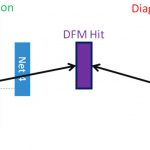
    The green polygon (left) is a critical feature location in the design as determined by DFM analysis. The red rectangle (right) is the diagnosed defect location for a bridge between two nets on one device failing manufacturing test. The purple box (center) is the intersection of critical feature analysis (CFA) and test failure diagnosis.

    Layout structures that are most susceptible to manufacturing process variability are called critical features. Critical features are believed to be increasing in number, but it is difficult to justify expensive test chip experiments to quantify critical feature impact. Historically yield engineers have identified systematic critical features by identifying higher than expected yield loss in silicon, submitting selected die to physical failure analysis (PFA) and obtaining at least two similar results, and then bringing in a panel of experts from across the company to hypothesize the true root cause based on the failure analysis results. Finally, experiments are devised to prove or disprove the hypothesis, for example, split lots or short loop experiments. In general this is an effective methodology, but very slow and expensive because of the reliance on PFA and multiple subject matter experts (SMEs).

    An alternate approach, which creates actionable data to facilitate yield learning at the fabless-foundry interface, is currently being evaluated by Mentor Graphics and GLOBALFOUNDRIES. The focus of this method is to provide the most precise description of the critical feature in terms of the immediately surrounding geometry. This is determined by evaluating several similar but different critical feature hypotheses in order to find the best fit for a population of die that have failed production testing. This means that every design essentially becomes a test chip that can be used to improve yield leaning, and ultimately the design and manufacturing process. The key to making this approach workable is to capture the right data from chip production testing, and to provide powerful statistical analysis tools to help engineers identify and organize correlations in the data that point to the critical features.

    A description of this methodology is provided in a paper authored by Mentor and GLOBALFOUNDRIES, which is available on Mentor’s foundry solutions web site. (See “GLOBALFOUNDRIES and Mentor Develop Methods to Identify Critical Features in IC Designs.”)