You are currently viewing SemiWiki as a guest which gives you limited access to the site. To view blog comments and experience other SemiWiki features you must be a registered member. Registration is fast, simple, and absolutely free so please,
join our community today!
Gross Profit Margin Percent Provides a Measure of Product Value
The difference between what customers will pay for a physical product and what it costs to make or acquire it is a good measure of differentiation. This difference divided by the revenue is the gross profit margin percent or GPM%. Once a product has an established market… Read More
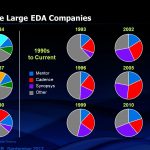
Electronic design automation, or EDA, became the term used for computer software and hardware developed to aid in the design and verification of electronics, from integrated circuits to printed circuit boards to the integrated electronics of large systems like planes, trains and cars. As the EDA industry evolved, certain … Read More
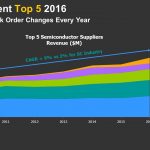
Recently, the combined market share of the top ten and top twenty semiconductor companies has been increasing, contrary to the trend of the last fifty years. Given the acceleration in mergers and acquisitions that began in 2015, one might assume that, as the semiconductor industry approaches maturity, companies are consolidating… Read More
For the last decade, semiconductor industry analysts have been writing articles and giving presentations that predict the increasing consolidation of the industry to the point where a few large companies dominate worldwide sales of semiconductor components. In recent years there has been some justification for this view… Read More
In 1825, Benjamin Gompertz proposed a mathematical model for time series that looks like an “S-curve”.1 Mathematically it is a double exponential (Figure 1) where y=a(exp(b(exp(-ct)))) where t is time and a, b and c are adjustable coefficients that modulate the steepness of the S-Curve. The Gompertz Curve has been used for a … Read More
(Adapted from a presentation first given under this title in 1989 and subsequently expanded in presentations over a period of nearly thirty years)
In 1965, Gordon Moore, then R&D Manager for Fairchild Semiconductor, published a paper in “Electronics” magazine predicting the trend for semiconductors in the next ten years. … Read More
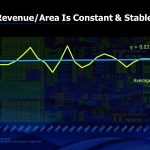
In the mid 1980’s, Tommy George, then President of Motorola’s Semiconductor Sector, pointed out to me that the semiconductor revenue per unit area had been a constant throughout the history of the industry including the period when germanium transistors made up a large share of semiconductor revenue. I began tracking the numbers… Read More
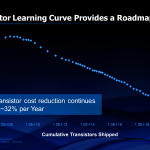
Figure 1 is the most basic of all the predictable parameters of the semiconductor industry, even more so than Moore’s Law. It is the learning curve for the transistor. Since 1954, the revenue per transistor (and presumably the cost per transistor, if we had the data from the manufacturers) has followed a highly predictable learning… Read More
It’s Sunday afternoon and I just attended the annual Needham presentation at #56DAC in sunny Las Vegas, where Rich Valera shared an upbeat view of EDA and IP growth. Here are the five drivers of this growth:
- IoT
- Automotive
- Webscale/FAANGs
- AI/ML
- China
For the IoT market they’ve seen a CAGR of 8.6% to $8.2B in 2018, projected… Read More
New products always take precedence since EDA is a “mature” market. I have inside knowledge on this one so I can tell you it is not to be missed. Coincidently, but not really, a related white paper was just published so if you are not going to 56thDAC you can still get a virtual briefing. If you are going to DAC be sure and stop by the Fractal… Read More