Intel announced today that they are partnering with cloud and EDA companies to better enable their foundry business. This is a natural extension of the Accelerator ecosystem program announced earlier. More and more chip designs are being done in the cloud and from my experience cloud based designs are better. Some companies use… Read More
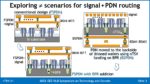
At the VLSI Technology Symposium Imec presented on Buried Power Rails (BPR) and Backside Power Delivery (BSPD) in a paper entitled: “Scaled FinFETs Connected by Using Both Wafer Sides for Routing via Buried Power Rails”. I recently had a chance to interview one of the authors, Naoto Horiguchi about the work. I have interviewed … Read More
In the world of financial trading, nanoseconds count. The faster a trade can be accomplished, the more money a trader can make. Getting a trade in before a competitor also results in improved profits. What does this have to do with the partnership deal recently inked between Silicon Creations and Achronix? Plenty. The two companies… Read More
TSMC recently held their annual Technology Symposium in Santa Clara, CA. The presentations provide a comprehensive overview of their technology status and upcoming roadmap, covering all facets of the process technology and advanced packaging development. This article will summarize the highlights of the advanced packaging… Read More
Semiconductor manufacturers are under constantly increasing and intense pressure to accelerate innovative new chip designs to market faster than ever in smaller package sizes while assuring signal integrity and reducing power consumption. Three-dimensional integrated circuits (3D-ICs) promise to answer all these demands… Read More
The original Silicon Shield theory, as described in my 2001 book, stated that Taiwan’s role as producer of 90 per cent of the world’s IT products (at that time) protected it from an attack by China because the United States, acting in its own self interest, would come to the island’s defense. A similar scenario – involving oil,… Read More
Dan is joined by Mahesh Turaga, VP of Cloud Business Development at Cadence Design Systems. Mahesh brings extensive customer-facing experience to Cadence in business development, strategy, pre-sales, and consulting. He provides an overview of the cloud solutions provided by Cadence. The various business models, technical… Read More
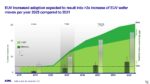
At the 2022 SPIE Advanced Lithography Conference, ASML presented an update on EUV. I recently had a chance to go over the presentations with Mike Lercel of ASML. The following is a summary of our discussions.
0.33 NA
The 0.33 NA EUV systems are the production workhorse systems for leading edge lithography today. 0.33 NA systems are… Read More
Our laptops and desktop computers have billions of transistors in their application processor chips, yet I often don’t consider the reliability effects of aging that the transistors experience in the chips. At the recent Synopsys User Group (aka SNUG), there was a technical presentation on this topic from Srinivas Bodapati,… Read More
It is common when a new type of analysis is introduced in almost any domain that it works well enough for a while. Until it begins to struggle with growing problem size, prompting refinements to the methodology to allow continued scaling. We see this routinely in analytics for SoC design, so it should not be a big surprise that safety… Read More









A Study of Photoresist Bake Influence on Stochastics for DUV Immersion Lithography