





When a small team at Intel began work on its second-generation 8-bit microcontroller in the summer of 1978, they took lessons from their first effort, the 8048, hoping to create something more flexible and enduring. Approaching five decades later, their creation, the 8051, is still going strong, although the current offerings are a far cry from the venerable 4μm technology packaged in a 40-pin DIP first introduced in 1980. Today, CAST offers a family of 8051 IP cores at various performance levels, some of which are 8051-binary-compatible and others that feature enhanced instructions or hardware acceleration, for a variety of use cases. We spoke briefly with Newton Abdalla, Vice President of Operations at CAST, to find out more about CAST’s 8051 lineup.
PPA efficiency makes the 8051 a strong choice
The original design goals for the 8051 were to create an easier-to-use instruction set supporting more memory and new peripherals, including two 16-bit timers, a built-in UART, and a Boolean processor for bit-level logic operating on select registers, ports, and RAM addresses. Another key architectural feature is four bank-selectable working register sets, handy for low-overhead entry and exit of interrupt service routines supporting prioritizable hardware interrupt lines.
At launch, those innovative features made the 8051 an ideal choice for interrupt-driven, real-time tasks in devices such as keyboards, appliances, toys, and automobiles, including monitoring and aggregating switch inputs, controlling lights or actuators, and converting data to serial formats. By today’s standards, its 12 MHz clock was rather pedestrian; typical instructions each took 12 clock cycles. But for many point-of-control jobs with simple computations, it was plenty fast and drew very little power. “Not everything needs raw performance; power consumption and size are far more important in many applications,” says Abdalla.
For a couple of decades, 8-bit microcontrollers ruled the landscape. 8051s landed in everything from Wrinkles the Dog, a talking plush toy that became a hit in 1986, to chips including GPS and audio featuring 8051 IP cores, including CAST’s offerings starting in 1998. Billions of 8051 units shipped prompted Bob Wickersheim, one of Intel’s designers on the project, to quip in a 2008 oral history panel interview with the Computer History Museum, “Chances are very high that a chip I worked on exists somewhere in your house.” His colleague Ron Towle followed up immediately, adding, “Or multiple of them in your house and in your car.”
That observation remains true today. While consumers may rarely see an 8051 listed on a product specification sheet, the architecture continues to serve as an embedded control engine inside billions of devices ranging from consumer electronics and industrial equipment to automotive systems and advanced AI-oriented SoCs.
With 8051s facing an onslaught of 32-bit microcontrollers, they still often come out ahead in power-performance-area (PPA) metrics. “For a small application needing the lowest power consumption, low interrupt latency, and small chip size, a 32-bit core can be overkill and may not even fit in an ASIC at the desired cost point,” continues Abdalla. “Modern 8051s are simple to program, occupy 50% or less silicon area than a minimal 32-bit core, use less power with less leakage, yet most deliver more DMIPS/MHz than the original 8051 design.” These modern cores, like the T8051XC3 shown next, include on-chip debug support and, in some cases, dynamic frequency scaling (DFS) for power savings. He adds that quite a few CAST customers are using 8051 cores alongside ARM and other 32-bit cores in ASIC designs to rightsize their implementations and keep power and area down.
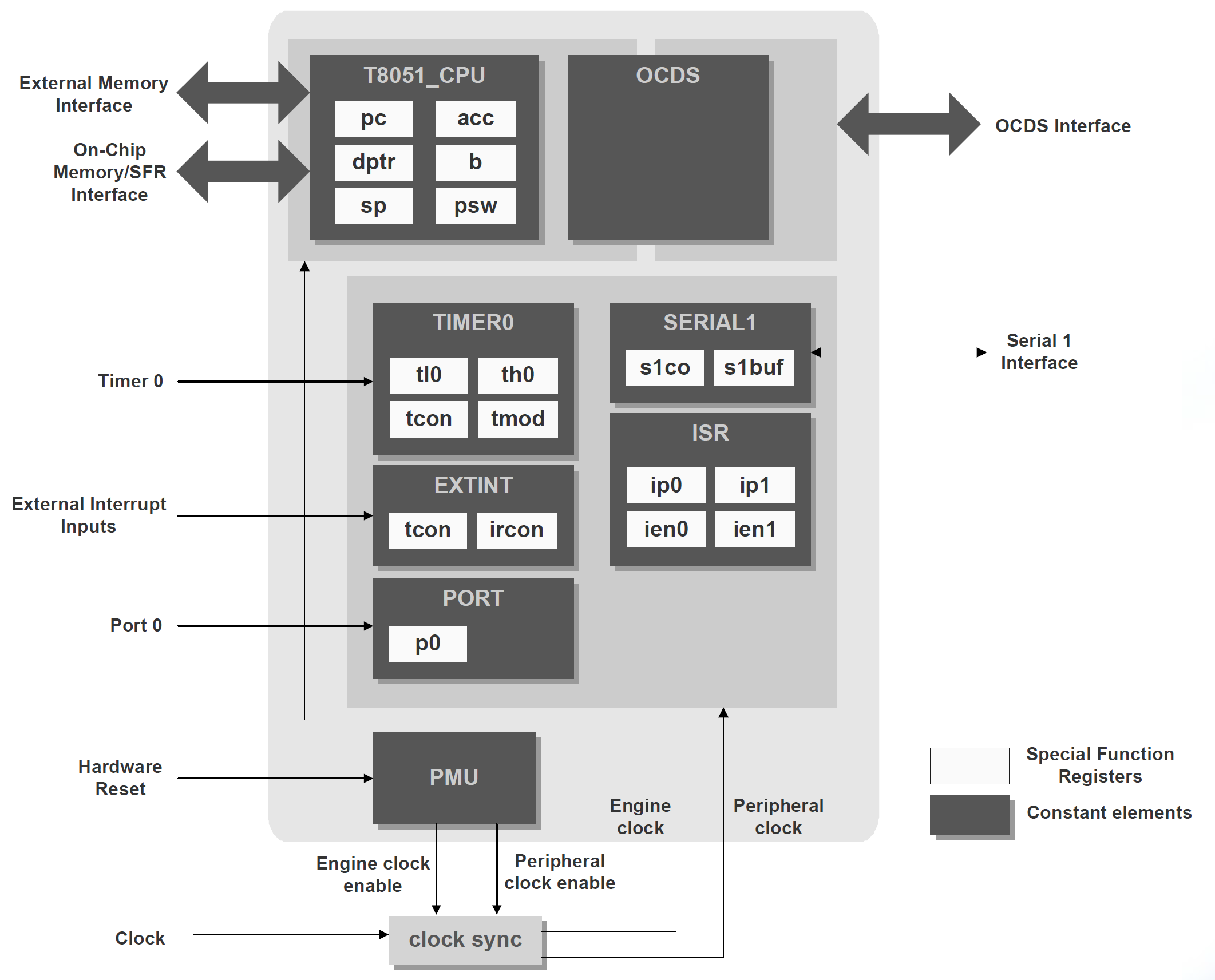
The CAST 8051 family and some of their use cases
PPA advantages and modern innovations in variants of 8051 IP cores, along with the passage of time, which has seen Intel and others exit the 8051 business, have helped CAST amass over 300 licenses for its 8051 family, according to Abdalla, with proven IP shipping in hundreds of products. CAST’s business model also plays a part – their licensing is royalty-free, relieving the burden of core counting and nullifying the impact of royalties on unit costs, which is important for cost-sensitive applications. “We are seeing customers license 8051s for brand new projects in areas such as battery and power-management ICs, USB-C power delivery controllers, Bluetooth and audio devices, sensors for automotive and industrial applications, and embedded control functions within larger SoCs,” Abdalla shares. ”In many of these applications, the combination of low power consumption, small silicon footprint, and fast interrupt response makes an 8051 a better fit than a larger 32-bit processor.”
In fact, most consumers likely interact with products containing one or more 8051-based controllers every day, whether through smartphones, laptops, wireless earbuds, appliances, battery-powered tools, automobiles, or countless other electronic devices.
CAST is now in its fourth generation of 8051 offerings, with four 8051 IP core lines and a fifth on the way. All cores are available in a CPU-only variant or loaded with a complement of configurable peripheral units. RTL is synthesizable for both ASIC and FPGA designs.
- The high-performance S8051XC3 core stretches boundaries with a 32-bit bus and an advanced execution architecture, qualified to run up to 880 MHz. It delivers an 8×8 multiply in 1 or 2 clock cycles, resulting in a 26.85x increase in DMIPS/MHz over the original 80C51 design. Coming soon is the FS8051XC3, essentially two S8051XC3 cores paired in a dual-lockstep configuration for use cases such as functional safety-compliant control.
- A blend of performance, power, and area comes in the mid-range R8051XC2 line. It offers a traditional 8-bit bus but improved 4-cycle execution for 8×8 multiplies, plus hardware support for faster 16×16 multiplies. With a 12.1x increase in DMIPS/MHz, the core can operate up to 1 GHz.
- When area and power are tight, the ultra-small T8051XC3 line requires only 4400 equivalent NAND2 gates, yet delivers 8-cycle 8×8 multiplies. A unique use case is battery pack charging management, where minimizing leakage power is crucial to ensuring charged packs remain fully ready when not in use.
- For a drop-in replacement and binary compatibility, the L8051XC1 line can extend the life of a legacy 8051 design. It faithfully reproduces either 12-cycle-per-instruction or 24-cycle-per-instruction timing, and delivers 1x, 2x, or 4x DMIPS/MHz throughput.
“When volumes are decent, the cost per unit in our licensing model to get exactly what you need out of an 8051 is compelling,” concludes Abdalla. Keil and IAR toolsets support all the CAST 8051 family for debugging, including JTAG and single-wire debug interfaces, software and hardware breakpoints, trace, and instruction set simulation (ISS).
More info on the CAST 8051 IP core family is available on their website:
8051 Microcontrollers: Proven, capable, royalty-free 8/16-bit MCUs
Also Read:
Configurable xSPI memory controller IP core is FuSa-ready
CAST’s Breakthrough in Automotive IP: The MSC-CTRL Microsecond Channel Controller
CAST Simplifies RISC-V Embedded Processor IP Adoption with New Catalyst Program
Share this post via:



Comments
There are no comments yet.
You must register or log in to view/post comments.