




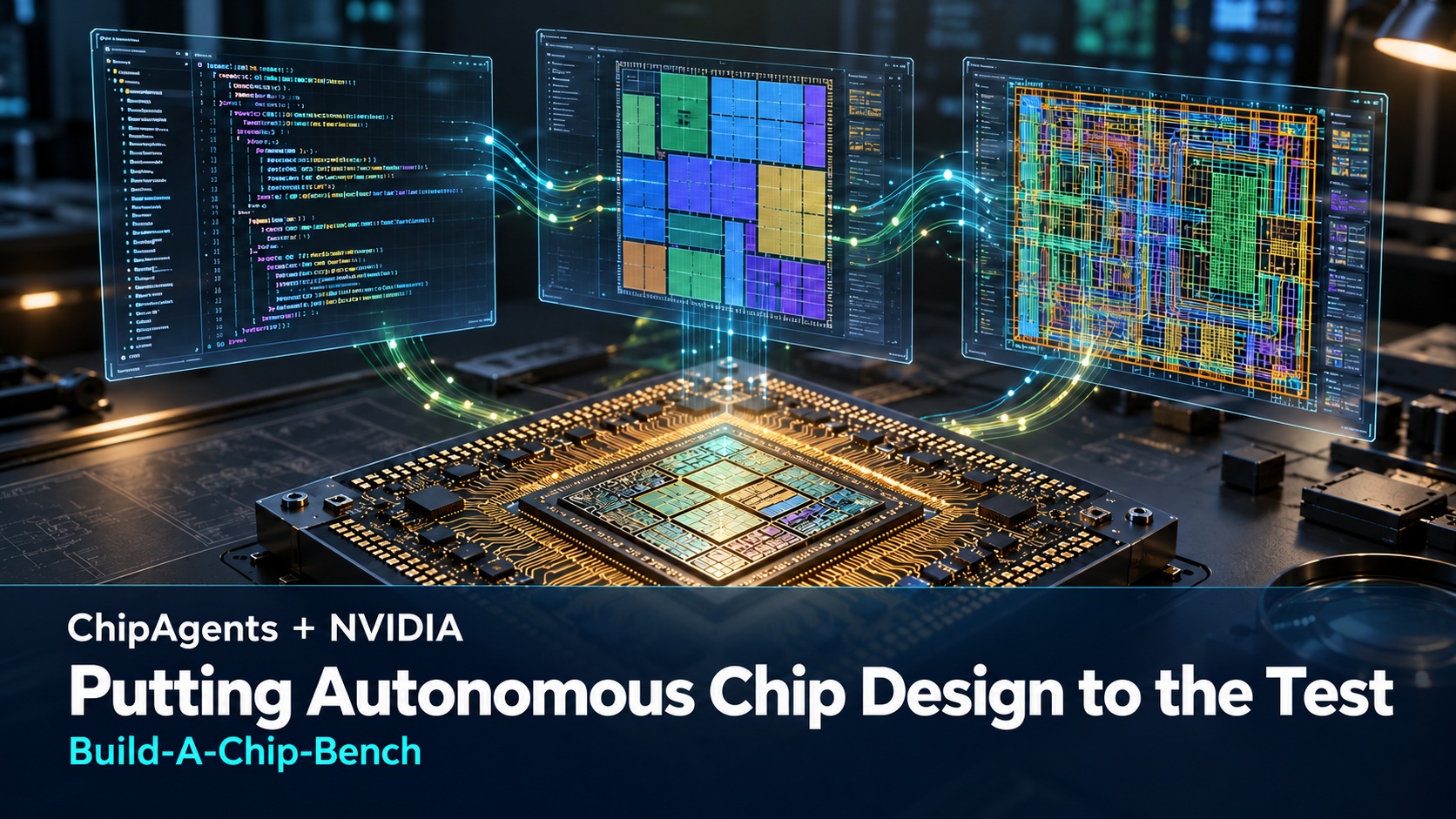

ChipAgents has introduced Build-A-Chip-Bench, a benchmark developed with NVIDIA to evaluate whether AI agents can complete digital chip design tasks from specification through physical implementation. The initiative measures progress beyond generating hardware code, asking whether autonomous systems can deliver verified layouts while satisfying interconnected engineering requirements. NVIDIA contributed technical expertise to the benchmark suite and scoring rubric.
The central question is commercially significant: can an AI system sustain sound engineering decisions throughout an entire workflow? A convincing demonstration of code generation offers only a partial answer. Semiconductor companies ultimately need designs that behave correctly, operate within constraints, and survive the implementation process. Build-A-Chip-Bench brings those outcomes into the evaluation.
According to ChipAgents, the benchmark covers architecture, microarchitecture, register-transfer-level design, functional verification, synthesis, floor planning, placement, clock-tree synthesis, routing, timing and power signoff, and physical verification. Its endpoint is verified GDS, the layout data representing the physical design. The breadth makes it a test of coordinated execution across stages whose requirements can pull a design in different directions.
Consider a hypothetical agent designing a processing block. It might choose an architecture that produces correct results in simulation, yet creates long signal paths after placement. Fixing those paths could require additional registers, changing latency and verification assumptions. Reducing area might introduce another timing problem. Success therefore requires managing consequences, including recognizing when an earlier architectural choice needs revision.
Initial results underline that difficulty. ChipAgents reports that tested agents passed functional verification on approximately 40% of tasks on average, while approximately 10% met the required physical performance, power, and area targets. These are company-reported results under the benchmark’s conditions; they should not be interpreted as universal success rates for AI chip design.
The practical lesson is that evaluation must follow the work far enough to expose downstream weaknesses. A tool can appear productive when judged by how quickly it generates an artifact. The more useful business question is how much validated progress that artifact creates. If subsequent stages require extensive repair, the apparent time saving may disappear.
For researchers, this suggests a richer improvement agenda. Better hardware-language generation remains valuable, but agents also need effective planning, disciplined experimentation, and reliable use of engineering feedback. They must distinguish a promising modification from a regression and decide whether another expensive tool run is justified. Those capabilities concern the management of a design process as much as the quality of individual answers.
NVIDIA places the collaboration within its broader work on AI for semiconductor engineering. The company says ChipAgents uses its AI infrastructure and model-training and optimization software to develop specialized chip-design models. NVIDIA describes Build-A-Chip-Bench as a measure of progress toward autonomous engineering across the workflow, reinforcing the connection between model development and measurable implementation outcomes.
For engineering managers, a benchmark of this kind could help frame more useful supplier discussions. Teams could ask where an agent succeeds, which constraints trigger failure, and how much human intervention is required. Comparisons would become more informative when they also disclose compute budgets, tool configurations, and repeatability. A headline score alone cannot capture every deployment consideration.
The potential economic benefits remain conditional. More dependable automation could shorten iterations and let engineers explore additional design alternatives. However, benchmark performance does not establish production readiness or guarantee savings on a customer’s proprietary design. Those outcomes require validation against the customer’s tools, intellectual property, constraints, and approval processes.
Build-A-Chip-Bench matters because it makes the distance between an impressive AI output and a completed engineering result more visible. Its immediate contribution is a demanding measurement framework. If that framework helps developers identify persistent failures and demonstrate reproducible improvements, it could guide autonomous chip design toward capabilities that semiconductor teams can assess, trust, and eventually deploy more broadly.
Read a technical blog + benchmark details: https://chipagents.ai/
Also Read:
Share this post via:




Comments
There are no comments yet.
You must register or log in to view/post comments.