





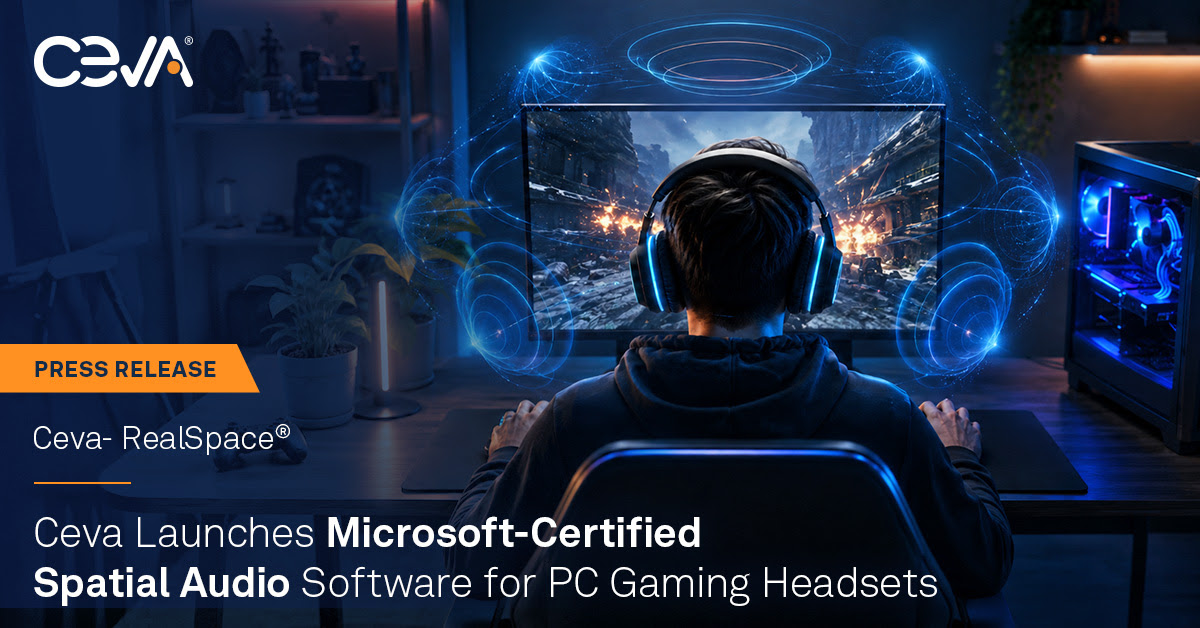
Ceva has launched RealSpace™ Elevate for Windows, a Microsoft-certified spatial audio software solution aimed at PC gaming headsets and PC OEMs. The product is delivered as a licensable Windows Audio Processing Object, or APO, giving device makers a production-ready way to add branded, customizable spatial audio to gaming and entertainment products without building a full software stack from scratch.
The announcement matters because spatial audio has quickly moved from a premium extra to an expected feature in PC gaming. Competitive players want to hear where footsteps, gunfire, vehicles, and environmental cues are coming from. Casual players want games, films, music, and live content to feel more immersive. For headset makers, that creates pressure: they need to offer convincing 3D sound, but they also need to control cost, integration time, performance, and brand differentiation.
Ceva’s RealSpace Elevate is designed to sit directly in that gap. Rather than relying only on operating-system-level spatial audio, which may offer limited room for differentiation, or third-party branded apps that can add cost and fragment the user experience, Ceva is offering OEMs a licensable platform they can customize. Headset and PC brands can tune the sound, create their own presets, and make spatial audio feel like a native part of their product rather than an add-on.
The Microsoft certification is especially important. In the Windows PC ecosystem, compatibility and reliability are critical. A Microsoft-certified APO gives manufacturers a clearer path to deployment across Windows devices, reducing some of the engineering friction that can slow product launches. For companies competing in the crowded gaming headset market, faster time to market can be as valuable as the feature itself.
RealSpace Elevate also highlights a broader shift in the audio market. Hardware alone is no longer enough to stand out. Many gaming headsets already offer similar industrial designs, wireless connectivity, noise-canceling microphones, and long battery life. Increasingly, the difference comes from software: spatial rendering, head tracking, audio presets, voice processing, low-latency optimization, and how seamlessly all of that works inside the PC experience.
That is where Ceva is trying to position itself. The company is not just selling a sound effect; it is selling an enabling layer for OEMs that want more control over the listening experience. For gamers, the practical promise is more accurate positioning, better externalization, and a stronger sense of distance and direction. In a first-person shooter, that could mean identifying an opponent’s location before seeing them. In a racing game, it could mean better awareness of nearby vehicles. In entertainment, it could make movies and music feel less like stereo playback and more like a three-dimensional scene.
The launch also fits Ceva’s broader strategy in smart edge software and sensing technologies. RealSpace Elevate expands its Sense portfolio and builds on the company’s existing RealSpace spatial audio technology, which supports 3D rendering and head tracking across headphones, earbuds, XR devices, speakers, mobile devices, and PCs.
For OEMs, the key benefit is differentiation without taking on the full burden of proprietary spatial audio development. For Microsoft’s Windows ecosystem, it could help raise the quality and consistency of PC headset audio. For gamers, it means more headsets may ship with advanced spatial audio tuned specifically for the product they buy.
Bottom line: Spatial audio is becoming a platform feature, not a novelty. Ceva’s RealSpace Elevate gives PC gaming headset makers another route to compete in that future: not just through better drivers or flashier design, but through branded, software-defined sound experiences.
Also Read:
CEVA Accelerates Wireless Edge Innovation with Bluetooth HDT and Integrated RF Design Win
All in One Bluetooth Audio: A Complete Solution on a TSMC 12nm Single Die
From Satellites to 5G: Ceva’s PentaG-NTN™ Lowers Barriers for Terminal Innovators
Share this post via:



Comments
There are no comments yet.
You must register or log in to view/post comments.