







Co-packaged optics, silicon photonics, optical I/O, and photonic engines are becoming central topics in the future of AI infrastructure.
The common story is simple:
Copper is reaching limits.
Light can move data farther and more efficiently.
Therefore, AI systems will move from electrical interconnects toward optical interconnects.
That story is directionally correct, but incomplete.
The real product challenge is not only the photonic device. It is not only the modulator, the photodiode, the laser, the waveguide, or the optical engine. Those are critical components, but they are not the full system.
For AI infrastructure, the product is the full electro-optical realization path.
That path includes:
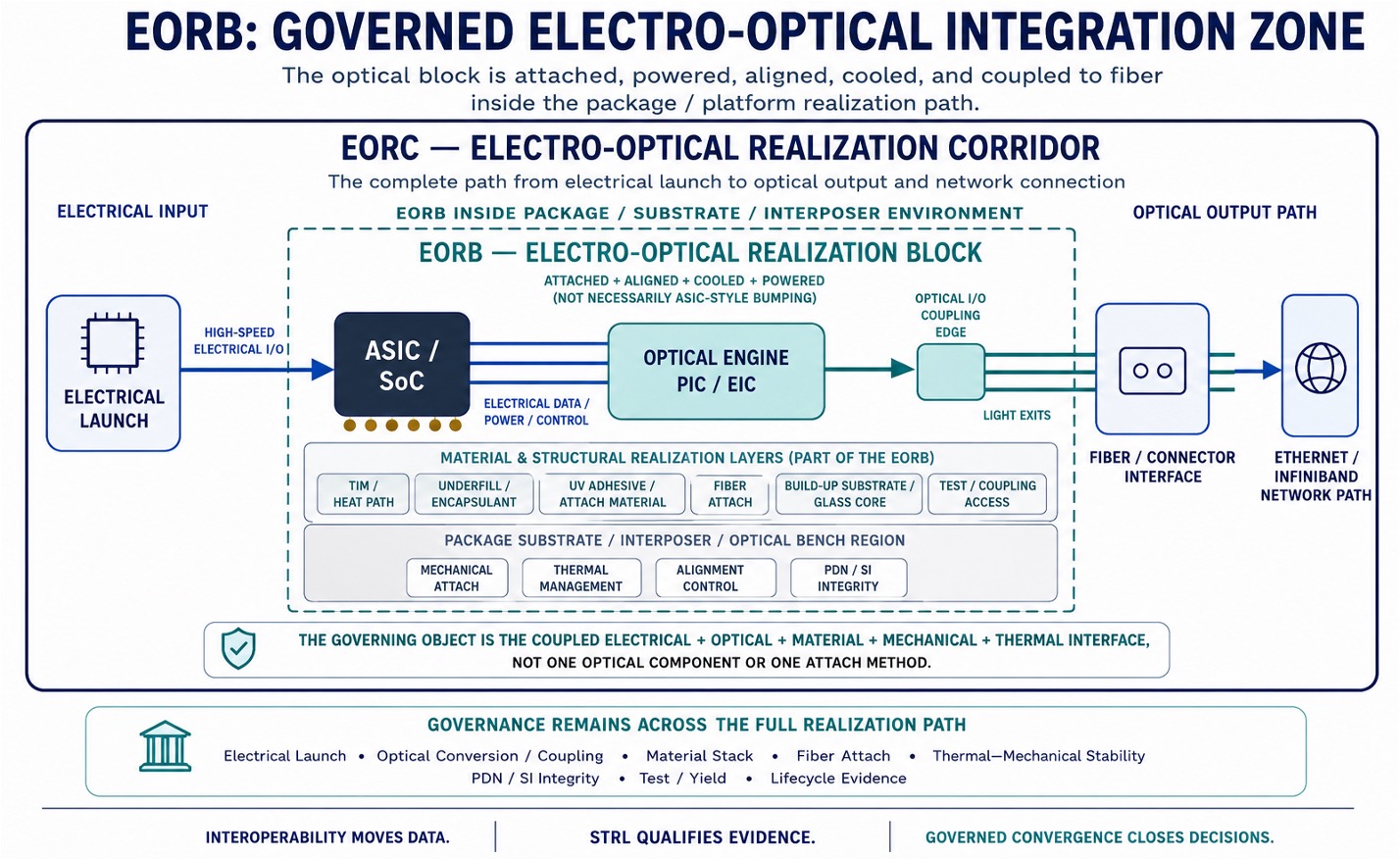
electrical launch → ASIC / SoC interface → EIC → PIC → modulator / photodiode / optical engine → coupling → fiber array attach → package substrate → TIM → underfill → adhesive system → heat spreading → thermal stability → mechanical alignment → signal and power integrity → wafer-level test → package-level test → module test → yield → reliability → lifecycle evidence
This is why I believe we need a stronger way to describe the problem.
I call this the Electro-Optical Realization Corridor, or EORC.
An EORC is the complete realization path where electrical, optical, thermal, mechanical, material, manufacturing, test, yield, reliability, and lifecycle constraints must converge before optical interconnect becomes trusted at system scale.
Inside this corridor, an Electro-Optical Realization Block, or EORB, is the local multi-material integration zone where the electrical interface, photonic engine, coupling structure, fiber attach, substrate, TIM, underfill, adhesive system, package environment, thermal behavior, mechanical alignment, and test access come together.
The distinction matters.
A photonic device can work.
A modulator can demonstrate strong bandwidth.
A photodiode can show excellent sensitivity.
A laser can meet target performance.
A coupling structure can show low insertion loss.
An optical engine can pass a controlled lab demonstration.
But AI infrastructure does not buy isolated device success.
AI infrastructure needs manufacturable, testable, package-integrated, thermally stable, yield-capable, serviceable, and reliable electro-optical systems.
That is a different problem.
Silicon Photonics Is Becoming a Materials-Integrated Realization Stack
There is another reason the device-only view is incomplete.
A silicon photonics product is not only a PIC, an EIC, a waveguide, a modulator, or a fiber interface. It is a materials-integrated realization stack.
The realized optical engine depends on many physical contributors:
TIM,
heat spreading,
underfill,
build-up film,
glass core or substrate platform,
UV adhesives,
fiber array attach,
coupling structures,
waveguides,
reflectors,
meta-lens elements,
package assembly,
test access,
and module-level reliability.
Each material and interface changes the final behavior of the system.
A UV adhesive is not only an assembly material. It can affect optical alignment, coupling stability, thermal drift, aging behavior, and field reliability.
An underfill is not only mechanical support. It can influence stress transfer, warpage, interface reliability, and optical alignment.
A TIM is not only a thermal material. It can change temperature gradients, wavelength stability, mechanical stress, and long-term optical performance.
A build-up substrate or glass core is not only a platform. It becomes part of the electrical, mechanical, thermal, and optical realization path.
This means silicon photonics is not only moving from copper to light. It is moving from device performance to multi-material realization.
That shift is important for AI infrastructure.
As optical engines move closer to ASICs, accelerators, switches, and package substrates, the number of coupled interfaces increases. The product must close across materials, structure, process, assembly, thermal behavior, test coverage, yield learning, and reliability evidence.
This is why the EORB should be understood as more than a photonic engine.
The optical engine is not only a photonic device. It is a multi-material electro-optical realization block.
The broader EORC then connects that local block to wafer processing, package assembly, module integration, system operation, lifecycle reliability, and future product learning.
In this view, materials are not secondary details.
They are evidence-bearing elements of the corridor.
CPO Is Not Optics Alone
Co-packaged optics is often described as moving optics closer to the switch ASIC, accelerator, or compute fabric.
That is true, but it hides the deeper integration challenge.
When optics move closer to compute, the optical problem becomes a package problem. The package problem becomes a material-interface problem. The material-interface problem becomes a thermal problem. The thermal problem becomes a reliability problem. The reliability problem becomes a lifecycle evidence problem.
This is the important shift.
CPO is not optics alone.
CPO is packaging realization.
The optical path has to survive real package conditions. The electrical launch must remain clean. The substrate must support escape and routing. The fiber attach must remain stable. The adhesive system must preserve alignment. The thermal environment must not destroy optical alignment, coupling behavior, or wavelength stability. The test strategy must support manufacturing confidence. The reliability data must support product guarantees.
In other words:
Light may solve distance, but realization determines scale.
The Device Is Not the Corridor
A single photonic component can be impressive and still fail to become a scalable AI infrastructure product.
Why?
Because the final system depends on cross-domain closure.
The device does not exist alone. It exists inside a stack of constraints:
electrical signaling,
package routing,
substrate loss,
return path behavior,
thermal gradients,
mechanical stress,
material aging,
adhesive stability,
fiber alignment,
connector reliability,
manufacturing variation,
test access,
calibration burden,
yield learning,
and field degradation.
Each domain can consume margin from another domain.
A thermal drift can become an optical penalty.
A package stress condition can become a coupling penalty.
A routing decision can become a signal-integrity penalty.
An adhesive shift can become an alignment penalty.
A fiber attach variation can become a yield penalty.
A test gap can become a reliability escape.
A material interface can become a lifecycle risk.
This is why electro-optical integration must be treated as a corridor, not as a collection of components.
The corridor is where margins interact.
Materials Are Part of the Evidence
In traditional semiconductor discussions, supply-chain analysis often emphasizes equipment.
That remains important.
But advanced packaging, silicon photonics, hybrid bonding, CoWoS-class integration, HBM integration, and optical engines are making materials central to realization.
Materials are no longer passive inputs.
They shape the final system.
They affect thermal gradients, stress fields, warpage, coupling stability, adhesion, optical loss, electrical performance, moisture sensitivity, aging behavior, rework limits, assembly yield, and long-term reliability.
This creates a new kind of realization evidence.
A material choice must be evaluated not only by its datasheet property, but by how it behaves inside the integrated electro-optical system.
For example:
A TIM must be evaluated through the thermal path, not only thermal conductivity.
An underfill must be evaluated through stress transfer and alignment impact, not only mechanical support.
A UV adhesive must be evaluated through coupling stability and aging behavior, not only bonding strength.
A substrate must be evaluated through electrical, mechanical, thermal, and optical integration, not only routing capability.
A fiber attach process must be evaluated through alignment, assembly tolerance, yield, and lifecycle stability.
This is why material behavior must become part of the electro-optical evidence chain.
In an EORC, materials are not background details.
They are part of the trusted realization record.
From Optical Performance to Realization Evidence
The next challenge for silicon photonics is not only improving optical performance.
It is generating evidence that the full electro-optical path is ready for product use.
That evidence must answer questions such as:
Can the electrical launch remain stable across operating conditions?
Can the optical engine maintain performance under thermal variation?
Can coupling remain stable through assembly and lifecycle stress?
Can the adhesive system preserve alignment over time?
Can the TIM and thermal path preserve optical stability?
Can underfill, substrate, and package stress remain compatible with optical performance?
Can wafer-level, package-level, or module-level test detect the right failure modes?
Can yield loss be traced to specific design, material, package, process, coupling, or assembly contributors?
Can field telemetry improve future product learning?
Can reliability claims be supported by measured evidence, not only model assumptions?
This is where the industry needs to move from device metrics to realization metrics.
Optical device performance is necessary, but not sufficient.
The larger question is:
Can the complete electro-optical corridor generate decision-ready evidence?
Evidence Must Mature Before Authority
In advanced AI systems, data is everywhere.
Simulation data.
Optical test data.
Thermal data.
Material characterization data.
Manufacturing data.
Reliability data.
Field telemetry.
Dashboard outputs.
But data is not automatically evidence.
A simulation result is not validated evidence.
Validated evidence is not causal explanation.
Causal explanation is not decision authority.
For an electro-optical system to be trusted, evidence must mature.
It must have measured correlation.
It must carry uncertainty.
It must preserve boundary conditions.
It must maintain traceability.
It must connect observed behavior to design, material, package, process, test, and assembly contributors.
It must support bounded engineering decisions.
This is where EORC connects naturally to a Scalable Trusted Realization Layer, or STRL.
An STRL treats advanced semiconductor systems as governed realization systems. The goal is not simply to collect more data. The goal is to determine when evidence is mature enough, traceable enough, and causally meaningful enough to support trusted engineering action.
For electro-optical systems, this matters because the failure modes are not isolated.
An optical penalty may have an electrical cause.
A thermal shift may have a packaging cause.
A coupling issue may have an adhesive or alignment cause.
A reliability issue may have a material or assembly cause.
A yield loss may have a coupling, test, substrate, or process contributor.
A field degradation pattern may reflect a hidden interaction between material aging, thermal cycling, mechanical stress, and optical alignment.
Without a trusted realization structure, these interactions can remain hidden until late in the product cycle.
The Electro-Optical Realization Corridor
The Electro-Optical Realization Corridor gives us a clearer way to frame the AI photonics challenge.
It says the product is not simply:
a laser,
a modulator,
a photodiode,
a waveguide,
a fiber interface,
or an optical engine.
The product is the realized corridor:
electrical launch,
photonic conversion,
multi-material package integration,
substrate interaction,
thermal stability,
mechanical alignment,
coupling stability,
testability,
yield control,
reliability evidence,
and lifecycle learning.
This framing is important because the AI infrastructure market will not scale on laboratory performance alone.
It will scale when optical interconnect becomes manufacturable, reliable, testable, serviceable, and trusted in real systems.
That is the shift from photonic device innovation to electro-optical realization.
Why This Matters for AI Infrastructure
AI scaling is often described through compute, memory, bandwidth, and power.
But the deeper challenge is bounded coexistence.
Compute, memory, optics, power delivery, thermal management, packaging, materials, firmware, and reliability do not naturally scale together. Each domain has its own physics, timing, limits, and failure modes.
The next generation of AI systems will require operational coherence across these domains.
That means the optical system cannot be optimized in isolation. It must coexist with the electrical system, the package, the substrate, the thermal path, the adhesive system, the material stack, the power corridor, the manufacturing flow, the test strategy, and the field reliability model.
This is why EORC is not only a photonics concept.
It is a system realization concept.
It connects photonics to packaging.
It connects packaging to materials.
It connects materials to thermal behavior.
It connects thermal behavior to alignment.
It connects alignment to coupling.
It connects coupling to test.
It connects test to yield.
It connects yield to reliability.
It connects reliability to lifecycle evidence.
It connects lifecycle evidence to future design decisions.
Conclusion
Silicon photonics and co-packaged optics are becoming essential to AI infrastructure, but the industry should be careful not to reduce the challenge to a simple copper-versus-light story.
The real question is not only whether light can move data.
The real question is whether the electro-optical path can be realized, manufactured, tested, trusted, and governed at scale.
The modulator is not the product.
The optical engine is not only a photonic device.
The manufacturable electro-optical corridor is the product.
That is why I believe the next phase of AI photonics should be framed not only around devices, engines, or modules, but around the Electro-Optical Realization Corridor.
Final question:
Are we still evaluating photonics as a device technology, or are we ready to evaluate it as a full electro-optical realization system?
Also Read:
CEO Interview with Vivek Raghunathan of Xscape Photonics
Synopsys and TSMC Deepen AI Design Alliance: What It Means
Another Quantum Topic: Quantum Communication
Share this post via:



Why ASML Is Racing to Build 110 EUV Machines