




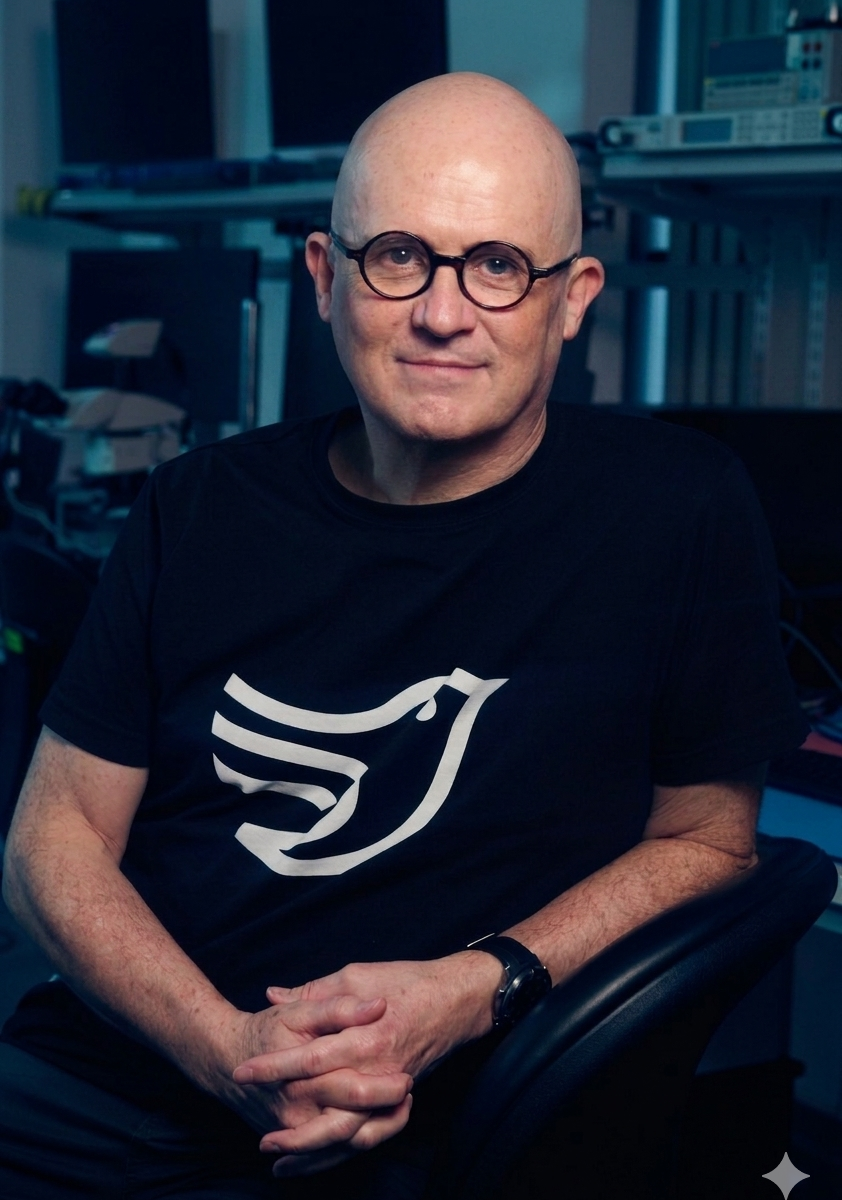



James Regan is a seasoned technology executive and physicist with over 30 years in optical communications. As Co-Founder and CEO of Oriole, he is pioneering the next radical breakthrough in advanced optical networking systems for AI. James has a proven track record of transforming university research into globally impactful companies. He is a frequent contributor to discussions on climate-conscious innovation, deep-tech commercialization, and the intersection of AI and photonics.

Tell us about your company.
We are building the next generation of data center networking, something fundamentally different from what’s come before. Oriole was founded out of University College London on the back of more than 20 years of research into optical networking, but what really defines us is the way we approached the problem.
Instead of starting with a piece of technology and looking for somewhere to apply it, we started with one of the biggest problems in the world right now – how do you scale AI? And we worked backwards from there.
That led us to a completely new kind of network: a pure photonic network that keeps data as light as it moves through the data center. It’s a full-stack system. We are not building a component; we are building the whole network. The goal is very simple: deliver dramatically higher performance, at dramatically lower power, so that AI can scale without hitting physical or economic limits.
What problems are you solving?
The core problem is that AI is running into the limits of existing infrastructure.
Today, if you want more performance, the industry response is essentially to just add more. More GPUs, more switches, more energy. But that only takes you so far. At some point, you run into very real constraints around power, cost, and complexity.
What’s happening is that the network is becoming the bottleneck. Electrical switching architectures simply can’t keep up with the scale and speed that modern AI demands.
That has very direct consequences, particularly for inference, which is where customers make money. As models scale, inference increasingly becomes latency-bound. The network sits on the critical path of how fast processors can work together, and if you introduce delay, you slow the whole system down.
The key point is this:
tokens per second, and tokens per second per user, are directly tied to revenue.
If your network is introducing latency, your GPUs are waiting. And when your GPUs are waiting, your throughput drops, immediately hitting your bottom line.
This isn’t just a technical problem; it’s an economic one.
What Oriole has done is reimagine the network from first principles and built a system where data moves as light, directly between processors, with extremely low and deterministic latency.
The result is that you can:
- drive significantly higher tokens per second
- deliver better tokens per second per user
- and ultimately generate more value from the same compute infrastructure
In simple terms, we’re solving the problem of how to move massive amounts of data at very low, deterministic latency, without consuming unsustainable amounts of power. And how to build a network that can keep up with AI and actually unlock the performance of the compute you’ve already paid for.
What application areas are your strongest?
Our primary focus is large-scale AI infrastructure, both training and inference.
That’s where the problem is most acute, and where the benefits of what we’re doing are most significant. When you’re running large models, you’re constantly moving data between processors, and the efficiency of that communication directly impacts performance.
If you improve that network, you don’t just make things marginally better. You fundamentally change what’s possible. You can train larger models, run inference more efficiently, and ultimately deliver better outcomes per unit of compute.
Beyond hyperscale AI, we’re also seeing strong interest from enterprises and areas like financial services, where performance and latency really matter. But the common theme is always the same: environments where data movement is the limiting factor.
What keeps your customers up at night?
Two things, really: scale and efficiency.
On the one hand, everyone is trying to build bigger and more powerful AI systems, but there is a growing recognition that the current approach doesn’t scale indefinitely. At some point, you simply can’t keep adding more hardware and more power.
On the other hand, there’s a very real concern around the economics of AI. If the cost per token or per workload becomes too high, it limits what you can do.
Underpinning both of those is the network. If the network introduces latency, inefficiency, or overhead, it directly impacts performance and cost.
So, what keeps people up at night is:
- Can we scale this?
- Can we afford to scale this?
- And will the infrastructure keep up with the ambition?
What does the competitive landscape look like and how do you differentiate?
There is a lot of activity in this space, but most of it is incremental. The industry is trying to evolve the current model. That means faster electrical switches, better optical links between those switches, or hybrid approaches that combine scale-up and scale-out networks. But those approaches still rely on the same underlying architecture, and that architecture has fundamental limits.
What Oriole has done is step outside that model entirely. We’ve built what we believe is the world’s first pure photonic AI network, where:
- data stays as light end-to-end
- every node connects directly to every other node
- the network operates in a single-hop, fully connected, contention-free topology
There are no layers of switching, no queuing, no waiting.
The differentiation isn’t incremental. It’s architectural. Others are optimizing the existing system. We’re removing the constraints of that system entirely and building the system that comes after it.
What new features/technology are you working on?
At the core, we’ve built PRISM (Photonic Routing Infrastructure for Scalable Models), the first and that’s already up and running today and we are now taking it into real-world deployments and scaling it (as per our most recent announcement).
In March this year, we announced the next evolution of our platform, which we call PRISM Ultra, which takes the same fundamental concept – light in, light out – but pushes it closer to the processor and dramatically increases scale and performance.
This means:
- direct processor connectivity
- one-hop communication across very large systems
- and extremely low, deterministic latency
At the same time, we’re continuing to innovate across the full stack, from software and control through to photonic hardware, because this only works if you solve the entire system end-to-end. What’s exciting is that once you introduce a fundamentally new technology like this, the pace of innovation accelerates very quickly.
How do customers normally engage with your company?
It typically starts with conversations. Because what we’re doing is quite different, people need to get their heads around it.
There’s often an initial reaction of excitement combined with scepticism, which is perfectly natural when you introduce something that challenges existing assumptions.
There are currently two engagement models, depending on the product and the customer.
For PRISM, it’s more of a transactional model, working with data centre builders, partners, and integrators to deploy systems.
For PRISM Ultra, it’s much more strategic and partnership-led, engaging directly with hyperscalers and leading-edge organisations who are building the next generation of AI infrastructure.
There’s a process of building confidence, what I’d describe as a “staircase”, where we go from demonstrating the technology to scaling it, and then to full production deployments.
Ultimately, because this is a full system solution, engagement is quite deep. We are not just dropping in a component; we’re working with customers on how to rethink their infrastructure for the next era of AI.
Also Read:
CEO Interview with Suresh Vasudevan of Clockwork.io
Q&A Interview with Mo Steinman, Lightelligence’s Senior Vice President and General Manager, U.S.
CEO Interview with Mike Horton CEO of HYFIX
Share this post via:



Why ASML Is Racing to Build 110 EUV Machines