





webinar IPXACT banner

Intel Versus TSMC 14nm Processes

Intel Versus TSMC 14nm Processes
by Scotten Jones on 08-13-2014 at 5:00 pm

Intel has begun to release some details on their 14nm process. I thought it would be interesting to contrast what Intel has disclosed to TSMC’s 16nm process disclosure from last year’s IEDM (TSMC calls their 14nm process 16nm).

[TABLE] align=”center” border=”1″
|-
| style=”width: 141px” |
| style=”width: 163px” | Intel 14nm
| style=”width: 168px” | TSMC 16nm
| style=”width: 116px” | Ratio TSMC/Intel
|-
| style=”width: 141px” | Process target
| style=”width: 163px” | MPU
| style=”width: 168px” | SOC
| style=”width: 116px” |
|-
| style=”width: 141px” | Status
| style=”width: 163px” | Shipping
| style=”width: 168px” | Development
| style=”width: 116px” |
|-
| style=”width: 141px” | Process type
| style=”width: 163px” | FinFET on bulk
| style=”width: 168px” | FinFET on bulk
| style=”width: 116px” |
|-
| style=”width: 141px” | Gate
| style=”width: 163px” | Gate last HKMG
| style=”width: 168px” | Gate last HKMG
| style=”width: 116px” |
|-
| style=”width: 141px” | Fin pitch
| style=”width: 163px” | 42nm
| style=”width: 168px” | 48nm
| style=”width: 116px” | 1.14
|-
| style=”width: 141px” | Gate pitch
| style=”width: 163px” | 70nm
| style=”width: 168px” | 90nm
| style=”width: 116px” | 1.29
|-
| style=”width: 141px” | M1 pitch
| style=”width: 163px” | 52nm
| style=”width: 168px” | 64nm
| style=”width: 116px” | 1.23
|-
| style=”width: 141px” | SRAM cell size
| style=”width: 163px” | 0.0588um2
| style=”width: 168px” | 0.07um2
| style=”width: 116px” | 1.19
|-

There are both similarities and differences between the processes. Intel’s process is for MPUs and TSMC’s process is for SOCs. MPU processes are more targeted and require fewer options. A TSMC SOC process for example would typically have 2 or more gate oxide thicknesses with options for 4 or more Vts while Intel’s MPU processes are single gate oxide and at 22nm were 3Vts. On the other hand Intel is now shipping 14nm MPUs while TSMC will not be shipping SOCs on 16nm until mid-next year (although Intel will likely not ship their SOC version of 14nm until next year either). Intel’s disclosure also shows a significant density advantage over TSMC at almost 20% for SRAM cell size.

Also read:Who Will Lead at 10nm?

The preceding numbers are all based on TSMC’s IEDM paper from last December. TSMC is also known to have an FF and FF+ process. The FF+ process shows significant improvements in performance over FF. Is this due to a shrink or what performance enhancement is used to achieve this? It will also be interesting to see how Samsung’s 14nm process compares once we have critical dimensions for them. I would be very interested to hear from any Semiwiki readers who can provide additional information on the TSMC or Samsung processes.

A critical metric for both processes will be cost. Intel has already disclosed that 14nm produces a significant cost reduction per transistor versus 22nm (at least for MPUs). Various industry observers have published articles projecting increased cost per transistor for foundries at both 20nm and 16nm/14nm. Our modeling suggests TSMC will achieve a cost reduction at 20nm and may achieve a small cost reduction at 16nm as well.

Smart Meters

Smart Meters
by Paul McLellan on 08-13-2014 at 7:05 am

The Internet of Things (IoT) isn’t a single homogenous market but splits up into different segments with very different requirements. A lot of IoT markets are still in our future: next generation wearable medical devices, autonomous cars and more. One area where IoT has been going strong, long enough that it probably pre-dates the catchy buzzword IoT, is smart power meters.

Today Atmel announced their latest power line communications SoC specifically designed for this market. The Atmel SAM4CP16B is an extension of Atmel’s SAM4Cx smart energy platform built on a dual-core 32-bit ARM Cortex-M4 architecture. It is fully compatible with Atmel’s ATPL230A OFDM physical layer device compliant with PRIME standard specification. The flexible solution addresses OEM’s requirements for various system partitioning, BOM reduction and time-to-market requirements by incorporating independent application, protocol stack and physical layer processing functions within the same device. Key features of the SoC include integrated low-power driver, advanced cryptography, 1MB of embedded Flash, 152KB of SRAM, low-power real-time clock, and an LCD display controller.


I think that as various submarkets of the internet of things develops, then we will see a lot of devices like this, SoCs that integrate everything that is required for a particular application, leaving the system company to customize the hardware, add their own software and so on. IoT will not be a market like mobile, with huge chips being done in the latest process generation. Many IoT designs will include analog, RF and sensors, all of which are best designed in older processes like 65nm or even 130nm.

The system volumes for many designs will be relatively low and so designing a specific chip for each application will be unattractive. Even in mobile where the volumes are much higher, only Apple and Samsung design their own application processors, as far as I know. Everyone else licenses one from Qualcomm, Mediatek or others. Even Apple gets the modem (radio) from Qualcomm. The aggregate volumes will end up being large (there will be a lot of things) so the prize goes to the semiconductor companies that do the best job of designing chips that match what the system companies require.

Data sheet for the Atmel part is here (warning, it’s 1000 pages)

See also:

What is the Latest in Mobile


More articles by Paul McLellan…


One Breath, One Milliwatt

One Breath, One Milliwatt
by Eran Belaish on 08-11-2014 at 8:00 pm

To understand how challenging it is to successfully implement Always-on Technology, consider doing any kind of sport while holding your breath. Sounds crazy? There’s actually one sport in which participants do just that – freediving. So what does freediving have to do with always-on technology? Quite a few things apparently.

Harsh Environment
In freediving, there is one resource which is by far scarcer than others – oxygen. In always-on technology that would be power. The problem is that these two resources are the most important ones to the functionality of the two types of systems, oxygen to the biological one and power to the electrical one. Being short of such fundamental resources usually spells bad news to the system, unless you know what you are doing.

Optimal Resource Utilization
To maintain an operational level of such precious resources, activity level has to be kept to the minimum necessary. Furthermore, any activity that is taking place has to make optimal use of the limited resources, which mandates deviating from old habits. For example, any component that is always-on must not include wasteful elements such as power-hungry processors like the ones found in smartphones. On the other hand, the always-on processor has to be efficient enough to be able to execute its tasks (e.g. Bluetooth-enabled voice activation, gesture recognition) — which could be quite intensive — with minimal power consumption. Similarly, to succeed in freediving one has to let go of terrestrial habits that might be fine given unlimited oxygen credit but have no real justification when submerged. Consider, for instance, hand movement that automatically happens when we walk. Such movement has no effect underwater and it wastes oxygen in vain. Furthermore, neutralizing the hands also helps in keeping a streamlined position.


Cutting Edge Technology to the Rescue

Less than 100 years ago, medical doctors believed that freediving below 30 meters was biologically impossible as the lungs would crash under the pressure of the water column above. Around that depth the air in the lungs indeed compresses dramatically and reaches residual volume which is about a third of original volume on surface. What the doctors didn’t know is that two mechanisms called mammalian diving reflex and blood shift kick in and slow down the heart rate, optimize blood circulation and transfer blood to the lungs to prevent them from crushing upon reaching residual volume. The current world record is 281 meters, so don’t believe everything your doctor tells you. In always-on technology, breakthroughs are still ahead of us. First and foremost SoC vendors should let dedicated processors handle always-on tasks rather than running them on yesterday’s power-hungry application processors. For example, the CEVA-TeakLite-4 runs various always-on functions simultaneously in less than 150uW at a 28nm HPM process node: voice trigger, face trigger, sensor fusion and Bluetooth Low Energy (BLE). Running similar functions on the application processor (AP) would require at least two orders of magnitude more power, clearly surpassing the power consumption threshold required for a reasonable battery life. This gap in power consumption is not accidental – unlike an AP, the CEVA-TeakLite-4 DSP is well adept to running such functions, which often require intensive signal processing. Furthermore, with its power-optimized hand-crafted RTL, power scaling mechanism and 10-stage pipeline that easily fits low power memories, the CEVA-TeakLite-4 consumes ultra-low power by design. On top of that there are a few technologies that still sound a little like science fiction but will probably commercialize given enough time, such as subthreshold conduction and energy harvesting that can dramatically reduce power consumption or charge the device with scavenged energy.

Separate the Men from the Boys
Any inefficiency in always-on systems has immediate implications, namely poor battery life as witnessed with recent smartwatches, for instance. While poor battery life can be tolerated by users of other devices, users of wearable ones are less forgiving, demanding longer times between charging (weeks vs. hours), and many of those devices end up in the back of a drawer as a consequence. In freediving, any inefficiency immediately translates to poor bottom time. The challenge here goes far beyond neutralizing frenzied limbs, as out of all organs, the brain is the biggest oxygen consumer and there is only one natural way to keep brain oxygen consumption to the minimum – relaxation. So next time you go freediving keep that in mind (or even better don’t keep anything in mind) and next time you design an always-on application, think carefully about which processor is the best fit for always-on functions. In both cases it will help you reach a similar goal – less frequent recharging.


Wanna start something new? Try this…

Wanna start something new? Try this…
by Pawan Fangaria on 08-11-2014 at 8:30 am

Often I have been asked by students, researchers and buddying young entrepreneurs about sources of funds for new technology development and innovation. When I came across this wonderful opportunity which has a global appeal, I couldn’t resist myself bringing it to the notice of a wider audience. I admire nVIDIA supporting research and education activities around the world through several of its programs including research centers, teaching centers, graduate fellowship, hardware donations, CUDA (Compute Unified Device Architecture) fellowship, Center of Excellence and many other programs. This kind of CSR (Corporate Social Responsibility) activity, I believe, is the most effective and a win-win solution for our growing talent and rising unemployment across the world.

I am particularly impressed with this new Global Impact Award Programwhich provides annual grant of $150,000 for ground breaking solution to the world’s most challenging social and humanitarian problems. This grant will be awarded to a researcher or institution that uses nVIDIA technology to achieve breakthrough results with broader impact on society. The areas of research include disease research, drug design & development, medical imaging, energy & fuel efficiency, weather prediction, natural disaster response, cyber security and any other such area with broader impact.

nVIDIA partners with research and higher education institutions and supports them in finding solution to complex computing problems in an accelerated way. The program is open to submissions from researchers, group of individuals, non-profit research organizations or universities from anywhere in the world. Multiple submissions from institutions or individual researchers are allowed.

The submissions can be self-nominated or nominated by third party. However endorsements from recognized experts in the relevant field of study are welcome and can strengthen the nomination. The nomination form can be downloaded from here.

The evaluation will be done on the basis of several criteria including innovation, social impact, effectiveness of result and public accessibility.

Key milestone dates are as follows –

[TABLE]
|-
| style=”width: 148px” | Date
| style=”width: 370px” | Activity
|-
| style=”width: 148px” | March 27, 2014
| style=”width: 370px” | NVIDIA Global Impact Award announced
|-
| style=”width: 148px” | Oct. 31, 2014
| style=”width: 370px” | Submissions due
|-
| style=”width: 148px” | Feb. 15, 2015
| style=”width: 370px” | Finalists announced
|-
| style=”width: 148px” | March 17, 2015
| style=”width: 370px” | Award recipient named at GPU Technology Conference
|-

So, go ahead if you have something to reflect on your talent. If you are the lucky one, you will be provided with transportation and accommodation to receive your award in person at the 2015 GPU Technology Conference. What more? You will be interviewed for potential coverage in nVIDIA’s communication channel and also present your work at nVIDIA-hosted events targeted at the research community.

More information about this program can be obtained from mailto:globalimpact@nvidia.com.

I view this program as a great motivator and confidence booster for researchers, engineers, software professionals and designers alike. Those who want to test their talents and innovations, and start on their own from ground-up, can use this platform to build their foundation. Comments welcome!

More Articles by Pawan Fangaria…..


What Comes After FinFET?

What Comes After FinFET?
by Paul McLellan on 08-10-2014 at 11:01 pm

So what comes after FinFETs? At 14/16nm (or 22nm if you are Intel) we had FinFET transistors, where the channel was no longer planar but stuck out of the wafer vertically, and the gate wrapped around it on 3 sides. The key thing that made FinFET transistors attractive was that the channel was thin so that the gate controlled it well. FD-SOI has the same attraction, although with a totally different topology. By building the channel on top of an insulator, it was thin and well-controlled. So is it FinFETs all the way down to 10nm, 7nm 5nm, how low can you go limbo dancing?

At the imec day at Semicon West a month ago, An Steegen told us what they thought. She is the senior vice president of process technology there and when she talks…well, water and fire-hoses come to mind.

Nanowires are the first thing to think about. Instead of having the gate wrapped around 3 sides of the channel, how about 4. The channel is basically a wire running through the gate. Is that better than a fin? Imec has studied it. 10nm turns out to be the FinFET scaling limit and at 7nm three nanowires running through the gate is the best solution.

So what you are probably thinking of is a vertical gate of some sort with some silicon nanowires running through. But maybe not. Making the whole structure vertical, so that the source and drain are above each other with the gate in between. The idea is to make the transistor smaller areally and make it take up less space for the source/drain contacts to the metal fabric above. At these dimensions wiring resistance is a huge problem too, so short wires are doubly attractive.

Alternatives are to enhance the effectiveness of the transistor. That means adding new materials to it such as strained germanium Pfets and III/V Nfets. Using new (well, old familiar favorites) to make the channel. Vdd can be lower but channel mobility higher.


These approaches are still CMOS, even if not clearly recognizable. But research is going on in even more esoteric approaches. Have you heard of magnetic tunnel junctions (MTJ). Yeah, me neither until An told me. Spin Wave. Spin Torque majority voting. Plasmonics. Lots to learn about still!

Then there is all the stuff about getting optical onto the chip. Or making 3D (TSV) really work.


More articles by Paul McLellan…


IoT Application: Road Biking Fitness

IoT Application: Road Biking Fitness
by Daniel Payne on 08-10-2014 at 8:00 pm

Eleven months ago I started a fitness kick in order to lose some weight, get healthy and have more energy, so I picked a familiar activity, road cycling. Being an engineer I have always loved measuring things, like my speed and distance, however I had an old-fashioned cyclocomputer called the Cateye Velo 2. This device connected to the handlebars and a wire went down the front fork to a sensor that picked up the magnetic signal from a spoke-mounted magnet.

Being some 10 years old, there was no mechanism for the Cateye Velo 2 to transfer the cycling data to a computer or the Internet, so I went searching for something high-tech that would connect my ride data to the web. My first approach was to use an Android-based cell phone with GPS enabled and a free app called Strava.This worked pretty well to show me a map of the route, speed and elevation.

The Strava app worked fine on my Samsung Galaxy Note 2 phone, and I just had to be patient waiting for the GPS signal to lock before starting a new ride. When the ride finished I pushed one button in the app to sync my ride data by WiFi to the Strava web site.
Related: Non-volatile Memory in the Internet of Things

Somehow I wasn’t content with just velocity, because I wanted to know my cycling cadence and heart rate too. My next approach was to buy a wireless device and I looked at several companies:

Garmin was too expensive for my budget, Trek was possible, Sigma was a brand not familiar to me, so I ended up with the Cateye Stealth 50. This device uses GPS to capture my location, along with wireless sensors for: speed, cadence and heart rate.

Being curious, I took the device apart to see what was inside, which of course voided my warranty.


Related: ARM and the Internet of Things

To the right is the lithium ion battery, separated from the main PCB by a black plastic housing. The PCB on the left has four main chips on it, none of them had corporate markings. From the Cateye website I learned that one of those chips is a 4-bit micro-controller. I can guess that this device has chips for:

  • 4-bit micro-controller
  • LCD display driver
  • ANT+ protocol
  • USB connectivity

The four shiny posts on the bottom of the PCB are the connectors to dock the Stealth 50 to a USB cradle, used after a ride to load your data to a computer, then upload to Strava or Cateye’s web site for analysis. The retail price of this device is $150.00, so I’ll also guess that the margins are also quite high with such a small Bill of Materials. Since were talking about making measurements a few times per second, the chip technology could probably be a mature process node like 180nm, so you don’t really need bleeding edge technology to make a successful IoT device.
Related: The Internet of Things

All four companies listed above support the ANT+ protocol for ultra low-power wireless device monitoring, and there’s even an industry association to promote it for a diverse set of uses: runners, swimmers, cyclists, exercise equipment, hiking and medical.

For my bike I added a Garmin sensor to monitor both speed and cadence, it attaches near the rear wheel, and uses the ANT+ wireless standard.

While at the Bike Gallery in Beaverton I purchased an ANT+ compatible heart rate sensor from Bontrager (Trek brand).

Since Cateye is a Japanese company their user manuals take some interpretation, so it was much easier for me to visit the USA web site and watch a how-to video to get all my gear talking and working together.

The fun part is actually going for a ride and being able to view in real time my: Speed, Cadence and Heart Rate. After the ride I can see all of the numbers or graphs in Strava:

The above graphs show the elevation of my route, speed, estimated power, heart rate and cadence. For the time point at the cursor I was gliding down a hill at 40.7 mph, while not pedaling so the cadence was 0, and a heart rate of 156 bpm. On that ride I averaged 90 rpm for cadence, 153 bpm for heart rate, and 20.7 mph for speed. Now that’s a lot of data for a cyclist to consume. The only other technology gizmo that I could add would be either a power meter crankset or pedals, but at prices between $995 and $1,995 that’s way too rich for my budget.

Summary

The IoT as a cyclocomputer and wireless sensors has many vendors to help you measure your fitness level and achievements. Standards like ANT+ make a lot of sense for both consumers and vendors, instead of taking a proprietary approach and you really can mix-and-match between them like I did. On the software side the two main web-based providers are Strava and MapMyRide, I started with MapMyRide and then moved over to Strava where the more competitive road cyclists hang out. All of this is made possible at an affordable price because of our semiconductor ecosystem powering the electronics.

Hopefully I may have inspired some of you to get fit too. I’ve lost 30 pounds in 11 months, and am at 170 pounds today because of my cycling fitness efforts. I’ll never go back to my old, sedate lifestyle again.


My son and I just finished the Portland Bridge PedalRide

Semiconductor Revenue Trends

Semiconductor Revenue Trends
by Peter Gasperini on 08-10-2014 at 9:00 am


Image Source: Wikipedia

Nescire autem quid ante quam natus sis acciderit, id est semper esse puerum. (Not to know what happened before you were born is to remain forever a child.)Cicero

2014 is destined to be a pivotal year for Silicon Valley and High Tech in general. End user markets have been stagnating or declining over the last several years – most notably, the HDTV and consumer PC markets. Even high flying segments such as tablets and smartphones have been slowing markedly, with the CEO of Best Buy complaining about collapsing tablet sales and cellphone service providers urgently promoting ever more aggressive smartphone pricing and service bundles to reignite momentum.

Yet according to most analysts, this is supposed to be a year of energetic recovery, in the way that 2012 and 2013 weren’t. The SIA has been enthusiastically proclaiming that they expect a new record year of revenues in 2014 for the semiconductor industry.

The situation is indeed puzzling. After all, the SIA reported 2013 was a record revenue year for the chip industry worldwide, with 4.8% growth to $318B. Yet at the next layer of detail, the news is less reassuring. The logic portion of semiconductors showed only a 0.4% uptick, with the overwhelming majority of revenue gains going to DRAM and Flash – in particular because of the memory chip supply shortage that carried over from 2012. Reports for 2014 have so far been encouraging, but the industry has yet again experienced memory shortages for at least the first half of this year.

The gross numbers are clearly not sufficient to gain a thorough understanding of how the chip business is faring. A more accurate assessment is possible by segmenting the industry according to markets served and technologies on offer, with a distinct prejudice against firms in the memory sector. To that end, I’ve assembled a portfolio of ten companies that span the gamut of market segments served by silicon – the three C’s (communications, consumer and computing), mobile computing (tablets & smartphones), ISM (industrial, scientific and medical), automotive and, finally, mil/aero. Technologies included are a broad mix of SoC, programmable logic, microprocessors and even systems & software with several systems houses thrown into the mix. From this selection, one can get a snapshot of the relative health of the logic portion of the chip sector, major systems markets served and the entire High Technology value chain.

What’s also vital for this data to have relevance is a historical perspective. To serve that purpose, I’ve compiled financial reporting information all the way back to Q1 2008. Please note that corporate financial statements are very often non-GAAP to exclude one-time charges or certain unpleasant liabilities (as well as to provide maximum room to spin the message for investor audiences.) Regardless of that fact, the numbers are still extremely useful for illustrating long term trends, and are presented below, with $B on the Y axis.

The amount of information on this graph is a bit overwhelming, but there’s a couple of things that leap out from it:

[LIST=1]

  • A couple of these companies show regular Q4 holiday season spikes – Apple, Microsoft and (strangely enough) IBM stand out in this.
  • The semiconductor firms are, with the notable exception of Qualcomm, relatively flat.
  • The venerable systems houses – IBM, HP and Cisco – are either flat or, rather alarmingly, trending down quite steadily over the long term.
  • There most certainly has not been a broad based recovery with vigorous growth since the 2008 Wall Street financial crisis. This suggests more forces are at play.

    Some of these companies are vastly larger than others and would benefit more from a segmented charting and analysis, grouping companies together by type and/or markets served. I’m doing that currently and offering the results on http://vigilfuturi.blogspot.com. For those who are interested in getting access to a spreadsheet of the source data, please let me know in the comments and we’ll figure out together how I can get the data to you for your own analyses.


  • Analog Model Equivalence Checking Accelerates SoC Verification

    Analog Model Equivalence Checking Accelerates SoC Verification
    by Pawan Fangaria on 08-09-2014 at 7:30 pm

    In the race to reduce verification time for ever growing sizes of SoCs, various techniques are being adopted at different levels in the design chain, functional verification being of utmost priority. In an analog-digital mixed design, which is the case with most of the SoCs, the Spice simulation of analog components is the limiting factor because it is inherently slow and cannot handle large designs. A mixed-signal simulator which integrates Spice solver with event-based (for digital) solver can be used to improve the overall speed (better than Spice) while keeping the accuracy at Spice level; however the speed is still substantially less than a pure event-driven simulator and capacity to handle large analog content is still a limitation. So, what’s the next alternative?

    We do have one where analog behavioral models can be used in place of analog IPs or components and can be simulated along with digital with event-based solvers at the same speed as digital without any major capacity limitation. An analog behavioral model is the abstract representation of its analog IP or component; the behavior is captured using either RealNumber or logic data types in HDLs. Since the actual implementation of the analog IP or component is done separately through schematic and layout in the design process, it’s necessary to check the equivalence between the actual implementation and the behavioral model.

    In the framework of analog behavioral model validation, verification planning is very important which brings together all stakeholders from analog, digital and verification teams, sets objectives of equivalence validation and establishes a continuous communication channel. The equivalence between behavioral model and circuit implementation must be ensured by verifying it every time any change in specification occurs which drives change in circuit implementation. The verification plan must contain all important criteria such as list of features and their tests, testplan, coverage, equivalence validation methods, review procedure, reporting, exception handling and verification closure criterion.

    In the simulation environment, every test has to be simulated twice; first the Spice view of analog IP and then the behavioral model as DUV (Device Under Verification). The test scenarios are derived from the verification plan and EqVC (Equivalence Validation Component) is placed in the testbench environment to capture information that is used to compare if simulation of both types of DUVs produce similar results and decide pass/fail for each test or waive off certain failing test depending on the closure criteria mentioned in the verification plan. The comparison technique varies with the type of EqVC. The testbench can be setup either in analog-on-top (i.e. schematic driven environment) or in digital-on-top (i.e. HDL based environment) fashion.

    This methodology of equivalence validation has been used and presented jointly by Mentor Graphicsand ST Microelectronicsin DVCon 2014. They used digital-on-top testbench environment and mixed-signal simulator which could handle both behavioral model as well as Spice view of analog IP without any change in testbench. To reduce simulation time, focus was on testing features relevant for functional verification; further, model with multiple functions was broken down into smaller simpler models, which aligns with the philosophy of analog circuits being modular, consisting of sub-circuits.

    There are three different types of EqVCs

    For quick equivalence validation, ‘waveform compare’ method is used which can be quickly setup with a waveform tool like EZWave for comparing continuous waveforms and automating post-processing of results for reports, such as pass/fail, through scripting. This method is good for simple models such as BIAS and PLL models of HDMI IP.

    Above is a snapshot of waveform mismatch between analog and behavioral model. The differences shown in red can be studied and used to fine tune tolerances and waiver criteria.

    The Assertion Based Verification (ABV) is similar to the way it is used in digital circuits, that is by adding assertions in the design description to capture the design intent and verify that the intent is implemented correctly. QuestaADMS extends SVA (System Verilog Assertion) bind scope to analog objects as well. This methodology improves design quality and verification productivity by increasing observability. It’s well suited for digital-on-top verification; the testplan acts as an executable verification plan and is linked to functional checks (in the form of assertions) from simulation results. A library of commonly used checkers and monitors such as monotonicity of signal, signal crossing a threshold etc. can be reused with different models whereas specific assertions have to be written afresh based on the functional specs.

    Above is an example of a testplan for a voltage regulator. The QuestaADMS allows use of scripts to link testplan and merge UCDB. The assertions from behavioral model simulation as well as Spice DUV are merged separately and then compared to ascertain failing testcases in the behavioral model.

    The Advanced Verification method is based on UVM, a standard methodology promoted by Accellera, based on reusable class libraries. This method includes constrained random stimulus to increase verification coverage and supports coverage driven verification. UVM agents are extended for analog specifications to increase test scenarios and measure coverage. The basic test methodology remains identical to ABV.

    Read more on coverage driven verification through UVM

    ST has successfully used this validation environment for multiple of their IPs. A mix of EqVC types can be used; ‘waveform compare’ method for simple models at leaf level and ABV/UVM method for complex models and interconnected models at the top level. QuestaADMS supports RealNumber data types in Verilog-AMS, VHDL and SystemVerilog and supports the above verification methodologies for low power and mixed-signal simulations. More detailed information can be found in a whitepaper at Mentor website.

    More Articles by Pawan Fangaria…..


    Speeding up IP and Data Management

    Speeding up IP and Data Management
    by Daniel Payne on 08-09-2014 at 8:00 am

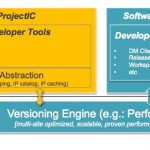
    IP and Data Management (DM) for SoC teams has gradually moved from ad-hoc approaches using simple Excel spreadsheets, to home-grown software that is specific to a project or company, and finally to commercially supported tools. One such commercial toolset for IP lifecycle management is from Methodics, named ProjectICwhere you can create, update and track workspaces using an open architecture, interfaces and data:

    It’s possible for a modern IC design team to be working with an 80GB workspace, which can take a long time to sync using DM tools like Subversion, Perforce, Git and others. To speed up this sync process there are a couple of approaches available:

    • Intelligent IP Caching – Project IC ensures that the data designers need is located as close to them as possible through an onsite IP cache, and that there is no unnecessary duplication of data. Only a subset of the data actually needed for editing is held in the user workspace, then visible for data management sync operations, providing a speed up for syncing and smaller file sizes. I blogged about this topic a bit back in January 2014.
    • Accelerating Underlying Storage – Since project IC is built on top of open interfaces and standards they are able to take advantage of any new technology that can speed workspace creation. An example of this speedup is a collaboration Methodics have with NetAppthat uses the FlexClone data provisioning technology, allowing 100GB workspaces to be created in less than one minute, versus having to wait hours when using a typical Subversion or Perforce operation.

    The FlexClone technology can create an exact, virtual copy of huge data volumes and files without buying additional storage space. This partnership between Methodics and NetApp looks very promising, and even Perforce is using and recommending NetApp to their customers doing hardware design, games development and other users of large data. Perforce joined the NetApp Alliance Partner program last year in October.

    Engineers at Methodics have taken the NetApp technology and added it directly inside of the ProjectIC software, speeding up IP and data management tasks. Other IP and DM vendors tend to build their own databases and version control systems, which kind of locks you into their tools, so that when they try to boost sync speed with NetApp it requires custom OS updates. The way that Methodics is using NetApp to dramatically cut down the workspace sync time is really transparent to the IC designers, yet does not lock your data into either companies tools.

    Further Reading

    If you’re interested in learning more about IP and DM, then consider these resources:


    Should we pay the price of Innovation?

    Should we pay the price of Innovation?
    by Eric Esteve on 08-08-2014 at 8:00 pm

    I agree that this question sounds stupid: nobody is forcing me to buy an innovative product, or even a gadget, if I don’t want to pay a high price, I just don’t buy the product. But it seems that some people don’t really think that way. The story is related to Qualcomm sales in China, and recently announced partnership with SMIC…

    The Partnership (the fact)

    From the joint Press Release: SAN DIEGO – July 03, 2014 – Semiconductor Manufacturing International Corporation (“SMIC”; NYSE: SMI; SEHK: 981) and Qualcomm Incorporated (NASDAQ: QCOM), have announced that SMIC and Qualcomm Technologies, Inc., a subsidiary of Qualcomm Incorporated, are working together in connection with 28nm process technology and wafer manufacturing services in China to manufacture Qualcomm® Snapdragon™ processors. Qualcomm Technologies’ Snapdragon processors are purpose built for mobile devices. SMIC is one of China’s largest and most advanced semiconductor foundries, and Qualcomm Technologies is one of the world’s largest fabless semiconductor vendors and a world leader in 3G, 4G and next-generation wireless technologies. This collaboration will help accelerate SMIC’s 28nm process maturity and capacity, and will also make SMIC one of the first semiconductor foundries in China to offer production locally for some of Qualcomm Technologies’ latest Snapdragon processors on 28nm node, both PolySiON (PS) and high-K dielectrics metal gate (HKMG).

    This PR sounds like both companies are enjoying a new partnership, maybe showing that one of the partners is getting higher benefit: “This collaboration will help accelerate SMIC’s 28nm process maturity and capacity, and will also make SMIC one of the first semiconductor foundries in China to offer production locally for some of Qualcomm Technologies’ latest Snapdragon processors on 28nm node…”. If you further analyze, “Qualcomm will help SMIC accelerate 28nm process maturity” sounds like the customer is devoting resources to help the supplier filling the technology gap with foundry competitors. If you prefer, this PR sounds like Qualcomm is paying an entry ticket to stay active and continue to sale Snapdragon on the Chinese market. Maybe this deal does not look any more like a win-win deal? The good question is to know why Qualcomm had to sign such a partnership?

    I found a possible answer in this article from Junko Yoshida, Chief International Correspondent, EETimesChina’s SMIC-Qualcomm 28-nm Deal: Why Now? “, here is an extract:

    Antitrust investigation in China
    Since China launched an antitrust probe into Qualcomm late last year, speculation abounds that Chinese authorities are probing ways to coerce Qualcomm into collaborating with their electronics industry.
    Qualcomm reportedly faces penalties that may exceed $1 billion. The National Development and Reform Commission (NDRC), China’s main planning body, raided Qualcomm’s Beijing and Shanghai offices last year.
    The NDRC has used the anti-monopoly law to target technology companies for practices that could lead to what it calls “unreasonably” high prices. In February, the Chinese regulator said it suspects Qualcomm of overcharging and abusing its market position.

    So the Chinese regulator (NDRC) considers that technology companies like Qualcomm are selling at “unreasonably” high prices. Let’s make a point: Qualcomm has invented and patented innovative modem techniques (CDMA and the like) for wireless communication, and these techniques have been selected by the telecommunication regulators in the USA (and other regions) to be at the hearth of the new standards. Qualcomm has a de facto monopoly, this is due to the international patent policy: every chip maker developing a modem has to pay a license and royalties to QCOM, and this gives a competitive advantage to Qualcomm when the company also develop modem IC. Qualcomm has been smart enough to also dominate the Application Processor market. The chip maker has just do a better job that TI, Nvidia, Marvell, Freescale… you name it. The equation is rather simple:

    Innovation (Patent) + Investment (IC design) + Roadmap = Strong Leader position

    As far as I am concerned, I don’t see any malfeasance in this strategy. We have seen in the past a high tech PC chip maker basing the company development, not only on a quasi-monopoly (leaving just enough room for a single competitor to survive, so the monopoly was not 100%), but also on anti-competitive practices (like paying back customers to make sure these will stay). Such a behavior has been sanctioned by the American law, and this was good decision. But the picture is completely different with Qualcomm. If you agree with the international patent policy, you must admit that a company cleaver enough to create innovation and turn it into a new technology and the related (IC) products should be in a position to harvest and get benefit from this innovation…

    Let’s make it clear: I have no negative a-priori against China. But I may have a certain reluctance when I see politician (from any country) trying to squeeze innovation. At the end of the day, SMIC will get benefit from this partnership, detrimental to TSMC, Samsung or GloFo, and detrimental also to innovation.

    Eric Esteve

    More Articles by Eric Esteve…..