You are currently viewing SemiWiki as a guest which gives you limited access to the site. To view blog comments and experience other SemiWiki features you must be a registered member. Registration is fast, simple, and absolutely free so please,
join our community today!
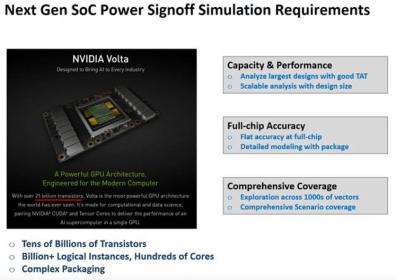
While it’s interesting to hear a tool-vendor’s point of view on the capabilities of their product, it’s always more compelling to hear a customer/user point of view, especially when that customer is NVIDIA, a company known for making monster chips.
A quick recap on the concept. At 7nm, operating voltages are getting much closer… Read More
Want to know how NVIDIA signs off on power integrity and reliability on mega-chips? Read on.
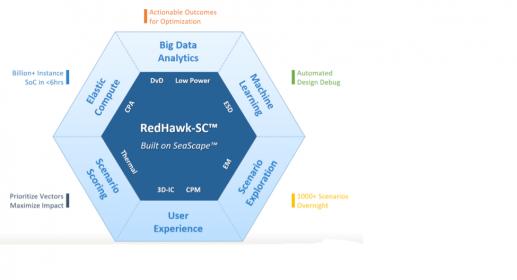
PPA over-design has repercussions in increased product cost and potential missed schedules with no guarantee of product success. Advanced SoCs pack more functionality and performance resulting in higher power density, but traditional… Read More
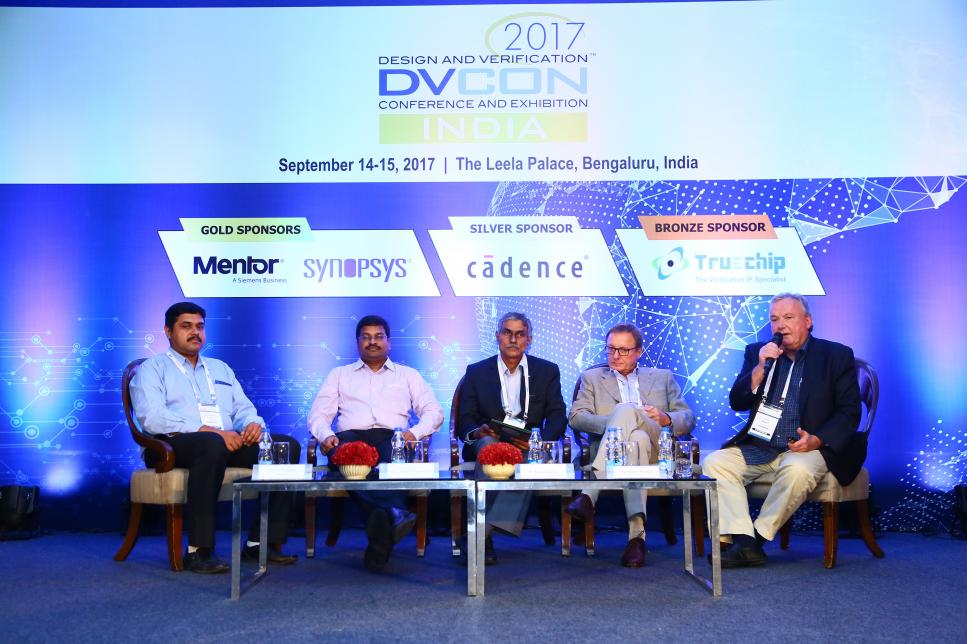
The fourth installment of DVCon India took place in Bangalore, September 14-15. As customary, it was hosted in the Leela Palace, a luxurious and tranquil resort in the center of Bangalore, and an excellent venue to host the popular event.
As reported in my previous DVCon India trip reports, the daily and evening traffic in Bangalore… Read More
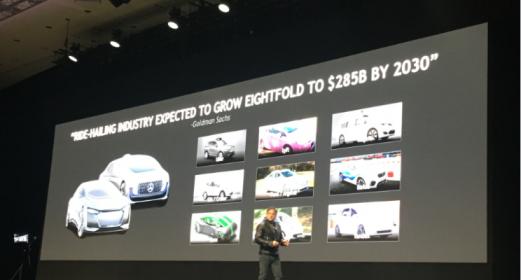
There hasn’t been this much excitement in Munich since the 1920’s. Nvidia’s great pivot was on display at the GPU Technology Conference Munich 2017. Digital dashboards are out and robotaxis are in as Nvidia narrows its focus on the tip of the automotive industry disruption spear.
To be clear, Nvidia is triangulating on the automotive… Read More
It really is an exciting time in semiconductors. The benchmarks on the new Apple A11 SoC and the Nvidia GPU are simply amazing. Even though Moore’s Law is slowing, the resulting chips are improving well above and beyond expectations, absolutely.
As I have mentioned before, non-traditional chip companies such as Apple, Amazon,… Read More
Traditionally, EDA has been a brute force methodology where we buy more software licenses and more CPUs and keep running endless jobs to keep up with the increasing design and process complexities. SPICE simulation for example; when I meet chip designers (which I do quite frequently) I ask them how many simulations they do for a … Read More
Virtualizing ICEby Bernard Murphy on 07-25-2017 at 7:00 amCategories: Cadence, EDA
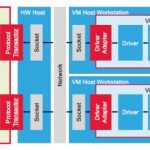
The defining characteristic of In-Circuit-Emulation (ICE) has been that the emulator is connected to real circuitry – a storage device perhaps, and PCIe or Ethernet interfaces. The advantage is that you can test your emulated model against real traffic and responses, rather than an interface model which may not fully capture… Read More
I recall back in the late 1980’s when logic synthesis tools were first commercialized, at first they could read in a gate-level netlist from one foundry then output an optimized netlist back into the same foundry. Next, they could migrate your gate-level netlist from Vendor A over to Vendor B, giving design companies some… Read More
At DAC this year you could learn a lot about hardware design for AI or Machine Learning (ML) applications. We are all familiar with the massively parallel hardware being developed for autonomous vehicles, cloud computing, search engines and the like. This includes, for instance, hardware from Nvidia and others that enable ML … Read More
When speaking before the U.S. Senate or Congress one has to choose one’s words carefully. The temptation, when one is speaking before legislators and microphones and cameras, is to tell it like it is and speak truth to power. The reality is that the power of the legislators and the microphones and the cameras must be respected and,… Read More