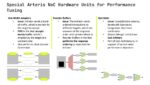
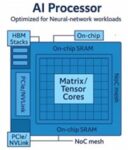
The explosive growth of AI and accelerated computing is placing unprecedented demands on system-on-chip (SoC) design. Modern AI workloads require extremely high bandwidth, ultra-low latency, and energy-efficient data movement across increasingly heterogeneous architectures. As SoCs scale to incorporate clusters of… Read More
Tag: noc
Boosting SoC Design Productivity with IP-XACT
IP-XACT, defined by IEEE 1685, is a standard that pulls together IP packaging, integration, and reuse. For anyone building modern SoCs (Systems on Chip), IP-XACT isn’t just another XML schema: it is a productivity multiplier and a risk-reduction tool that brings order to your electronic system design.
What is IP-XACT?
IP-XACT… Read More
The IO Hub: An Emerging Pattern for System Connectivity in Chiplet-Based Designs
In chiplet-based design we continue the march of Moore’s Law by scaling what we can put in a semiconductor package beyond the boundaries of what we can build on a single die. This style is already gaining traction in AI applications, high performance computing, and automotive, each of which aims to scale out to highly integrated … Read More
Arteris Expands Their Multi-Die Support
I am tracking the shift to multi-die design, so it’s good to see Arteris extend their NoC expertise, connecting chiplets across an interposer. After all, network connectivity needs don’t stop at the boundaries of chiplets. A multi-die package is at a logical level just a scaled-up SoC for which you still need traffic routing and… Read More
Arteris Raises Bar Again with AI-Based NoC Design
Modern semiconductor devices, a far cry from the chips we once knew, are now highly complex intelligent systems used in datacenters, communications infrastructure, in consumer electronics, automotive, home and office automation, almost everywhere. All such applications build around large subsystems, invariably compute,… Read More
Cadence® Janus™ Network-on-Chip (NoC)
A Network-on-Chip (NoC) IP addresses the challenges of interconnect complexity in SoCs by significantly reducing wiring congestion and providing a scalable architecture. It allows for efficient communication among numerous initiators and targets with minimal latency and high speed. A NoC facilitates design changes, enabling… Read More
Automotive Designs Have No Room for Error!
Automotive designs demand a high level of fault tolerance, and one of the methods to achieve this is to use error correcting codes (ECC). This Wikipedia page ECC Memory gives a flavor, though that article concentrates on memory and we are interested in wider applications using a form of forward error correction. This technique … Read More
Arteris is Solving SoC Integration Challenges
The difficulty of SoC integration is clearly getting more demanding. Driven by process node density, multi-chip integration and seemingly never-ending demands for more performance at lower power, the hurdles continue to increase. When you consider these challenges in the context of Arteris, it’s natural to think about hardware… Read More
Challenge and Response Automotive Keynote at DVCon
Keynotes commonly provide a one-sided perspective of a domain, either customer-centric or supplier-centric. Kudos therefore to Cadence’s Paul Cunningham for breaking the mold in offering the first half of his keynote to Anthony Hill, a TI fellow, to talk about outstanding challenges he sees in verification for automotive … Read More
Moderating Our Open Chiplet Enthusiasm. A NoC Perspective
I recently talked with Frank Schirrmeister (Solutions & Business Development, Arteris) on the state of progress to the open chiplet ideal. You know – where a multi-die system in package can be assembled with UCIe (or other) connections seamlessly connecting data flows between dies. If artificial general intelligence and… Read More