





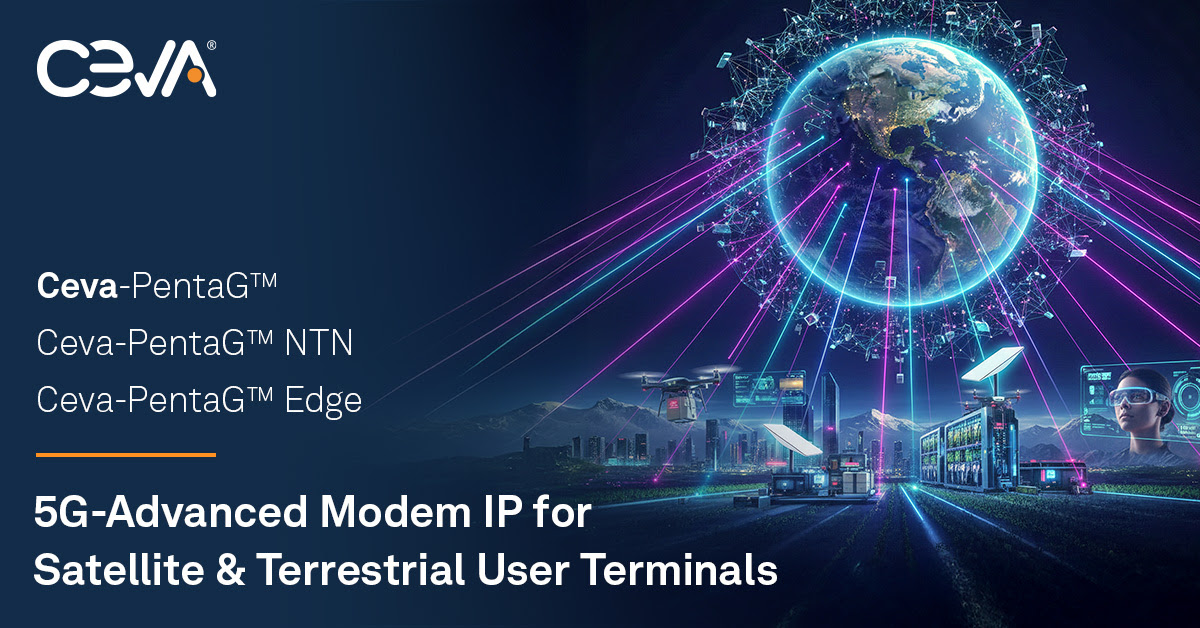
Ceva, Inc., a leading provider of silicon and software IP for the Smart Edge, has unveiled PentaG-NTN™, its groundbreaking 5G Advanced modem IP subsystem tailored for satellite user terminals in Low Earth Orbit (LEO) and Medium Earth Orbit (MEO) constellations. Announced at Mobile World Congress 2026 in Barcelona on March 3, 2026, this innovation marks a pivotal step in merging satellite and terrestrial cellular networks, enabling faster, more reliable global connectivity.
PentaG-NTN™ is the inaugural offering from Ceva’s third-generation PentaG platform, a robust, production-ready 5G-Advanced baseband architecture. This platform unifies baseband hardware accelerators, Layer 1 (L1) PHY software, and extensive verification tools into a cohesive, reusable subsystem. It serves as a versatile foundation for derivatives like PentaG-Edge™ for terrestrial 5G-Advanced edge and IoT uses. Compared to prior generations, it offers major gains in performance, scalability, and integration efficiency, supporting both satellite and ground-based deployments with up to 400 MHz bandwidth per component carrier across FR1 (sub-7 GHz) and FR2 (mmWave) bands.
The surge in satellite constellations driven by commercial ventures and government efforts for broader coverage and strategic sovereignty has intensified the push to embed 5G standards into space-based systems. Yet, 5G-Non-Terrestrial Networks (NTN) impose cellular-level complexity on an industry long focused on spacecraft, payloads, and orbital management rather than modem engineering. Satellite-native players, experts in constellation design and operations, now face the steep learning curve of 3GPP-compliant cellular basebands.
Ceva addresses this gap with PentaG-NTN™, a fully integrated, plug-and-play modem subsystem. It eliminates much of the complexity, shortens development timelines, and minimizes risks for teams without deep cellular expertise. As Jake Saunders, Vice President at ABI Research, observes, this convergence dismantles traditional satellite silos, harnessing the maturity, scale, and cost advantages of cellular ecosystems. Solutions that ease modem integration while preserving differentiation are essential for scaling 5G-NTN from prototypes to widespread commercial use.
PentaG-NTN™ is engineered for LEO’s demanding conditions, including severe Doppler shifts, timing offsets, and extended propagation delays. Key features include optimized Doppler compensation, frequency-offset mitigation, latency-tuned L1 processing for LEO/MEO channels, full 3GPP Release-18 compliance (with a roadmap to Release-19), Ka/Ku-band support, narrowband proprietary waveforms, and scalable throughput from 10 Mbps to 2 Gbps with 256-QAM modulation.
Crucially, the subsystem balances standards adherence with innovation freedom. It pairs hardware acceleration with programmable DSPs and flexible software interfaces, allowing licensees to layer proprietary algorithms, waveform enhancements, or application-specific optimizations atop the 3GPP foundation. This empowers satellite innovators to stand out in competitive markets.
Delivered as a complete modem subsystem, not mere IP blocks, PentaG-NTN™ includes optimized baseband hardware, L1 PHY software, and a thorough verification suite featuring a Virtual Platform Simulator (VPS), system-level simulations, test benches, and FPGA emulation. This enables early software validation and system testing pre-silicon, boosting predictability and speeding market entry.
Ceva estimates the third-generation PentaG platform slashes modem silicon development time by about 65% and reduces program costs by tens of millions compared to in-house builds requiring specialized R&D teams.
Guy Keshet, Vice President and General Manager of Ceva’s Mobile Broadband Business Unit, emphasizes: “5G-NTN brings cellular standards to the satellite domain, but satellite innovators shouldn’t need to become modem experts. PentaG-NTN™ lowers entry barriers with a proven, compliant foundation while enabling true differentiation.”
Bottom line: This launch underscores Ceva’s role in powering the Smart Edge, where connectivity, sensing, and inference converge. With over 20 billion devices shipped and partnerships spanning wearables, IoT, vehicles, and infrastructure, Ceva’s IP encompassing 5G, Bluetooth, Wi-Fi, UWB, and Edge AI, fuels intelligent, always-connected products. As Physical AI emerges, PentaG-NTN™ positions satellite connectivity as a seamless 5G extension, promising ubiquitous coverage and transformative applications worldwide.
CONTACT CEVA
Also Read:
Ceva IP: Powering the Era of Physical AI
Ceva Wi-Fi 6 and Bluetooth IPs Power Renesas’ First Combo MCUs for IoT and Connected Home
Ceva-XC21 Crowned “Best IP/Processor of the Year”
Share this post via:



Comments
There are no comments yet.
You must register or log in to view/post comments.