






The semiconductor industry is undergoing a profound transformation as system complexity, performance expectations, and time-to-market pressures continue to rise. Traditional monolithic system-on-chip (SoC) designs are increasingly giving way to modular, chiplet-based architectures that enable flexibility, scalability, and faster innovation cycles. Within this evolving landscape, the collaboration between Menta and Arteris illustrates how a scalable NoC strategy can serve as the backbone of a modular silicon platform.
Founded in 2007, Menta has established itself as a pioneer in eFPGA IP, delivering highly configurable programmable logic solutions for integration into SoCs and ASICs. Its focus on measurable performance gains, power efficiency, and long-term sustainability has positioned the company strongly in high-value embedded markets such as edge AI, robotics, industrial automation, and smart vision systems. As system requirements expanded, Menta recognized the need for a more advanced integration framework capable of supporting heterogeneous chiplets across multiple generations and configurations.
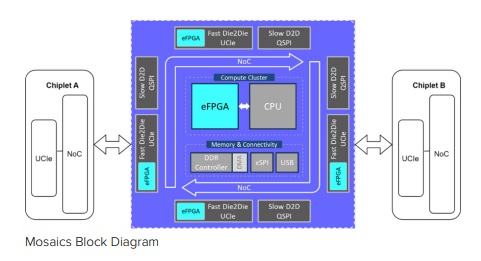
This vision materialized in the MOSAICS platform, a modular chiplet-based architecture designed to rethink how custom silicon systems are built and deployed. At the center of this platform is the MOSAICS Hub, delivered as a Known Good Die to ensure predictable system integration. The Hub orchestrates communication among diverse chiplets, enabling system-in-package designs with significantly reduced risk. The platform promises up to ten times lower system costs and up to four times faster time-to-market, reflecting a strong emphasis on scalability and ecosystem enablement.
However, realizing this vision required overcoming significant technical challenges. A chiplet-based architecture demands a robust on-chip communication infrastructure capable of managing both bandwidth-intensive data transfers and latency-sensitive control transactions. The interconnect must scale across multiple chiplet generations while maintaining performance, area efficiency, and power constraints. Additionally, it must integrate seamlessly with a wide range of initiators and targets without increasing redesign effort or integration risk.
To address these requirements, Menta selected FlexNoC® interconnect IP from Arteris as the communication backbone of the MOSAICS Hub. FlexNoC is a silicon-proven, highly configurable NoC solution designed to optimize data movement in complex SoCs. By leveraging FlexNoC, Menta implemented a high-performance interconnect capable of supporting more than 30 initiators and targets operating at frequencies exceeding 500 MHz. This architecture enabled the team to balance scalability, performance, and silicon efficiency while accommodating diverse traffic profiles within a single coherent framework.
The configurability of FlexNoC proved particularly valuable. In a heterogeneous chiplet environment, predictable QoS, error detection and correction, and future functional safety capabilities are essential, especially for high-end HPC and AI applications in data centers. FlexNoC’s mature feature set provided these capabilities while integrating smoothly into Menta’s existing design framework. This reduced engineering complexity and minimized integration risk across the broader MOSAICS roadmap.
Another key benefit was accelerated development. The ease of configuration and integration allowed Menta’s engineering team to rapidly prototype, test, and validate the NoC implementation. Faster iteration cycles translated directly into reduced development timelines and improved confidence in meeting both performance and area targets. For a platform aimed at edge AI and other demanding embedded markets, this agility is critical.
The results demonstrate that a well-architected NoC foundation is more than a technical component, it is a strategic enabler. By standardizing on a scalable interconnect solution, Menta established a communication fabric capable of evolving alongside its chiplet ecosystem. This foundation supports current deployments while providing flexibility for next-generation platforms, new customer configurations, and emerging market requirements.
Bottom line: MOSAICS represents more than a single product initiative. It introduces a new model for designing and delivering custom silicon through modularity, ecosystem collaboration, and silicon-proven building blocks. The partnership between Menta and Arteris underscores the importance of strong technology alliances in achieving this vision. By combining programmable logic innovation with a scalable, power-efficient NoC architecture, the companies have laid the groundwork for a new generation of chiplet-based systems that are faster to develop, easier to integrate, and built for long-term scalability.
Also Read:
Arteris Smart NoC Automation: Accelerating AI-Ready SoC Design in the Era of Chiplets
WEBINAR: Why Network-on-Chip (NoC) Has Become the Cornerstone of AI-Optimized SoCs
The IO Hub: An Emerging Pattern for System Connectivity in Chiplet-Based Designs
Share this post via:



Comments
There are no comments yet.
You must register or log in to view/post comments.