





At lower frequencies with simpler modulation, RF power amplifier (PA) designers could safely concentrate on a few primary metrics – like gain and bandwidth – and rely on relaxed margins to ensure proper operation in a range of conditions. Today’s advanced RF PA design is a different story. mmWave and sub-THz frequencies introduce complex effects. Extremely wide bandwidths stress performance. Higher-order digital modulation tightens margins. Designers often face the challenge of improving one metric while degrading others, suggesting that evaluating metrics simultaneously under authentic conditions is essential.
Keysight launched a two-part masterclass on RF PA design, featuring online webinars highlighting the greater role of complex layout and accurate modeling in Keysight Advanced Design System (ADS), coupled with Keysight RF Circuit Simulation Professional and its programmatically-callable simulator. The first session introduces the concept of power waves and a vector network analysis (VNA)-inspired load-pull analysis via simulation, using a- and b-waves for high-fidelity active characterization. The second session will delve into improving PA efficiency, extending load-pull analysis for multi-performance optimization, and using simulation data to improve artificial neural network (ANN) modeling for more accurate representations.
Evolving from measured to simulated load-pull analysis
At its core, load-pull analysis evaluates PA performance under varying load and source conditions. It traces its roots to scalar measurements using simple input signals and power meters, essentially characterizing a few operating points at a designer’s discretion. Complexity rapidly undermines the value of a scalar approach, with too many interactions and too few data points to provoke and observe anomalous behavior.
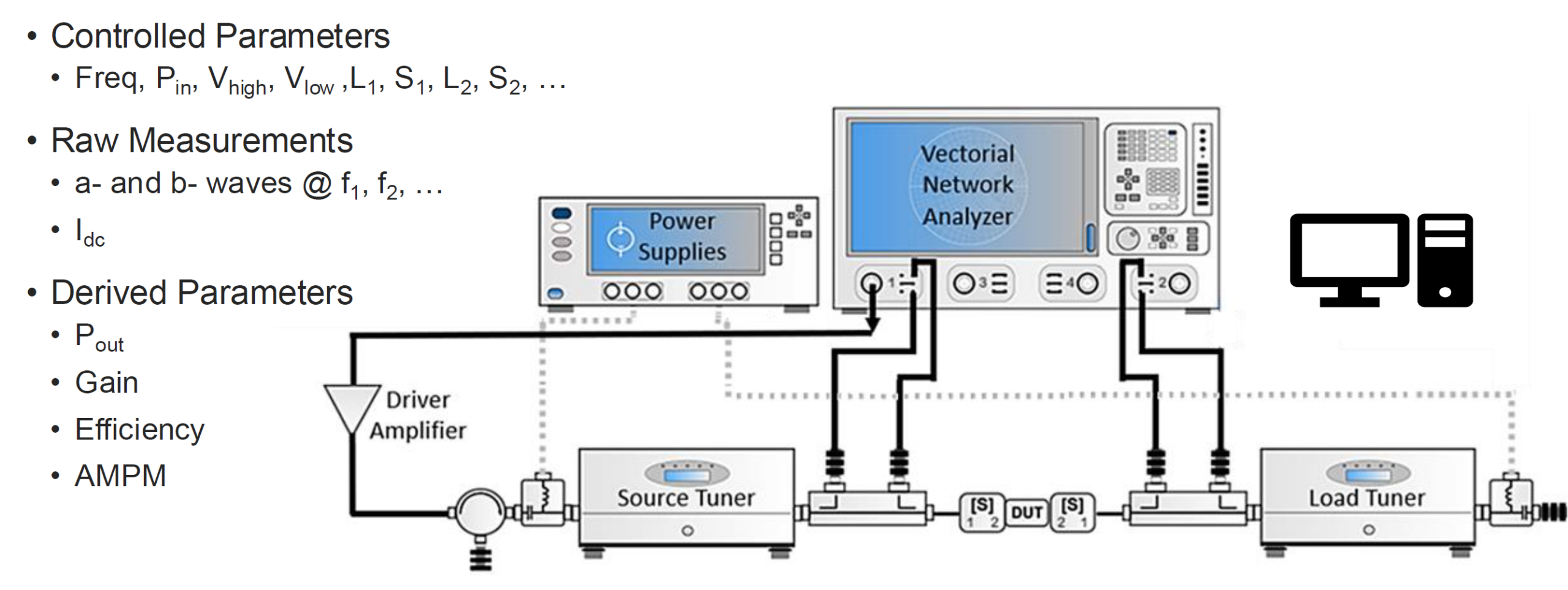
An improved approach is vector load-pull analysis, which leverages sophisticated VNAs to enable control, measurement, and derivation of more critical PA parameters in fewer passes. Schematically, vector load-pull analysis looks like this:
While capturing parameters unavailable in scalar testbenches, some VNA measurements remain tedious to set up, lengthy to execute, and can be difficult to repeat. Physical VNA techniques, limited to visibility at the input and output, also don’t capture what’s happening inside the PA at the transistor level under various conditions.
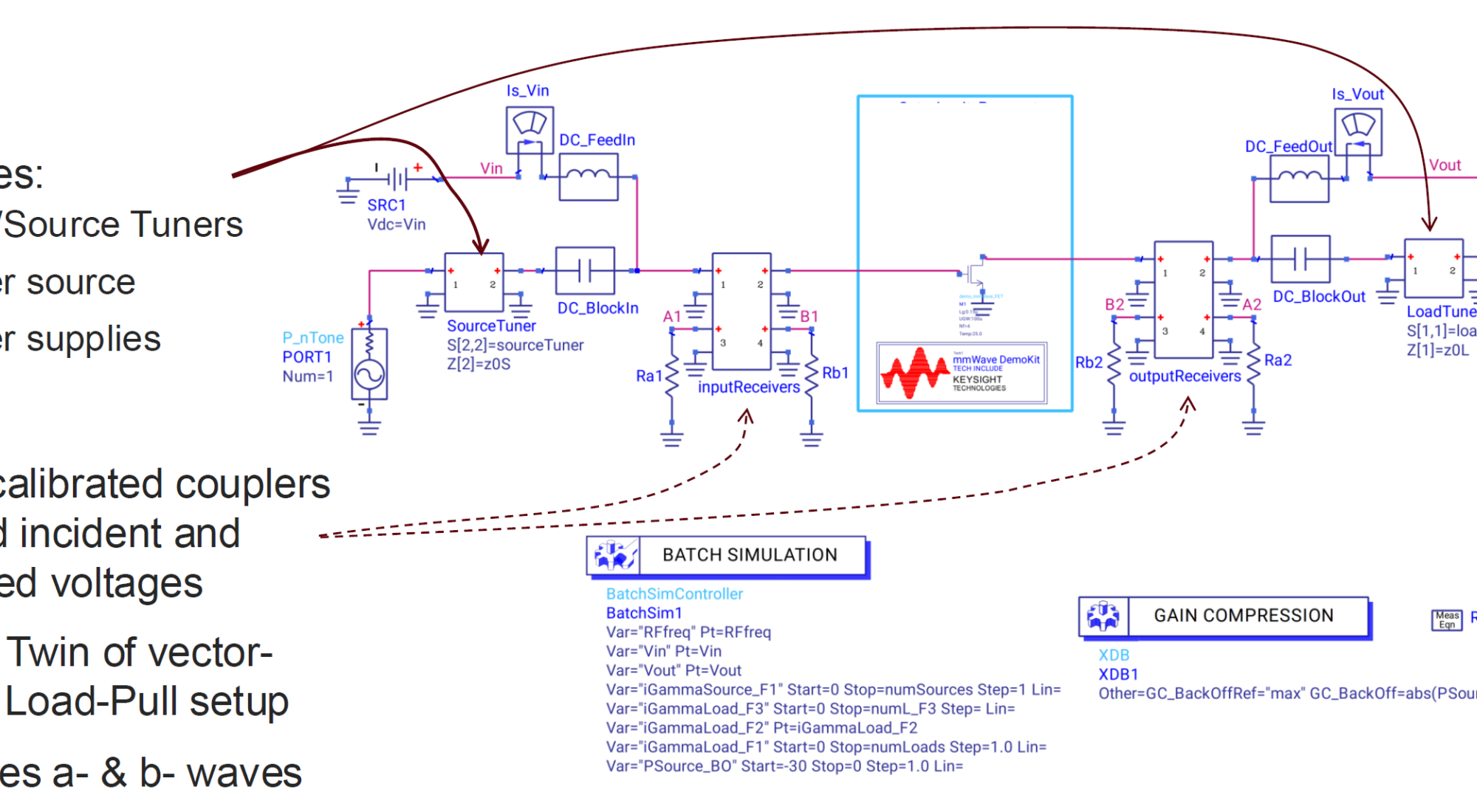
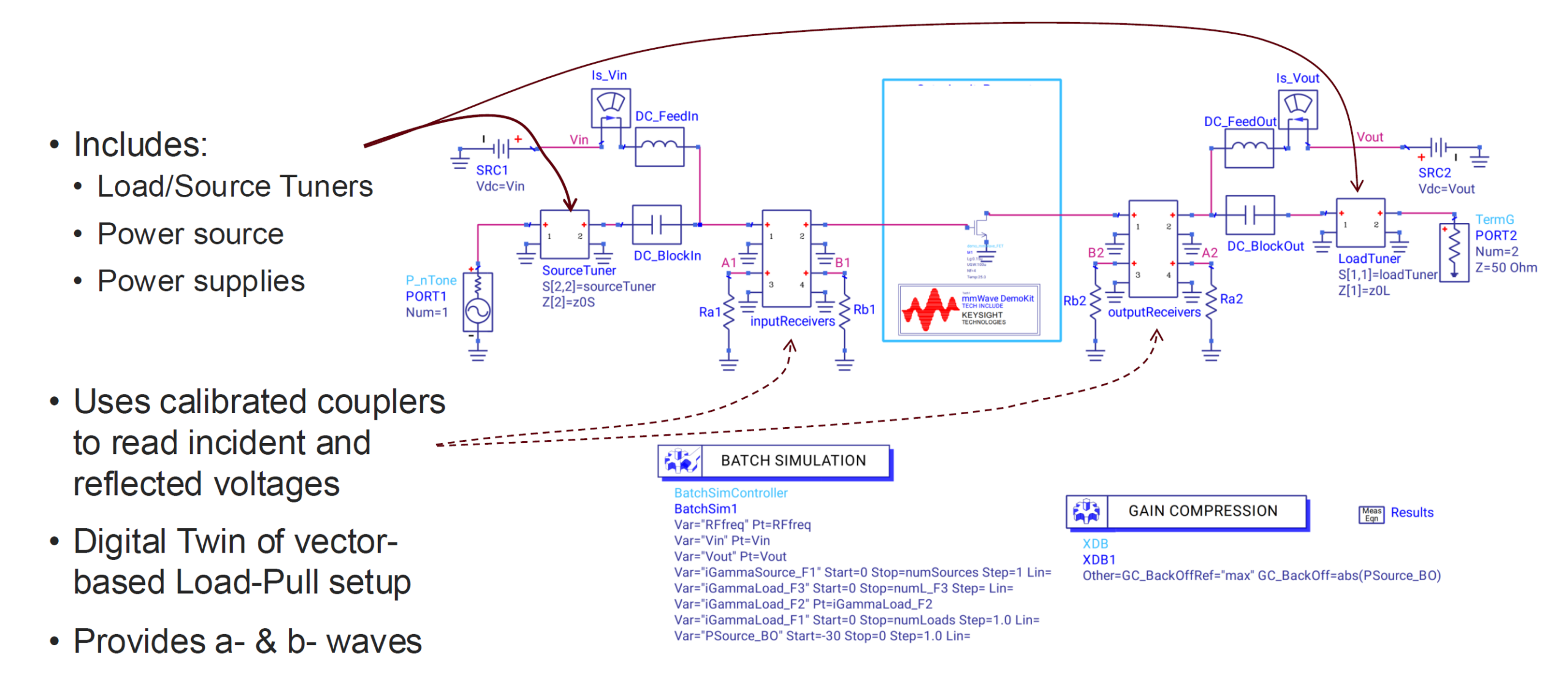
Active load-pull analysis via simulation is a state-of-the-art technique that draws inspiration from the VNA setup, borrowing measurement algorithms pioneered in hardware by researchers for simulations that run orders of magnitude faster in software. A basic setup in Keysight ADS for VNA-inspired load-pull analysis looks like this:
More advantages to a simulated load-pull approach
There are several more advantages to simulated load-pull analysis in a highly accurate environment, such as ADS with RF Circuit Simulation Professional. Incorporating a- and b-waves instantly adds fidelity. Simulation can easily handle many more degrees of freedom, generating complex sweeps and contours. Using Python, designers can set up spiral, circular, and rectangular shapes for impedance sweeps. Simulation can also perform 2D interpolation, reducing the need for dense sweeps.
Other types of analysis can augment load pull. One insightful analysis, which can run separately or together with load pull, is gain compression. Sweeps of input power at back-off values (set by the user) reveal important insights into PA characterization. Designers can also jump back and forth between their preferred data displays – for instance, switching between rectangular and Smith charts, or drilling down to any parameter. Optimization routines in Python that call simulation sequences can quickly explore multivariate contours.
A design in ADS can grow into a digital twin of an RF PA, enabling designers to study discrepancies and refine models. Load-pull simulation data serves as training data for artificial neural network (ANN) device models, producing highly accurate representations of PA behavior in minutes rather than the weeks of effort normally required, with more modeling detail.
A look ahead to using intrinsic techniques for efficiency
Those last two ideas, deeper analysis for optimization and ANN modeling enhancement, including a look at system-level metrics like EVM, are the primary focus for the second session of this RF PA design series. It will build on the power wave load-pull technique, with more detail on digital twin setup and ideas such as harmonic-matching networks. By registering (link below), you’ll gain access to the first session on Why Use the Power Wave Load-Pull Technique on demand, which will prepare you for the second session on Why Use Intrinsic Techniques for High-Efficiency PA Design coming in April.
One question that came up during the first session is whether viewers can access the demo workspace presenters show. Yes, the ADS workspace is available online in the Keysight EDA Knowledge Center, so users with ADS and RF Circuit Simulation Professional (in licensed or free-trial versions) can follow along at work. There are also downloadable supplementary documents with design guides, application notes on PA design, and more.
Registration for this Keysight webinar series is now open:
RF Power Amplifier Design MasterClass Webinar Series
Also Read:
On the high-speed digital design frontier with Keysight’s Hee-Soo Lee
2026 Outlook with Nilesh Kamdar of Keysight EDA
From Silos to Systems, From Data to Insight: Keysight’s Upcoming Webinar on EDA Data Transformation
Share this post via:



Comments
There are no comments yet.
You must register or log in to view/post comments.