You are currently viewing SemiWiki as a guest which gives you limited access to the site. To view blog comments and experience other SemiWiki features you must be a registered member. Registration is fast, simple, and absolutely free so please,
join our community today!
WP_Term Object
(
    [term_id] => 178
    [name] => IP
    [slug] => ip
    [term_group] => 0
    [term_taxonomy_id] => 178
    [taxonomy] => category
    [description] => Semiconductor Intellectual Property
    [parent] => 0
    [count] => 1994
    [filter] => raw
    [cat_ID] => 178
    [category_count] => 1994
    [category_description] => Semiconductor Intellectual Property
    [cat_name] => IP
    [category_nicename] => ip
    [category_parent] => 0
    [is_post] =>
)
Dan is joined by Michal Siwinski, Chief Marketing Officer for Arteris IP. Arteris provides network-on-chip interconnect semiconductor IP and deployment technology to accelerate SoC development and integration for a wide range of applications from AI to automobiles, mobile phones, IoT, cameras, SSD controllers, and servers.… Read More
The latest advanced driver-assistance systems (ADAS) like Mercedes’ Drive Pilot and Tesla’s FSD perform SAE Level 3 self-driving, with the driver ready to take back control if the vehicle calls for it. Reaching Level 5 – full, unconditional autonomy – means facing a new class of challenges unsolvable with existing technology… Read More
The tremendous amount of data generated by AI/ML driven applications and other hyperscale computing applications have forced the age old server architecture to change. The new architecture is driven by the resource disaggregation paradigm, wherein memory and storage are decoupled from the host CPU and managed independently… Read More
Way back in the early 2000s when XAUI was falling short on link flexibility a search for an alternative chip-to-chip data transfer interface with SPI like features lead Cisco Systems and Cortina System to put forward the proposal for the Interlaken standard. The new standard married the best of XAUI’s serialized data and SPI’s … Read More
Since 2012, Dr. Jan Peter Berns is the CEO of Hyperstone, a producer of Flash Memory Controllers for Industrially Embedded Storage Solutions. Before that, he held a Senior Manager Position at Toshiba Electronics for several years. Jan Peter brings more than 20 years of management and executive experience in the semiconductor… Read More
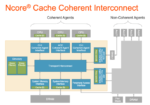
Ever wonder why coherent networks are needed beyond server design? The value of cache coherence in a multi-core or many-core server is now well understood. Software developers want to write multi-threaded programs for such systems and expect well-defined behavior when accessing common memory locations. They reasonably expect… Read More
3D IC technology development started many years ago well before the slowing down of Moore’s law benefits became a topic of discussion. The technology was originally leveraged for stacking functional blocks with high-bandwidth buses between them. Memory manufacturers and other IDMs were the ones to typically leverage this … Read More
As embedded systems continue to become more complex and integrate greater functionality, SoC developers are faced with the challenge of developing more powerful, yet more energy-efficient devices. The processors used in these embedded applications must be efficient to deliver high levels of performance within limited power… Read More
While the ASIC market has always had its advantages over alternate solutions, it has faced boom and bust cycles typically driven by high NRE development costs and time to market lead times. During the same time, the FPGA market has been consistently bringing out more and more advanced products with each new generation. With very… Read More
Whether we realize it or not, everyday applications we use depend on data gathered by sensors. We can bet that pretty much every application uses at least a couple of different types of sensors, if not more. That is because different types of sensors are better suited to collect data depending on the application, the environment … Read More








Musk’s Orbital Compute Vision: TERAFAB and the End of the Terrestrial Data Center