





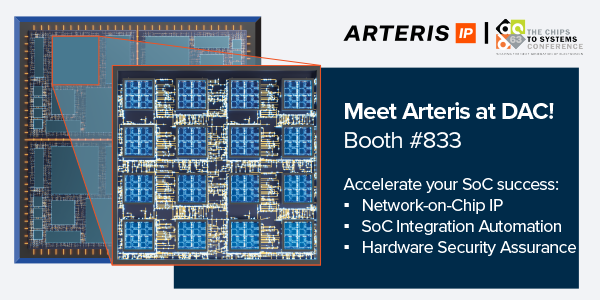
The semiconductor industry has entered a new era as AI workloads, chiplets, heterogeneous computing, software-defined vehicles, and intelligent edge devices are transforming how chips are designed.
Silicon success is no longer determined by transistor counts alone, but by how efficiently data moves across increasingly complex systems, how quickly sophisticated SoCs can be integrated, and how confidently security can be built into the silicon from day one.
For more than two decades, Arteris has helped the world’s leading semiconductor companies solve some of the industry’s most difficult design challenges. Today, the company’s portfolio spans three foundational technologies that have become increasingly interconnected as silicon grows more sophisticated:
- Connect: Network-on-chip (NoC) interconnect IP for optimized on-chip data movement.
- Integrate: System integration automation to simplify complex SoC development.
- Secure: Hardware security assurance that helps engineers identify vulnerabilities before tape-out.
Together, these technologies enable engineering teams to develop higher-performance, more scalable, and more secure silicon while reducing design effort, integration risk, and time to market. More than 950 design starts and 4 billion devices shipped demonstrate the industry’s confidence in Arteris technology and expertise.
At DAC 2026, visitors to Booth #833 will see how this approach supports the industry’s most demanding applications, including AI infrastructure, hyperscale data centers, automotive systems, industrial automation, communications, edge AI, and advanced chiplet and multi-die architectures.
As design complexity continues to accelerate, Arteris helps engineering organizations optimize data movement, simplify system integration, and build trusted silicon without compromising performance or development schedules.
Beyond the booth, Arteris experts will participate in the DAC panel and industry roundtables discussing hardware security assurance, AI-assisted semiconductor design, and the future of multi-die and chiplet architectures. These sessions reflect Arteris’ ongoing role in helping shape many of the industry’s most important technology conversations.
On July 27, 2:00 PM-2:45 PM, join Michal Siwinski, Chief Product & Marketing Officer at Arteris, and the industry leaders from Caspia Technologies, Graf Research and Crypto Quantique for a panel discussion on the topic of “From RTL to Reality: Building Security into the Silicon Lifecycle”.
Whether you’re an SoC architect, engineering manager, silicon security specialist, semiconductor executive, or technology partner, visit our talks or Booth #833 to discuss the technologies shaping the next generation of semiconductor design and discover how Arteris is helping the world’s leading companies connect innovation for silicon success.
Book a meeting with the team here.
Also Read:
Apple’s planned $30 billion-plus chip-supply agreement with Broadcom marks a significant step in the company’s effort to localize more of its semiconductor supply chain in the United States. According to Reuters, the multi-year deal extends through 2031 and centers on U.S.-made wireless and radio-frequency components, including FBAR filters used to support connectivity functions in Apple devices such as 5G, Wi-Fi, Bluetooth and GPS.
From a technical-supply perspective, the agreement strengthens Apple’s access to specialized RF front-end components, which are critical for signal filtering, power efficiency and reliable wireless performance in compact consumer electronics. Broadcom will invest about $1.5 billion to expand its Fort Collins, Colorado facility, with the program expected to produce at least 15 billion chips.
The deal also reflects Apple’s broader strategy of diversifying semiconductor sourcing while increasing domestic manufacturing exposure. Although Apple’s most advanced application processors and memory components remain tied to global foundries and suppliers, RF chips are a practical category for U.S. capacity expansion because they rely on specialized manufacturing processes and long-term qualification cycles. Locking in supply through 2031 gives Apple greater control over component availability, reduces geopolitical and tariff-related risk, and supports closer collaboration with Broadcom on custom silicon requirements.
For Broadcom, the agreement deepens its role as a strategic Apple supplier and justifies capital investment in domestic capacity. For Apple, it is both a supply-chain resilience move and a policy-aligned investment in U.S. semiconductor production.
Also Read:
Connecting the Dots: Why RISC-V System Design Is Entering a New Era
Scalable Network-on-Chip Enables a Modular Chiplet Platform
Share this post via:



Comments
There are no comments yet.
You must register or log in to view/post comments.