webinar banner AI 2026 v2

Changes Coming at the Top in Semiconductor Equipment Ranking

Changes Coming at the Top in Semiconductor Equipment Ranking
by Robert Castellano on 12-10-2018 at 12:00 pm

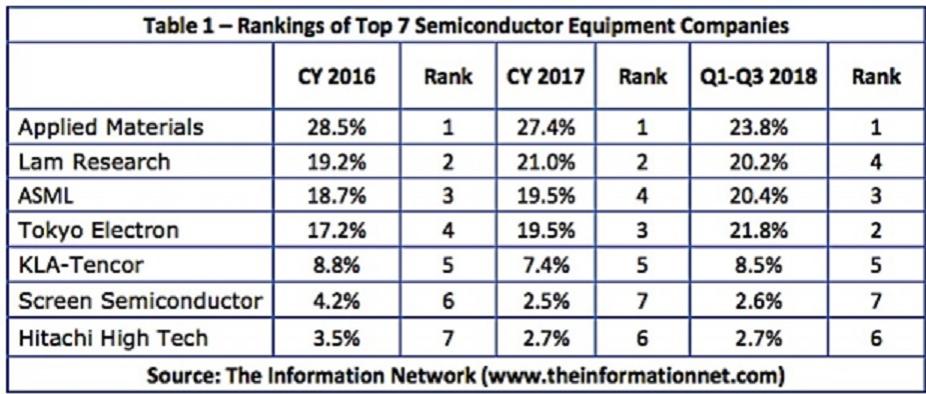
Semiconductor equipment vendor ranking, which didn’t change much between 2016 and 2017, is undergoing a makeover, as Lam Research, ASML, and Tokyo Electron (TEL) are switching places and top-ranked Applied Materials is getting closer to losing its number one ranking.

Since the 1990s, Applied Materials has been the market leader in the semiconductor equipment space. Previously, Japan’s TEL was the market leader going back to 1989. TEL, which was No. 4 in 2016 is now No. 2 through the first three quarters of 2018. But most important, the spread between the No. 1 and No. 2 companies is rapidly shrinking.

In 2016, Applied Materials was 9.3 share points ahead of Lam Research. In 2017, Applied’s lead dropped to 6.4 share points ahead of Lam. Now, through the first three quarters of 2018, Applied’s lead has shrunk to just 2 share points ahead of TEL.

An important takeaway is that Applied Materials is the only company that lost market share sequentially in each of the time periods, while ASML and TEL were the only two companies that sequentially increased market share in the periods.

More Headwinds Coming
The semiconductor equipment market grew from $41.2 billion in 2016 to $56.6 billion in 2017, an increase of 37.2%. For the first three quarters of 2018, global revenues increased 19.4%. Assuming a growth of 10% for all of 2018, revenues for Q4 2018 should only reach $12.7 billion, down 15.2% YoY from Q4 2017. Chart 1 plots semiconductor market between 2015 and 2018 on a quarterly basis.

Much of the growth in equipment came from Korean semiconductor manufacturers, particularly memory companies Samsung Electronics and SK Hynix. In 2017, Korea represented 31.7% of the $56.6 billion semiconductor equipment sector. Through the first three quarters of 2018, Korea accounted for 29.4% of the global market.

Demand in the server, PC, and mobile markets is weaker than it was earlier in the year, and memory prices are softening in the near term. Because of a drop in average selling prices of DRAMs and NAND, memory companies are pushing out capex spend. Samsung Electronics said the addition of 20,000-30,000 wafers/month of DRAM capacity at the Pyeongtaek plant’s second floor will be postponed to 2020 in order to maintain profitability along with strategic inventory controls.

If margins decrease, Samsung will likely delay a 2019 planned NAND capacity expansion of 30,000 wafers per month on the second floor of Pyeongtaek #1 plant and at its Xian #2 plant to 2020.

While all semiconductor equipment suppliers tout the memory companies among its customers, Applied Materials and Lam Research have high exposure to memory. In its most recent quarter ending October 2018, Applied reported that 60% of its revenue came from the memory sector.

TSMC has also reduced its capital spending outlay for the year, due to weaker than expected sales in iPhones, where it supplies the processor chip, and because the collapse in cryptocurrencies

Applied Materials competes against all equipment companies listed in Table 1 except lithography ASML. ASML is the sole supplier of EUV (extreme ultra violet) lithography equipment. EUV is supposed to slowly replace DUV immersion lithography as the industry moves to the 7nm technology node.

The replacement of DUV immersion by EUV will dramatically reduce deposition, etch, and metrology steps. Current DUV immersion is viable for processing devices with 30nm features. Below that, engineers employ multiple patterning steps as a way of extending the DUV lithography tool. These multiple processing steps are deposition-etch intensively, utilizing equipment from AMAT and LRCX (and others). In other words, semiconductor manufacturers are utilizing multiple patterning processes, requiring extensive use of deposition and etch equipment, to avoid purchasing the extremely expensive EUV lithography equipment.

If we look at Chart 2, using immersion DUV (ArF-1) at the 20nm node there are 13 mask layers, etch of which use multiple dep-etch steps. If we move across the top of the chart, at 10nm there are 18 mask layers, an increase of 50% in the use of deposition-etch steps.

Chart 2

Multiple patterning at the 7nm node, as shown in the bottom left of the chart, requires 27 mask layers. However, by switching to EUV (bottom right) at 7nm, only 14 mask layers are required, similar to the 20nm node with DUV.

As for the terminology, switching from DUV to EUV, the double litho, double etch (LELE) process will be eliminated while ArF-I (immersion DUV) would continue to be used for the self-aligned double patterning (SADP) and self-aligned quadruple patterning (SAQP) processes. Most importantly, half the processing steps will be eliminated.

A combination of all these headwinds are significant detriments to the sustained growth of the semiconductor equipment market in 2019. According to The Information Network’s report “The Global Semiconductor Equipment: Markets, Market Shares and Market Forecasts,” that means global equipment revenues could drop 8%.


IEDM 2018 Trip Report!

IEDM 2018 Trip Report!
by Daniel Nenni on 12-10-2018 at 7:00 am

Hello, my name is Daniel Nenni and I am a semiconductor conference addict. I just can’t seem to get enough. The semiconductor ecosystem is very wide now and moves so quickly it is nearly impossible to keep up without constant conference attendance. As a SemiWiki contributor not only do I get free conference passes, I get access to people and materials that help feed my insatiable appetite for semiconductor information. The world really does revolve around semiconductors and now me personally since I know all that is semiconductor, absolutely.

Premier SemiWiki blogger Scott Jones also attended IEDM and will have more detailed blogs coming soon.

About IEDM
With a history stretching back more than 60 years, the IEEE International Electron Devices Meeting (IEDM) is the world’s pre-eminent forum for reporting technological breakthroughs in the areas of semiconductor and electronic device technology, design, manufacturing, physics, and modeling. IEDM is the flagship conference for nanometer-scale CMOS transistor technology, advanced memory, displays, sensors, MEMS devices, novel quantum and nano-scale devices and phenomenology, optoelectronics, devices for power and energy harvesting, high-speed devices, as well as process technology and device modeling and simulation. The conference scope not only encompasses devices in silicon, compound and organic semiconductors, but also in emerging material systems. IEDM is truly an international conference, with strong representation from speakers from around the globe.

As I mentioned before, IEDM is the premier semiconductor process technology conference. This year the theme is Device Breakthroughs from Quantum to 5G and Beyond. One of the more interesting topics to me was Interconnects to Enable Continued Scaling with papers from ARM, IBM, IMEC, UT Austin, GlobalFoundries, Stanford, and AMAT. This is a must read for those of you who think Moore’s Law (which is actually an observation) and semiconductor scaling is at an end, because it is not, not even close.

There was also an interesting session on 3D integration: High Density Stacked FinFETs and 3D integration of 2D memory. Memory technology was a major focus (especially MRAM), and rightly so, but I did not have time for it unfortunately. Photonics also made it into the program which is a good thing. We track photonics related content on SemiWiki and have seen a significant rise in content and readership in 2018.

Based on my time mingling amongst the crowd I was happy to see a lot of young faces. IEDM is clearly doing a great recruitment job. The old guard, me included, always wonders who will replace us as time goes by. Based on what I saw this week I think we are in good hands, no problem.

The one criticism I do have is the exhibit hall. It was pretty lame to which I say why even have one at all? Seriously, a complete waste of precious space. If a vendor wants exposure make them write papers and rent hotel suites for more intimate conversations. Leave the exhibit halls to the user group meetings and less technical conferences like CES, my opinion.

We can have an IEDM discussion in the comments section if you like. I have copies of the presentations and conference proceedings for reference.


GM: Stop the Downsizing!

GM: Stop the Downsizing!
by Roger C. Lanctot on 12-10-2018 at 7:00 am

General Motors CEO Mary Barra is known for a number of quotes one of which is: “My father was a die maker for 39 years, so I had a basic understanding of the automobile industry and what the manufacturing world was like, just from the opportunity to spend time with him, just talking, because he was a car buff.” One has to wonder what Mary’s dad would have so say about the latest news out of GM.

Two major press events preceded this year’s Los Angeles Auto Show and AutomobilityLA. The first event arrived the Friday before the Show following the Thanksgiving holiday bringing news of a government report revealing catastrophic human-influenced climate change. On Monday, General Motors announced its plans to idle or close five plants (four in the U.S. and one in Canada), layoff 14,000 workers and terminate five sedans: the Chevrolet Cruze, Volt and Impala, Buick LaCrosse and Cadillac CT6.

The catastrophic climate report was notable for its release occurring on a Friday in the middle of a holiday. Journalists commented that the decision was clearly taken by the Trump administration to dump the report on a Friday to ensure that it received as little attention as possible.

In contrast, the GM announcement came on the Monday following the holiday weekend and preceding the L.A. Auto Show guaranteeing widespread press attention and analysis. The decision was clearly a calculated one as GM’s stock price rose nearly 5% on the news, as investors rewarded GM’s apparent fiscal prudence.

Unfortunately, the decision to release the announcement on Monday also revealed GM’s priorities. In spite of anything GM’s leadership might have to say about its employees or its customers, the top priority is clearly investors.

In spite of GM’s best efforts, though, the stock hasn’t budged much from its IPO price. The latest bump, like those that have preceded it, will rapidly fade and fall.

GM’s massive market retreat has been underway since the government bailout and bankruptcy approximately 10 years ago. At that time GM, along with Chrysler, used the opportunity of bankruptcy to justify the termination of 3,389 dealers.

Terminating dealers seems like a counter-intuitive strategy for a company planning to emerge from bankruptcy and needing to sell more cars. But as Tammy Darvish, author of “Outraged,” describes it, the move was clearly intended to reduce inter-dealer competition and goose profit margins.

GM has continued to pursue higher vehicle prices and profits by dialing back on incentives. It remains unclear as to precisely how sustainable that strategy will be. GM’s profit-driven market manipulations have plunged the company to fifth place globally based on vehicle production – well behind Hyundai and slightly ahead of Ford.

The pursuit of profit has contributed to decisions to close plants in Australia, Indonesia, India and Russia while pulling out of the European market by selling Opel to PSA. Other market exits included India, South Africa, and Russia.

The company has also bought back $10B in stock since 2015. Investors have questioned the purpose or wisdom of these buybacks – normally done to increase the stock price – since the stock has shown little movement.

Meanwhile GM has been sinking hundreds of millions of dollars into Cruise Automation and launching the Maven car sharing service. The company line on this mix of exits and investments is that GM is investing in the future, preparing for a shared, autonomous, electric vehicle future.

But it is difficult for the company to escape the logic that its strategy of focusing on profitable operations and cutting off unprofitable ones directly contradicts its investment strategy of pouring money into ventures with uncertain prospects. Both Maven and Cruise are facing mixed results with Maven expansion plans on hold and Cruise failing to meet critical milestones on the path to autonomous operation.

The biggest and most dubious claim of all at GM – and it is one that is shared by Ford Motor Company – is the company’s almost complete exit from the passenger car market – joining FCA and Ford in focusing on SUVs, crossovers and pickup trucks. GM, like its Detroit competitors, blames a lack of consumer interest in passenger cars and a correlated decline in sales.

GM, Ford and FCA make much more money selling SUVs, crossovers and pickups than they do selling cars. So it is logical to want to make more of these large vehicles and less of smaller, passenger vehicles.

This myopic profit-driven strategy is effectively painting the three Detroit OEMs into a marketing corner. A trucks-and-SUVs-only strategy makes all three of these auto makers more vulnerable than ever to imports and domestically manufactured trucks and SUVs from import makes.

What is perhaps most stunning, though, is GM’s decision to terminate the Volt. It’s easy to make the case that sales of the Volt failed to meet the 30k/month goal originally intended, but it is also easy to make the case that GM never fully funded the market funnel to drive demand.

Car makers often paint themselves as the sad victims of market forces and lagging demand. The reality is that car makers spend billions of dollars telling consumers what cars they “want” or “need.” Consumer demand is not occurring in a vacuum.

The Volt extended range EV has consistently produced some of the most amazing customer satisfaction scores ever seen by General Motors. Volt evangelists are legion, yet GM has somehow failed to embrace these brand ambassadors and leverage them to build a stronger footing in the EV market.

Now GM is terminating the Volt – or so it seems. Such a move represents an extraordinary destruction of market value comparable only to GM’s sales of Opel to PSA.

It’s not too late for GM to turn in the direction of the skid and get itself back on track. Of course, the Trump administration won’t make that easy with threats of suspending GM’s EV subsidies and slapping tariffs on cars imported from GM factories in China.

It’s time for GM to take a greater interest in its customers, its dealers, and its workers and, for at least a quarter or two, tell Wall Street to take a hike. It’s time to get back to basics – get back to the product.

With the passing of FCA CEO Sergio Marchionne and the ousting of Renault-Nissan-Mitsubishi Chairman Carlos Ghosn the stage is clear for a real game changer, GM’s Mary Barra. It’s time for Barra to take her place as the leading voice of the global automotive industry – an industry that needs a more inspiring vison than the prospect of endless downsizing that has unfolded under her guidance thus far.

Another one of Mary Barra’s noted quotes is: “My definition of ‘innovative’ is providing value to the customer.” Right on, Mary.


Volvo: Car-less is Better Than Clueless

Volvo: Car-less is Better Than Clueless
by Roger C. Lanctot on 12-09-2018 at 7:00 am

Sweden has embraced the movement toward a cashless society with banks no longer taking cash deposits and retailers, like Ikea, experimenting with cashlessness. Perhaps taking a cue from the Swedish financial sector, Volvo Cars last week revealed its plans for a car-less stand at this week’s L.A. Auto Show – and the co-located AutomobilityLA.

Volvo’s announcement shines a light on Swedish thought leadership at a time when competing car companies babble incoherently about so-called “mobility.” The car-less stance is in keeping with Volvo’s visionary past which emphasized safety before it was sexy and years-ago gave a yet-unmatched promise to accept crash liability once autonomous driving is achieved.

From General Motors to Ford Motor Company to Toyota and Volkswagen, auto CEOs struggle to redefine their missions in an industry on the cusp of massive disruption. Simultaneously, politicians are at war with cars, car owners and car makers around the world (water cannons and tear gas in Paris this past weekend along over higher fuel taxes) putting pressure on car makers to pave the path to peace.

For Volvo, that path means exploring alternatives to vehicle ownership along with developing creative ways of using cars. “We are trying to shift our focus from doing what we have done for the last 90 years,” Volvo Senior Vice President of Corporate Strategy Marten Levenstam, purported mastermind behind the Volvo exhibit, told Automotive News.

The Automotive News reported that Volvo will use its display area for interactive demonstrations of connectivity services, such as in-car delivery, its vision for autonomous driving and its Care by Volvo vehicle subscription service. The stand will also show Volvo’s plans for car sharing.

Volvo’s CEO, Hakan Samuelsen, added that the company wants to move beyond simply building and selling cars. In its quest for redefinition, Volvo has partnered with Amazon, Google, Nvidia, Luminar and Zenuity.

It is difficult to overstate the significance of Volvo’s move coming at the L.A. Auto Show. At a time when car companies are reconsidering their participation in car shows in Paris, Frankfurt, Geneva and elsewhere, the U.S. continues to host half a dozen prominent car shows including Detroit, Los Angeles, New York, Chicago and Washington. The Los Angeles and Detroit events are the largest and most popular and those cities each have a unique relationship with cars.

Detroit, Motown, is seen as the epicenter and birthplace of the North American automotive industry with General Motors’ headquarters located downtown and Ford and FCA based in the suburbs. L.A., on the other hand, is the ultimate embodiment of North American automotive culture blending Hollywood, and hundreds of miles of freeways and ocean-front beaches.

Detroit and L.A. also share a tortured relationship with public transportation. L.A., at least, has the benefit of mass transit including rail running above and below ground to go along with an extensive bus transit system. Detroit has little or no mass transit for stitching together the city with surrounding suburbs. In fact, Detroit crashed out of contention for Amazon’s HQ2 sweepstakes thanks in large part to its lack of mass transit infrastructure.

General Motors bears more than a little of the blame for having cutoff Detroit’s transit oxygen. Now, would be a good time for the General to reverse course especially in the context of the current “mobility” push.

The birthplace of the car in North America, faces the prospect of becoming an automotive cemetery due to the city and the State of Michigan’s inability to craft an attractive transit program better integrating the city with the suburbs. In spite of GM’s prominent downtown location, it is Dan Gilbert, CEO of Quicken Loans, also headquartered downtown, who has taken a leadership role in fostering the fledgling Qline trolley limping along Woodward Avenue.

Disruptive times demand bold moves. Volvo may not have all the answers, but the company is making a statement in L.A. that the time has come to think differently about cars and transportation. (Even Tesla Motors CEO Elon Musk has taken on the transit challenge with his Hyperloop and Boring Company initiatives.)

It is clear that no single company, in fact no company, has the answers today. But the challenge of moving people into and around cities and suburbs in the safest, cleanest and most efficient manner possible is the goal. It may require cars or it may require something entirely different. Volvo is pointing the way to new possibilities. Car companies need to get into the game.


Could China Conflict Curtail Chip Comeback? Part 2

Could China Conflict Curtail Chip Comeback? Part 2
by Robert Maire on 12-07-2018 at 12:00 pm

In our recent note sent several days ago we suggested that the China conflict would come back to haunt the US chip industry. From a stock perspective we suggested taking short term gains from a recent bounce back off the table. Both ideas turned out true, but way faster than we had thought! Not only have investors figured out that the trade truce was hollow but just to make sure, the US had Huawei’s CFO arrested in Canada.

Given that Meng Wanzhou, who was arrested, was not only the CFO but also the daughter of the founder of Huawei, China’s biggest tech success story, as well as a high ranking female, this is not just a slap in the face but rather Trump personally spitting in Xi’s face.

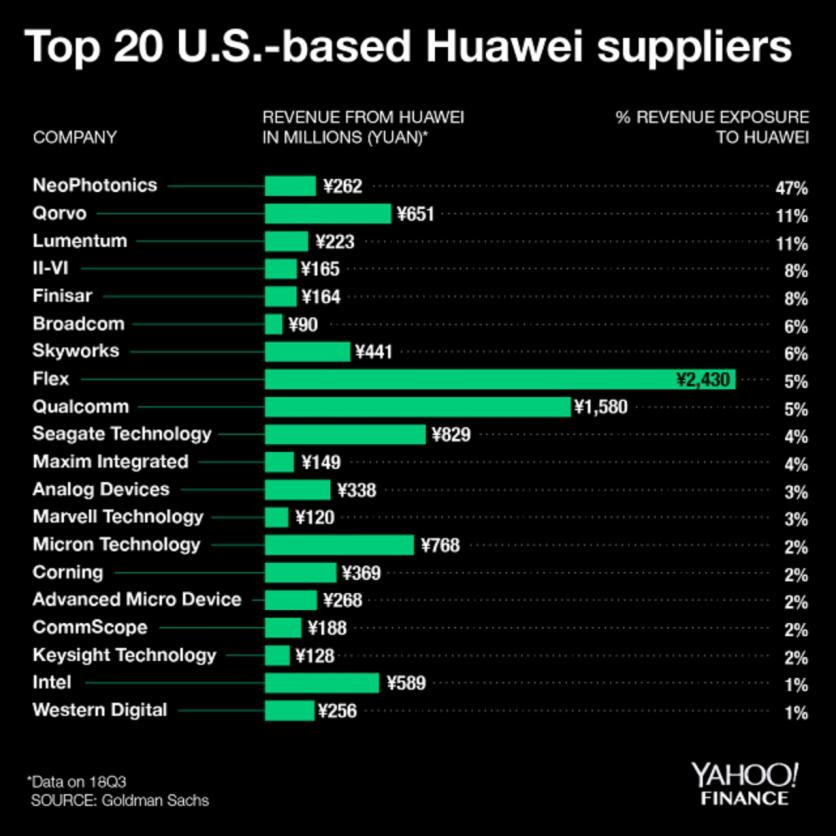
Guilt or innocence is not the issue as we think Huawei is very guilty. The ongoing joke from 15 years ago, which was no joke, was that Huawei routers when booted up would say Cisco on the display as all the code was stolen from Cisco. Huawei even admitted in court to stealing some of Cisco’s code, it was that blatant. We are also very sure that Huawei could care less if their products containing US semiconductors are sold to bad actors around the globe, much as ZTE did.
Yes, Huawei is very, very guilty but the timing of the arrest is the question not the guilt. Its very personal now between Trump & Xi.

If ZTE doubled China’s resolve to get big in the semiconductor business, Huawei just tripled it.

The next question is whether the administration did this on purpose to piss off China and play the role of “disruptor in chief” or it was just just a question of one hand not knowing what the other was doing. Maybe if its the latter the Chinese could brush it off to stupidity and not react as badly….but we’ll never know.

We would now put the odds of a “good” trade resolution at less than 50%. By good we mean tariffs going away and not giving up everything.

Payback
We would not be surprised if there were some further retaliation against the US tech industry. If we were the CEO/CFO of Micron, we probably wouldn’t want to be traveling anywhere near China for fear of being yanked off a plane for patent infringement, or some other charge.

Whereas the trade truce was likely good for KLAC/ORBK, China could now squash the deal as Huawei payback as it has clearly admitted that M&A approval is only political in nature. Responding in a non-tariff way would allow the Chinese to say they are respecting the truce just like the US.

Reconsidering QCOM/NXP was a joke as everyone understands it was dead and buried.

American Sniper
The arrest of Meng Wanzhou is like a US sniper taking out a North Korean general across the DMZ two days after the truce in 1953…..they might not be happy with us. We don’t think this is a case of a lone sniper not getting the ceasefire message, we think this was calculated on the US part.

Do we even make it to 90 days?
If this is the start of the ceasefire, how much worse can it get? China has now publicly played down what ever was not agreed to in South America. We think the Chinese position got very much more entrenched over the Huawei arrest, and will make compromise very, very difficult.

It all comes back to the semiconductor industry
As we have said for a long time, all roads in trade lead back to the chip industry. The core issue here are the US chips in Huawei products . China needs desperately to be independent of the US to get rid of this issue once and for all.

Chip equipment is at the very core of being independent. China desperately needs chip equipment to get their own chip production up. Jinhua / UMC / Micron was just the beginning of an ongoing struggle behind the public trade war.

The only true leverage the US has is to stop export of semiconductor equipment to any Chinese fab, foreign or domestic, which will choke off China’s oxygen supply. That may become the ultimate “nuclear option” if trade talks go south from here.

The stocks
We would still avoid the stocks as we don’t like where things are headed (in a hurry). We think the downside beta remains higher than the upside beta in the trade issue and the tech industry could wind up with the short end of the stick if there were a bad agreement.

The administration seems more focused on soybeans and cars than chips and technology which is the real underlying issue. We would not be surprised for the administration to announce a “win” in trade on selling the Chinese more soybeans and cars only to cave on chips and technology which is less well understood.

Either way, its going to be rocky for a while with the stocks in a volatile pattern. We would rather watch from the sidelines.

Also Read: Could China Conflict Curtail Chip Comeback?


ARM Answers Server Doubts

ARM Answers Server Doubts
by Bernard Murphy on 12-07-2018 at 7:00 am

At ARM TechCon this year, the company announced the Neoverse brand targeted to infrastructure, contrasting with the Cortex brand we are familiar with for edge devices such as smartphones and IoT devices. Cortex was already used in infrastructure, in networking, base stations and the like but Neoverse splits the infrastructure line of business from the edge line of business, including a roadmap for a dedicated family of processors.

Few would dispute that ARM has a big footprint in communication infrastructure, but the high end of the Neoverse plan, as presented at TechCon, is in servers. Here many would argue that the evidence for progress was less compelling. Servers from HPE (based on Cavium/Marvell processors) and Ampere for example show some progress, and ARM asserts a million units have shipped this year. But Qualcomm dropping out of servers was widely read as a negative and some of us had started to wonder if ARM plans for servers were more hope than substance. ARM may not be Apple or Samsung, but they’re at a scale where a million units in a year is no longer particularly exciting. Where were the big wins?

ARM answered that question definitively when AWS (Amazon Web Services) very recently announced the immediate availability of Neoverse-based servers in their instance lineup. The Graviton processor at the heart of these servers was developed by Annapurna Labs (wholly owned by AWS). This news is compelling on a couple of levels. First, ARM-based servers are part of the AWS instance line-up (EC2 A1 instances). That’s about as a big a win for ARM servers as you can hope to find. Second, AWS developed these processors themselves. That certainly helps with cost and power, but more importantly it signals expanding need to differentiate in the cloud providers. We knew about this around the edges: GPUs for deep learning and ASICs/FPGAs for network optimization and software-defined storage. Looking for advantage in custom servers over commercial solutions takes differentiation to a new level and is likely to cause some disruption in the value-chain.

I talked with Mohamed Awad, VP of the infrastructure line of business at ARM to get more information on why the ARM-based servers work in the AWS lineup and how this may evolve over time. Mohamed acknowledges that lower cost instances in AWS EC2 services are a very visible advantage to cloud users, especially for ARM-based workloads. I have no doubt also that AWS is attracted to ARM’s end-to-end IoT strategy which should drive lots of traffic to their cloud. Why not make that as easy as possible?

I had to ask about performance. There are a number of comparisons of ARM-based server performance (EC2 A1 and Ampere for example) which show these are not as fast as high-end Intel Xeon or AMD Epyc servers. Are ARM-based servers intended mostly to serve ARM-generated traffic and the low-end of the cloud market?

Not at all, according to Mohamed. I’m probably not alone in thinking of datacenters as homogenous ranks of high-end server blades with maybe a few special-case oddities like GPUs sprinkled around. But Mohamed told me that’s already changing. Cloud workloads are not homogenous and there are multiple ways competitive providers can provide services to optimize those workloads, beyond deep-learning, network and storage accelerators. Less familiar may be support for web services (more data throughput than compute intensive, but need to serve many clients in parallel), containerized microservices (a popular trend virtualizing components of a larger service) and applications caching (like caching inside a device but here caching state for an application across many devices). Could you do all of this with Xeon or Epyc servers? Probably. Could you do it more cost-competitively, and maybe better in distributed compute throughput with custom servers? Absolutely.

The EC2 A1/Graviton instance is based on the ARM Cosmos platform, in turn based on the A72 and A75 cores. Following this ARM plan to introduce, on a yearly beat, the Ares, Zeus and Poseidon architectures, each of which they intend will show ~30% incremental improvement in performance, along with new features. Can they catch up with the high-end Intel/AMD processors? Who knows, but clearly that isn’t a necessary goal. There seems to be plenty of compute share they can grab in these rapidly evolving datacenter architectures.

Finally, I asked Mohamed about the other cloud providers – Microsoft Azure, Google Cloud and others. He wouldn’t tell me, but I have seen indications elsewhere that similar programs are underway. And frankly, if you were running those operations and you knew AWS were working on an added edge based on ARM-based servers, wouldn’t you be talking to ARM too?

Looks like ARM knew all along what they were doing in servers, they just didn’t tell us. And we spent all our time looking in the wrong direction.


Samsung IEDM 2018 Keynote and the Foundry Business

Samsung IEDM 2018 Keynote and the Foundry Business
by Daniel Nenni on 12-06-2018 at 12:00 pm

IEDM is a premier semiconductor conference so it was certainly appropriate for Samsung to do the keynote since they are the largest and one of the most innovative semiconductor companies in the world, absolutely.

Samsung is also one of the more interesting semiconductor companies since they do it all: chip design, semiconductor manufacturing, consumer electronics, and foundry services. Having worked with Samsung many times throughout my career, which included numerous trips to Seoul, I will offer my experience, observation, and opinion, but first let’s talk a bit about the keynote.

Dr. ES Jung, President and GM of the Samsung Foundry business, did the keynote. He started with a joke stating that ES stands for engineering samples which got quite a few laughs, especially from me. ES is a career Samsung employee (he started in 1985) and has spearheaded research and development of advanced logic and memory process technologies and now leads foundry services.

Here is the abstract for his presentation. Remember, IEDM is a conference not a trade show so everyone does papers with abstracts and references:

4th Industrial Revolution and Foundry: Challenges and Opportunities
Abstract—Semiconductor has been the key enabler in the advancement of electronics for the past 50 years. With the coming of 4th industrial revolution, semiconductor will continue to play an even greater role as we invite a wide variety of new applications into our lives, including smart cars, smart factories, artificial intelligence, data centers, robots, etc. Such importance of semiconductor is attributed to its unique ability to copy and create everything human beings imagine. In this paper, the roles of foundry in the 4th industrial revolution, as the entity to turn ideas into reality along with electronic design automation (EDA), intellectual property (IP) vendor, and outsourced semiconductor assembly and test (OSAT) companies, as well as the need for global open innovation to overcome imminent challenges will be discussed.

I also have the slides but I’m not able to share them due to conference guidelines. It is a shame too because there are some very interesting ones. The presentation is in three parts: Industrial Revolution and Semiconductor History, Foundry, Challenges and Opportunities for Innovation.

I’m a big history fan because you really need to know how you got to where you are today to better plan for where you are going tomorrow, right? We have all seen the semiconductor history slides and know semiconductors are a critical part of modern life but it’s nice to be reminded before you get into the really interesting foundry and innovation slides.

With Samsung we have come full circle with the foundry business which started when IDMs had extra fab space that they rented out. Unfortunately, when IDM fabs filled up, the foundry business was shelved, which is what happened to Intel Foundry and is now quietly but officially shut down. The rest is history, pure-play foundries took over and have dominated the fabless chip business for more than 30 years now.

An important part of the foundry business was the ability to multi source to get the best pricing and availability. I remember being involved with a design that was sourced to four different 40nm fabs (TSMC, UMC, SMIC, and Chartered). Some fabless companies were loyal to one fab but that was rare. Now multi sourcing one design to multiple fabs is not possible. In fact, at the leading edge you now only have two foundry choices (TSMC and Samsung). You can certainly use both fabs for different designs and moving forward many companies will do just that, my opinion.

This brings me to the realization I had watching the Samsung keynote. In my dealings with Samsung the most important thing I learned is that they do not give up which is critical in the foundry business. I remember many years ago Samsung told me during one of my visits that they were going to be the number one semiconductor company in the world and here they are. Today, if Samsung told me they were going to be the number one foundry in the world I would not bet against it.

Currently TSMC ($32B+) is the number one foundry by a very large margin with GF ($6B+), UMC (>$5B+), Samsung (>$5B+), and SMIC $3B+) barely visible in the rearview mirror. My prediction today is that Samsung and TSMC will share the majority of the foundry business in the coming years with UMC and GF joining the ranks of the boutique foundries. SMIC is the big question since they have the upper hand in the Chinese market but lack the leading edge innovation. Remember, China buys more chips than the rest of the world and that number will only increase in the years to come, my opinion.

So, my prediction for leading edge wafers in 2025 is that TSMC will have 60% market share and Samsung 40%. I will make my case in the comments section.


Imperas and RISC-V

Imperas and RISC-V
by Bernard Murphy on 12-06-2018 at 7:00 am

I met Imperas at TechCon this year because I wanted to become a bit more knowledgeable about virtual modeling. That led me to become more interested in RISC-V and a talk given by Krste Asanovic of UCB and SiFive. My takeaway surprised me. I had thought this was an open-source David versus proprietary Goliaths (Intel and ARM) battle in the world of processors/controllers (or more exactly the instruction set architectures – ISAs – underlying those systems). With of course everyone rooting for the plucky newcomer.

I’m sure that remains an aspiration, but I took from Krste’s talk that RISC-V can still be very successful even if the Goliaths hold onto their primary roles. He talked about SoCs with 15-16 ISAs, from the core CPU (usually ARM) to graphics, image processing, radio and audio DSPs, power management, security management, etc, etc. Standard MCU solutions are likely to be sub-optimal for some of these functions, and custom solutions must seem compelling for IP vendors and in-house developers who need an embedded controller. Standardizing the ISA for some of these functions seems like a natural win given potential for healthy competition and hopefully a robust software ecosystem growing around the standard.

I’m not so sure about the DSP examples as a target; radio performance depends on some pretty carefully-crafted architecture support in the more demanding wireless standards. Doesn’t seem like a good fit for a general-purpose ISA, but maybe that’s just my lack of understanding. RISC-V allows you to tune the ISA, which might overcome objections of this kind. In fact this appears to be one of the real attractions in the standard.

But that raises a question – how much can you change before you become non-compliant? Change enough and what you are using is just a convenient starting point on your way to yet another proprietary ISA. So as you’re refining your architecture against your (hopefully) extensive software regression suites, you will want to assess performance and power, among other metrics, when making decision on ISA optimization. But you also want to know that you are staying inside the boundaries of RISC-V compliance. How do you do any of that when you don’t yet have even a hardware simulation model?

The answer is that you use an instruction set simulator (ISS) reflecting the RISC-V ISA, adapted with whatever changes you want to make. Unlike hardware simulators, these things can run at near real-time speed, so it is possible to run those extensive regression suites and compare and contrast performance, power etc between different ISA tweaks. Since the ISA is free, why would you want to pay for this simulator? You don’t have to. In the spirit of the standard, Imperas provides a free ISS for RISC-V; notably this is used by the RISC-V Foundation’s compliance working group in their compliance testing, a feather in Imperas’ cap.

Naturally Imperas offers a number of (presumably charged) options. After all they have to make money somewhere. This model isn’t noticeably different from RedHat or many “freemium” business models. So more power to them.

I talked with Kevin McDermott (VP Marketing at Imperas) while at TechCon to get a bit more insight into his view on the role of virtual prototyping in system design. He acknowledges they didn’t invent this concept but believes they offer a differentiated solution over similar products First, they focus exclusively on virtual prototyping and are not trying to extend down into implementation. Where connection to implementation is important, they partner with companies like Cadence to do hybrid prototyping. Imperas models the CPU/cluster part of an SoC running a software stack and the rest of the SoC runs on Palladium. This allows for software performance, communicating with hardware accuracy where needed.

Second they have an open approach to models. Generic models for many processors, platforms and peripherals are already available under OVP and you are free to adapt these to match what you intend to use/build. The Imperas ISS generated for your system based on these models can then be used for driver development, OS and hypervisor integration and application-level software development, allowing all of this to start before you’ve written your first line of RTL.

Another interesting capability Imperas support is safety analysis with fault injection. In this forum, we’re used to ISO 26262 safety analysis in the hardware domain. ISO 26262 safety analysis is just as important in software and requires, unsurprisingly, fault injection in the software. The Imperas solution has been adopted for safety coverage analysis in aspects of Audi design, which tells me this has to be competitive.


Could China Conflict Curtail Chip Comeback?

Could China Conflict Curtail Chip Comeback?
by Robert Maire on 12-05-2018 at 7:00 am

At the recent trade talks in South America, the US and China both kicked the can down the road as neither one were obviously willing to do a deal nor had done any background work to get a deal done. Instead we have a bunch of empty promises and vague and conflicting descriptions of what was not really even agreed to.

Essentially worthless
However, the market was happy that nothing happened as stocks rallied based on hope that something might happen in the future as the alternative of continuing on to higher tariffs was an unpalatable alternative.

The semiconductor and tech industries remain at the core of the trade conflict and perhaps are the most critical and difficult trade issue to resolve. While selling soybeans may feed a few more people more food, chips and the technology infrastructure associated with them represents technological and therefore military dominance between the two superpowers who are locked in a new struggle with technology substituting for thermonuclear devices.

At some point we will likely no longer be able to kick the can further down the road and we will need to resolve trade issues. The longer the delay, the better off for China as they have the current advantage. Much as with North Korea, where a similar can has been kicked down the road with no agreements or resolution sooner or later there will be an explosion (figuratively or literally).

Even though there was talk of a 90 day timer, even that information was conflicted as it was unclear whether it was 90 days from the dinner or 90 days from January 1st (90 days or 120 days??). Our view is that by not addressing the issue it will come back some time in the spring.

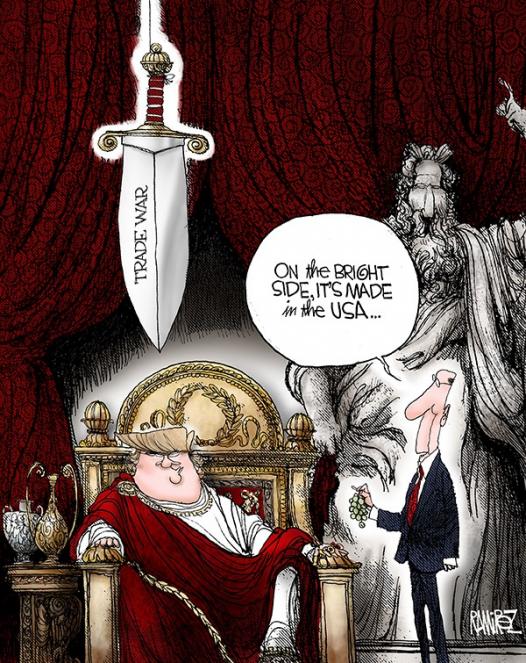
The sword of Damocles gets frozen
From a stock perspective, the near term pressure is off so the stocks have popped. However we think that investors need to be aware that the sword hanging over tech stocks did not go away but is just delayed.

While tariffs are not going further up they are not going away and espionage is still ongoing.
We don’t see China/Xi as caving in over the next 3-4 months (much as Kim in North Korea hasn’t caved). In fact, it would appear the US was willing to kick the can down the road due to domestic issues and pressure and thus was more of a strategic win for China who benefits from a delay in further tariff increases.

Our view is that the ongoing trade issues will be an ongoing “discount” to many chip and tech stocks that will not fully go away until we get a real, permanent resolution. This discount will likely increase as we near the end of the 3-4 month period when people will start looking for an answer. We could easily find ourselves back where we started with no real progress. We also remain concerned that tech companies could get the short shrift in trade talks as California is not the political base of the administration which seems to care more about less strategic soybeans and their farmers.

An admission of the politicization of M&A – QCOM/NXP
Its obviously no surprise that the Chinese admitted that the QCOM/NXP deal was sunk for political reasons. We had clearly stated this in several of our previous notes. It shows, as we had suggested, that the Chinese will use all tools at its disposal, to get an advantage in the trade and technology wars. The US administration seems to think they have the upper hand as there are more Chinese imports than US exports and therefore more exposed to tariffs but tariffs are obviously only one lever that China has to respond.

M&A is likely more critical to US companies and thus may be more valuable than adding to tariffs. In blocking and burying the QCOM/NXP deal (which is not coming back from the dead), the Chinese blocked the US becoming even more dominant in semiconductor telecommunications technology.

Given that China has used M&A approval as a weapon in the past, its a safe bet they will use it in the future to get their way in tech, which they clearly care about.

KLAC/ORBK – What does the trade truce really mean?
The knee jerk reaction is that the current truce period is likely good for the KLAC/ORBK deal approval as the Chinese probably don’t want to take an offensive action during this ceasefire period.

You can add to that logic the fact that China has approved several deals recently that are much larger than the rounding error size of the KLAC/ORBK deal. UTX’s $30B purchase of Rockwell Collins was approved along with Disney’s $71B deal to buy Fox entertainment.

The UTX deal is more of a proxy for KLAC/ORBK as Rockwell Collins is a defense electronics manufacturer. While we think the KLAC/ORBK deal goes through and the trade truce is a good omen we remain concerned about the length of time for a relatively small deal as we are quickly approaching the self imposed end of year deadline for the deal. Could it be that the Chinese care more about a chip related deal?

What will it take to make you Capitulate?
(Apologies to Musk’s girlfriend Grimes for stealing lyrics- Appreciate Power)

In looking at AMAT’s recently announced quarter, we wonder if capitulation is what it will take for the semi equipment stocks to move on and up.

Applied had a very bad quarter with a big miss on guidance and the stock dropped sharply in the after market on the news. Yet the following day the stock seemingly recovered on no other news.

Some investors and industry participants suggested that Applied’s “capitulation” in admitting to the down cycle rather than fighting reality was the reason for the bounce in the stock in the face of otherwise ugly news.

On the call, Applied CFO, Dam Durn, had suggested that they didn’t know where the bottom of the cycle was and seemed to be capitulating to the fact that cyclicality still exists rather than trying to fight it and suggest otherwise.

Is capitulation of the chip/tech slowdown the “cathartic cleansing” we need to have the stocks get over it and move on? Perhaps so…

The stocks
We have had a nice bounce off the bottom here and have gotten another bounce from the trade truce. Our concern remains that these are more emotional reactions rather than hard facts that support a real recovery and thus could be short lived.

We are well past the peak season and holiday driven demand, of semiconductor sales and about to head into the weakest quarter of the year (Q1) for chips which is almost always a sort of postpartum period after the holidays and usually the low point for memory sales/pricing. Q1 also contains Chinese new year which also slows sales.
This suggests that we will not get positive data over the next few weeks/ months to support the bounce or a more extended recovery.

We might consider taking some short term gains off the table as we may get a chance to buy them back at a lower valuation.


Also Read: Could China Conflict Curtail Chip Comeback? Part 2


Cadence Summit Highlights Automotive Market Dynamics and System Enablement

Cadence Summit Highlights Automotive Market Dynamics and System Enablement
by Camille Kokozaki on 12-04-2018 at 12:00 pm

Cadence held a well-attended Automotive Summit where Cadence presented an overview of their solution and system enablement along with industry experts and established or startup companies sharing their perspective and product features from autonomous driving, LiDAR, Radar, thermal imaging, sensor imaging, and AI.

Continue reading “Cadence Summit Highlights Automotive Market Dynamics and System Enablement”