RVN! 26 Banner revised (800 x 100 px) (600 x 100 px)

OpenAccess

OpenAccess
by Paul McLellan on 06-21-2011 at 1:11 pm

Probably everyone knows that openAccess is a layout database. It was originally developed at Cadence (called Genesis) but has since been transferred to Si2. Strictly speaking, openAccess is actually an API and the database is a reference implementation. The code is licensed under a sort of halfway to open-source: you can use it, but you can’t incorporate it into a different implementation of the API. The FAQ on openAccess on the Si2 website is here.

Cadence never really planned to make openAccess that open. When I was there it was an internal project with the long-term aim of replacing the databases underlying the digital design and custom design tools and so, eventually, unifying them. However, several large customers had internal database projects of their own and were pushing back on switching to openAccess if it remained proprietary to Cadence. Apart from the general wastefulness of every semiconductor company investing in creating their own database so that they could interface their own internal scripts and tools, Cadence realized that it would be a maintenance and business headache if, gradually, their customers stored all their design data in proprietary databases with different semantics.

So openAccess was opened by donating it to Si2, and eventually the source code was available too. Note that at this point the real purpose of openAccess was to make the interface between Cadence’s customers’ internal developments interface cleanly with Cadence’s tools. I don’t think Cadence clearly though through the implications for the EDA ecosystem.

The dirty secret of the early days of openAccess was that, despite being developed at Cadence, no Cadence tools ran on openAccesss natively. There were translators in and out of it to the other Cadence databases. Cadence, being a large company with a huge installed base was also not the nimblest and so the first tools that ran on openAccess were from smaller companies.

Today, customers and especially other EDA companies, look at openAccess as a way to interface tools from different vendors. For example, SpringSoft’s Laker layout environment supports openAccess and uses it as the means to run Mentor’s Calibre DRC incrementally and interactively behind the scenes as editing takes place.

But openAccess on its own is only a part of the problem of interfacing the Cadence layout environment to the rest of the world. A key part of Cadence’s layout system are pCells, especially those that are in the physical design kits (PDKs) supplied by the foundries. pCells are not part of openAccess and, as a result, it is not really a complete interface. Of course Cadence regards this as a competitive advantage and it is clear that they are not going to make pCells open. I ran the custom IC product division of Cadence for a year or so and, without revealing any numbers (I can’t remember them anyway), you won’t be surprised to know it was the definition of a cash cow, making a large amount of money for a relatively small engineering investment (off topic: gateEnsemble was even better, with an 8-figure revenue and only about one bug report per year. Management would regularly try and kill it in an irrational desire to reduce the breadth of the product line).

The IC layout market really splits into two halves: Cadence, and everyone else. Cadence has a closed system (think Apple) whereas everyone else (SpringSoft, Synopsys and others) is open, competing on technology, service etc and not on lock-in. To an extent, any switch away from Cadence to one of the other players is a win for all of them in the short term. Once the tipping point away from Cadence is reached, if it happens, then the game switches to a land-grab for market share on a level playing field. Open systems usually win in the end even against entrenched lock-in: Windows-NT was surpassed by Linux for internet servers despite Microsofts advantages.


Can Your Router Handle 28 nm?

Can Your Router Handle 28 nm?
by Beth Martin on 06-20-2011 at 7:11 pm

attachment

With the adoption of the 32/28 nm process node, some significant new challenges in digital routing arise—including complex design rule checking (DRC) and design for manufacturing (DFM) rules, increasing rule counts, very large (1 billion transistor) designs. To meet quality, time-to-market, and cost targets, design teams must adopt new routing technologies that can solve for multiple design objectives within the scope of required tool capacity, memory footprint, and runtime.

A router must be flexible and robust to effectively deal with the growing DRC/DFM rule count and complexity at sub-nanometer nodes. To ensure optimization of all design parameters across all process and operational modes and corners, the router should be multi-mode, multi-corner (MCMM) aware. The router should also have signal integrity (SI) costing native to the routing kernel, to enable dynamic and incremental MCMM SI analysis. Incremental, on-the-fly extraction, polygon-based DRC analysis, and MCMM timing analysis are also essential to make quick decisions on issues such as wire spreading and rerouting critical nets.

Another key requirement for 28nm routing is the support for all of the DFM requirements including recommended rules, pattern matching, redundant vias, wire spreading and widening, timing-aware metal fill, and sophisticated non-default rules (NDRs). Finally, because of the growing design sizes, routers need to use multiple cores and CPUs and physical memory very efficiently. The requirements of a routing system for 28 nm are illustrated in Figure 1.

Figure 1. A convergent routing flow for advanced-node designs.

Nanometer Routing Challenges and Solutions

The primary challenges at 28 nm that require new routing technologies include:
• Growing number of DRC/DFM rules and rule complexity
• Poor estimates for global route resources
• Disconnected physical signoff and engineering change order (ECO) iterations
• Huge design sizes and long runtimes

Growing DRC/DFM Requirements

Design rules and DFM requirements correct for the manufacturing defects (parametric, systematic, and random) that occur when trying to print sub-wavelength features. The number of design rules has roughly doubled between the 90 nm and 28 nm nodes, and model-based DFM analysis is becoming mandatory. In addition to the mandatory DRC, for 28 nm foundries also provide “recommended rules” – soft rules that improve yield. Although the recommended rules are discretionary, if these rules are not honored by the router it can have a direct impact on the design yield.

The routing engines should support all the complex 32 nm and 28 nm design rules and at the same time control the impact on runtime. One method is to use algorithms that intelligently minimize the number of operations performed during routing. The router should make use of the full DRC/DFM models during all stages of routing for better accuracy and to minimize violations that need to be fixed during post route optimization and signoff. The DRC engine should use polygon shapes rather than edge-to-edge checks, which enables complex 28 nm rules to be represented and adhered to effectively.

In addition to the default hard rules, the router should also support recommended rules and corresponding rule priorities. Automatic routing repair should be performed based on the priority as defined by the foundry or the user to ensure the best DFM score.

Global Routing Estimation

Before creating detailed routes, routing tools perform a ‘global routing’ step to estimate the available routing resources. These global routing estimates must be accurate, which means more than simply counting the number of routing tracks across the chip that meet minimum spacing requirements. Some routing engines use only a subset of the foundry design rules in a simplified form for global routing, and invoke the full set of DRC rules only for detail, or final routing. The result is poor correlation between early estimates and final routing results and ultimately, routing closure problems.

A timing- and congestion-aware 3D global router is best at estimating routing layer resources. The global router should use the complete set of DRC/DFM rules, including recommended rules, to avoid intractable DFM problems that typically are found as late-stage surprises. The router should use new modeling technologies to ensure that the resources consumed by vias, stacked via patterns, blockages, and staggered macros are accounted for when calculating resource availability.

Efficient Physical Signoff and ECO Iterations

Another key challenge at 28 nm is a result of the traditional decoupling of the routing and the signoff verification engines. Typically, a router uses simplified DRC and DFM models to provide the optimal trade-off between runtime and accuracy during routing. Once the implementation is complete, the GDSII layout is verified using signoff-quality DRC/DFM models and Standard Verification Rule Format (SVRF) rule decks. For previous nodes, this worked adequately because the number of violations discovered at signoff was relatively low.

Designers are also finding that DFM techniques, including metal fill/CMP, litho, and critical area analysis, are starting to affect the traditional design metrics like timing, power, and signal integrity. These challenges are made worse by the fact that there is no automated way to repair the DRC/DFM violations, and the traditional flow requires the transfer of huge ASCII files between the implementation and signoff environments, which slows the design process. In summary, the design-then-verify flow that has worked in the past is increasingly unmanageable and unpredictable.

Advanced IC designs need the physical signoff engines to be directly integrated in the place and route environment to natively perform SVRF-based DRC and DFM analysis. Access to the actual signoff engines running golden SVRF rule decks is the key to the effectiveness of the platform. This ensures that all manufacturability issues are addressed without introducing new ones, and without degrading the performance of the design. It significantly speeds up the manufacturing signoff process, and delivers higher quality results with faster time to market.

Capacity and Turn-Around-Time

A routing solution must also have an extremely efficient and scalable data model to handle huge design sizes. The number of operations the router must perform at 28 nm is nearly four times more than what was required at the 65 nm node. One technique for maintaining the routing runtime is a method for clustering and filtering rules. Rather than applying each rule separately, a more intelligent tool can detect rule commonalities and group them for more efficient processing.

Another performance factor is the efficient use multiple CPUs. Figure 2 illustrates the speedup that can be achieved for different CPU configurations when the router architecture has a very efficient data model and is built for maximum parallelism.

Figure 2. Routing speedup with Multi-CPU runs using the Mentor Graphics’ Olympus-SoC place and route system.

Conclusion

Advanced process node designs face a raft of significant routing challenges due to the increased number and complexity of DRC/DFM requirements, increased design sizes, and multiple design goals. Routers for 28 nm must offer a flexible and powerful architecture to address these concerns and achieve optimal QoR across all design metrics in the shortest time.

— By Alexander Volkov, Principle Technologist, Mentor Graphics Place and Route Division.

For more information about Mentors Graphics’ routing technology, see the whitepaper “Routing Technology for Advanced-Node IC Designs“.


Semiconductor IP State of the Union

Semiconductor IP State of the Union
by Daniel Nenni on 06-19-2011 at 10:15 am

After the mega IP acquisitions last year by Cadence (Denali) and Synopsys (Virage) a lot of people are wondering what is next for the commercial Semiconductor IP market. Let me offer my opinion as a person who works closely with foundries and their top customers and the opinion of Dr. Eric Esteve, an expert on interface IP.

The commercial semiconductor IP industry will experience exponential growth due to both the mobile internet explosion and the shortened shelf life of the end products we serve. On the foundry side, the complexities of shrinking geometries and increasing design requirements for high speed and low power devices will keep commercial IP vendors growing for years to come, my opinion.

At the 48[SUP]th[/SUP] Design Automation Conference commercial semiconductor IP vendors dominated the foundry partner space for a reason, foundries cannot succeed without them. The next generation of fabless semiconductor companies cannot succeed without them. The semiconductor design ecosystem cannot survive without commercial IP.

Eric Esteve recently completed a four part interview with Synopsys IP manager Hezi Saar which can be found HERE. I worked with Hezi at Virage Logic and now work with Eric at SemiWiki.com. You will be hard pressed to find more IP savvy guys than Hezi and Eric. If Interface IP touches your profession you will definitely want to read this interview and spend more time with Eric on SemiWiki.com.

Q: Eric, give us a quick introduction about your background as it relates to interface IP
A: I have spent 20 years working as a designer, then FAE, then Marketing for TI and Atmel, before working as a WW Marketing Director for PLDA, where I have launched…
Q: What are your high level thoughts about the semiconductor industry in general and mobile segment in particular?
A: The semiconductor industry is still growing, with an 8% CAGR for the last 20 years or so, but it is a matter of fact that there is a consolidation, and the ASIC or ASSP design starts are slightly….
Q: What do you believe are the challenges facing the mobile electronics industry?
A: I think some of the challenges the mobile electronic industry is facing are almost the same than for the other….
Q: What can you tell us more about the evolving time to market pressures?
A: Time to market for handset applications is probably the more stringent of the industry….

Q: Since you (and Synopsys) focus on interface IP what do you see as the overarching trends for interface IP?
A: Being strongly focused on Interface IP, since 2005, I have seen the massive adoption of the differential, high speed, serial communication techniques inside and outside…..
Q: What are the most promising interfaces used by semiconductor SoCs targeting mobile market segments and why?
A: Lets take TI’s OMAP5 an an example, we have pretty much the list of most promising interfaces for Application Processor SoC targeting mobile market segments…..
Q: You are projecting a very strong growth for these interfaces, almost 100% from 2010 to 2015. How do you explain this growth with your prediction you made about lower number of design starts going forward?
A: First, I should precise that different predictions, from different analyst, like Gartner has proposed during IP-SoC in December 2010, show a
Q: That’s interesting distinction between Gartner’s growth numbers and yours, what are the reasons for doubling the interface IP market while design starts decline?
A: The first reason is structural: yes the number of design starts per year declines at a 2 to 4% yearly rate, but the nature of the ASIC or ASSP SoC designs strongly change….
Q: Last thoughts about the mobile computing space as compared to traditional computing, storage, enterprise segments? How do you think the future will look like?
A: During the last few years, the most drastic change we have seen in the mobile computing space has been the democratization…..

The most frequent calls for help I get now are from fledgling IP companies. Literally a dozen of them and more to come as semiconductor company consolidation continues. Downsized silicon proven IP groups on the street and ready to go. The question is how will they differentiate and thrive? The answer of course starts with Eric’s industry reports on IP-Nest.

Note: To read/write comments you must be logged in


Circuit Simulation and IC Layout update from Mentor at DAC

Circuit Simulation and IC Layout update from Mentor at DAC
by Daniel Payne on 06-17-2011 at 7:06 pm

Intro
On Monday evening I talked with Linda Fosler, Director of marketing for the DSM Division at Mentor about what’s new at DAC this year in circuit simulation and IC layout tools.

Notes
IC Station – old name for IC layout tools

Eldo – Eldo Classic- Cell characterization
– ST is the early customer and teaching customer, their Golden Simulator
– Widely deployed worldwide

Eldo Premier (January 2011 introduced, free transition from Eldo customers, new option, uses 2X the licenses) – Multi core, multi cpu
– Accuracy driven
– More accurate than Berkeley (they focus on PLL)
– FineSim from Magma
– XA from Synopsys
– Developed in Grenoble, all new kernel, native MT
– Average of 2.5X faster than Eldo at same accuracy, up to 20x faster
– Input netlists: Eldo, HSPICE
– Some analysis missing in Premier and will be released in next 12 months
– DAC Session at 9AM on Tuesday AM

ADiT – Fast SPICE simulator- Analog blocks up to 50 Million devices
– Adding new capabilities
– MediaTek standardized on ADiT
– Similar to other Fast SPICE tools
– Macro tuning capability and new partitioning in development

Questa ADMS – Single kernel AMS simulator- Number one or two market share per EDAC, Gary Smith EDA
– Close to Cadence in market share

Grenoble – Eldo/Eldo Premier R&D
Taiwan – ADiT team/Design Kits
Armenia – CICD R&D
Cairo – models, PDK
Fremont – Division Headquarters
Wilsonville – Custom IC Design R&D
Austin – Custom Router R&D

Innovate In IC physical design, stay close to silicon design.

Technical Advisory Board – multiple initiatives
– Quarterly meetings
Simulators – all work within Cadence Virtuoso (Artist Link)

Analog within Intel microprocessors

Challenges
– Variability (Physical, Electrical)
– Design Risk, AMS is 75% of the risk for failure and cost for design and verification
– Need MS verification (SPICE, HDL, Analog HDL, RTL)
– Questa AMS (Analog Real Number modeling)

Questa ADMS – C/C++, Matlab, VHDL-AMS, …

IC Station (Version 9) – New name is: Pyxis Custom IC Platform (Version 10)

Pyxis – OA database compliant (available now)
– OA native for some functions
– Schematics, Layout, Floorplanning
– Launch simulators
– Concurrent design, multiple designers can edit in the sam cell at the same time
– Custom router
– Multiple designers can edit in the same cell at the same time
– Interface with Clio Soft
– Can be used on LAN, not so tested on WAN yet
– Custom Router (Native OA), easily go back and forth
o Transistor, Cell, Block, Chip, Proven (Used at Marvell) [not related to Olympus – big digital, different division]
o Interactive or batch routing
o Uses Calibre RealTime deck, good integration

Design Kits – founding member of IPL
– Part of Open PDK
– Can help to translate Development Kit formats
– Pcell translator: Robust, accurate, fast (1 foundry, 1 customer using it too)
– Create new PDK’s in a few weeks, able to QA libraries quickly

Summary
Mentor updates their tools for IC layout through the Pyxis acquisition and enhances circuit simulation with a speedier Eldo Premier. AMS co-simulation between HDL and SPICE simulators is a strong point for Mentor.


DRC tool guns for Calibre at DAC

DRC tool guns for Calibre at DAC
by Daniel Payne on 06-17-2011 at 6:48 pm

Intro
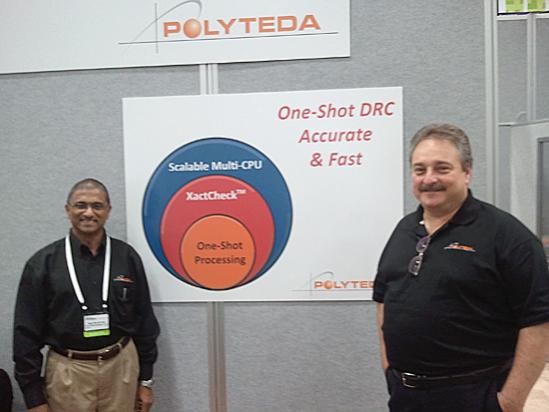
Across the aisle from the Mentor booth at DAC sat a DRC tool competitor to Calibre. I received an update from Randy Smith of Polyteda on Wednesday afternoon, my last EDA vendor of the week.

Ravi Ravikumar, Randy Smith

Notes
Randy Smith – CEO (February 2011) [former founder is gone]- 1979 at HP developing internal tools
– Trilogy
– Tangent, Acquired by Cadence
– Bought 4 times
– Celestry->Cadence
– Gambit->Synopsys
– Japan consulting business
Before – big performance claims

Now – about 2 to 3X faster than Calibre while running in flat mode, PowerDRC– Look for a new hierarchical announcement by end of year, look for a new name
– Smaller memory footprint
– Easy to scale across multi-processors
– TSMC has a reference flow, while larger companies can use a new DRC tool during design process
o 3 way NDA between: Polyteda, TSMC, Client. Tune the rule deck. 40nm deck. Takes 18 months to reach sign off, stay tuned.
– OEM relationship with AWR – single CPU limitation
– IHP – customer, AMS client at 180nm (Pricing of Calibre seems too high)
– Price/Performance – produce more results with less cost than Calibre
– Learning curve: batch oriented, easy to learn, debugging is more of the issue, something similar to RVE called RDE (still internal)
– Time based licensing, tied to the number of CPUs
– Mentor has two licenses: Flat or Hierarchical
– Polyteda will have one license: Flat and Hierarchical
– Over 40 people in the company
o R&D in Moscow
o HQ in Santa Clara
Summary
Polyteda has reset expectations about their DRC tool performance and will have to battle against the entrenched Calibre in the marketplace. Competition always benefits the EDA tool users who need every advantage to get to market quickly and have first silicon success.


An Affordable 3D Field Solver at DAC

An Affordable 3D Field Solver at DAC
by Daniel Payne on 06-17-2011 at 6:35 pm

Intro
Massimo Sivilotti, Ph.D of Tanner EDA showed me their 3D field solver in the HiPer PX extraction tool at DAC last week.

Notes

Tool Suites – schematics, layout, SPICE simulation, DRC/LVS
– HiPer PX: 3D Field solvero Layers, dielectrics,
o Finite element analysis
o Boundary element methods
o 2D mode for pattern matching
o PDK – includes the info for PX extraction
o 3D viewer to see the IC Layout
o Offered for a few years now
o Extract: Devices, parasitic, interconnect
o Produces RC netlist (not L, not s-parameters), coupled C
o Take parasitic from PX extraction then view it in Schematic editor (S-Edit)
 Swap out cell parasitics by changing the view
o Run times are more limited by your simulator, not the extraction
o Built-in netlist reduction algorithms (supply a frequency range), typically the reduced netlist is 10% the size of the original netlist
o Not a multi-core algorithm yet (T-Spice is multi-core for circuit simulation)
o Developed at TU Delft in Europe, licensed technology
o Runs on both PC and Linux (32 or 64bit)
o Comparable accuracy with Assura RX

Licensing – Sentinel
– Dongles
– Commuter
– Time-based
– Rentals
– Even permanent licenses

L-Edit – used for stacked die layout with IC and Mems
– Packaging techniques to locate all pads

3D Solid Modeler
– Used for MEMS Design – have a solid modeler (air or dielectrics)
– Interfaces to Finite Element Analysis
– Optical example with mirror

Summary
Tanner EDA continues to offer affordable IC design tools, HiPer PX offers both 3D and 2.5D extraction depending on the accuracy that you need.


Hardware Configuration Management at DAC

Hardware Configuration Management at DAC
by Daniel Payne on 06-17-2011 at 6:20 pm

Intro
Show me what has changed in my RTL or Schematic since the last time I looked. This task is now automated by Cliosoft with their new hierarchical tool called Visual Design Difference (VDD). Srinath showed me what was new for DAC.


Srinath Anantharaman

Notes
LSI, STMicro – use DesignSync for their DM but use VDD for seeing visual differences.

Visual Diff – Tool introduced just over one year.
– This year it handles hierarchy.
– Can also ignore Cosmetic Changes that have no electrical changes.
– If you make changes to your RTL design, then how do you see what has changed?
– Demo: Compared two versions of a designo Tree widget shows the hierarchy of where to find the changes
o Expand the tree widget, see each difference in logic
o See changes in different colors
o Zoom on changes per pin or net, complete text description
o Standard feature at no extra cost for existing customers
o Can even see property changes along with logical changes

Clients: Virage – started with Springsoft Laker, then Virtuoso, now Custom Designer (stayed with Cliosoft DM throughout)

Summary
If your IC design team has two or more engineers then your job will be made easier with a tool like VDD from Cliosoft.

Also Read

Cadence Virtuoso 6.1.5 and ClioSoft Hardware Configuration Management – Webinar Review

How Avnera uses Hardware Configuration Management with Virtuoso IC Tools

Hardware Configuration Management and why it’s different than Software Configuration Management


Circuit Simulation update from Cadence at DAC

Circuit Simulation update from Cadence at DAC
by Daniel Payne on 06-17-2011 at 6:06 pm

Intro
In the bloggers suite I met with John Pierce of Cadence last Wednesday to get an update on what’s new with circuit simulation at DAC this year.

Notes

News – market is growing, RF CMOS simulation is growing
– Show on RF (MTT – Microwave Technology ) this week, sharing a booth with AWR this week
Recent news with Lorenz (EM tool to create inductors), they’re part of Connections program
– APS RF released on year ago (Parallel in the new engine)
– RF usability improved, able to do s-parameter analysis

Virtuoso APS – continued to improve, up to 16 cores
– December 2010 now you can go distributed, across machines
– No special setup required
– Uses more tokens
– Super Threading: multi-core plus distributed processing (multi-core per box)
– Typical usage: Two machines, 4 cores per machine

UltraSim – looking at next generation technologies
– Usability and speed improvements done and planned
– New developers added
– Did a new RF model

Modeling – how to model FInFET (Tri-gate)?
– Compact Modeling group involvement

Altos – acquired library characterization company
– Integrated with them last year, especially memory characterization
– Works with either Spectre or UltraSim or internal simulator

Growth – Altos had 11 out of 20 top semi companies for library characterization
– Good collaboration over past 12 months too (Jim Mccanney)

Spectre – New in last year is APS and distributed
– Shares models with UltraSim

AMS Designer – transistor simulation plus HDL
– Real number modeling (standard part of SystemVerilog) lets you model analog effects in a logic verification environment
– Did a paper at the ARM conference last year, DVCON this year (assertions plus real number modeling)
o Help ADC test bench verification
– Adoption of real number modeling is driven by the design style more than the technology
– Work with designersguide.com on training the next generation of AMS designers, classes tailored to the client and offer consulting services
– Knowlent went out of business as Analog Verification IP (too limited of an approach, not portable)
– How to influence the next generation, Universities

Parasitic Aware Design – simulation with real parasitic, as early as possible in the flow
– Quickly go from schematic to layout to extracted parasitic, better simulation results
– Virtuoso can help manage the whole parasitic flow

IMS Chips (Germany) – Used Custom Designer, then went back to Virtuoso (Feb 2011)

Wolfson (UK) – Uses SNPS digital tools, and internal analog tools. They evaluated Custom Designer but choose Virtuoso plus digital flows.

Summary
Cadence has plenty of competitors in the circuit simulation space so they continue to update and innovate their tools to stay current. Only three vendors offer an integrated co-simulation between SPICE and a widely-adopted HDL simulator (Cadence, Mentor, Synopsys).


Reduced IC leakage at DAC

Reduced IC leakage at DAC
by Daniel Payne on 06-17-2011 at 5:46 pm

Intro
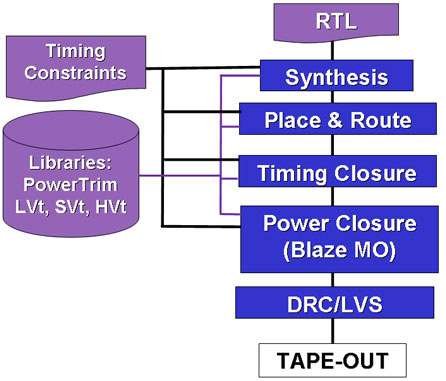
Neal Carney, VP of Marketing at Tela Innovations provided me an update at DAC last week. Their company partnered with TSMC to reduce leakage in IC designs by biasing the gate lengths on your paths that are non-critical to timing.

Notes

Why do this?
– Reduce leakage
– Increase gate lengths on paths with slack
– Recharacterize cells for change channel length, new performance
– Take the output from Primetime for paths with slack
– Our tool also has a timing engine built into it
– Fine grain optimization for leakage optimization
– Our tool does more cell swaps than other tools do
– Can swap multi vt cells as well
– TSMC has four Vt choices, but with gate biasing you have finer control than just swapping Vt
– Gate biasing doesn’t require another mask
– Optimize for: Performance, leakage, costs
– At 28nm the PowerTrim libraries should become more mainstream
– At 40nm, you can bias the gate length to optimize as well
– Another technique for 28nm is to start with 35nm then use gate biasing
– Customers can ask for design services from Tela, or ask TSMC to use PowerTrim
– Customers: LSI Logic, Melanox, undisclosed (over 50 tapeouts so far)
– Gate biasing can make the device go faster (more leakage) or slower (less leakage)

Summary
If you fab with TSMC and want to reduce your leakage currents, then consider the PowerTrim library approach.


Cadence spinout at DAC

Cadence spinout at DAC
by Daniel Payne on 06-17-2011 at 5:37 pm

Intro
I remember when Celestry was acquired by Cadence because that gave them a hierarchical Fast SPICE simulator to compete with HSIM. In 2007 part of Celestry spun out from Cadence and became Proplus, which now offers a SPICE simulator called NanoDesigner.

Notes
Proplus – US company, founded in 1995 (Used to be Celestry, acquired by Cadence, spun out in 2007)
– R&D in Beijing and Silicon Valley
– NanoDesigner (4 years old): SPICE tool, not Fast SPICEo Compete with: Spectre, FInesim, HSPICE
o Accuracy is the goals
o Statistical SPICE (Monte Carlo technique)
o Customers: Not disclosed
o Pricing: Not disclosed
– IR/EM Verificationo Partnership with Grid Simulation Tech
o Customers: Not yet
Summary
I hadn’t heard of Proplus before last week, so I’ve added it to the list of all SPICE tools on our wiki page.