You are currently viewing SemiWiki as a guest which gives you limited access to the site. To view blog comments and experience other SemiWiki features you must be a registered member. Registration is fast, simple, and absolutely free so please,
join our community today!
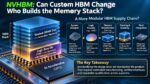
NVIDIA’s NVHBM could change more than how memory connects to an AI accelerator. It could also change how the semiconductor industry divides responsibility for designing, manufacturing, and qualifying high-bandwidth memory.
According to October 18 reporting from Seoul Economic Daily, NVIDIA has asked Samsung, SK … Read More
Teradyne has announced Magnum E2, a memory test system designed to address the increasingly demanding interfaces used in artificial intelligence and high performance computing. The platform targets advanced DRAM and flash technologies, including LPDDR6, DDR6, GDDR7, and NAND flash, while combining engineering and production… Read More
Charlie Cheng is CEO of TeRAM, with four decades of technology experience focused on microprocessor architecture and semiconductor memory. Before TeRAM, he worked on several AI processors, including multiple generations of Meta’s MTIA accelerators beginning in 2019. Previously, he served as CEO of Kilopass, a semiconductor… Read More
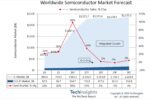
The semiconductor industry is entering an extraordinary growth phase, driven primarily by artificial intelligence infrastructure and the severe supply constraints surrounding advanced logic and memory devices. According to the McClean Report’s June 2026 update, the global semiconductor market is forecast to grow 98.3%… Read More
Dr. Il Park is the Founder and CEO of Primemas Inc. Prior to founding Primemas, he was Vice President at SK hynix where he led memory solutions, design innovation, and CAE. Prior to that he was the head of the SOC architecture development and engineering team at Samsung Electronics. Earlier in his career, Il was at IBM T.J. Watson Research… Read More
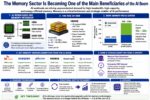
The explosive growth of artificial intelligence is transforming the semiconductor industry, and nowhere is this more evident than in the memory sector. AI training and inference workloads are fundamentally memory-intensive, driving unprecedented demand for advanced DRAM architectures, High Bandwidth Memory (HBM), and… Read More
The patterning of features outside a DRAM cell array can be just as challenging as those within the array itself [1]. The array contains features which are densely packed, but regularly arranged. On the other hand, outside the array, the minimum pitch features, such as the lowest metal lines in the periphery for the sense amplifier… Read More
By Tetsu Ho
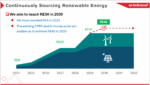
With the ever-increasing global demand for smarter, faster electronic systems, the semiconductor industry faces a dual challenge: delivering high-performance memory while reducing environmental impact. Winbond is meeting this challenge head-on by embedding sustainability into every layer of its operations—from… Read More
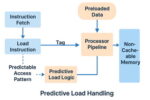
When people talk about bottlenecks in digital signal processors (DSPs), they usually focus on compute throughput: how many MACs per second, how wide the vector unit is, how fast the clock runs. But ask any embedded AI engineer working on always-on voice, radar, or low-power vision—and they’ll tell you the truth: memory stalls … Read More
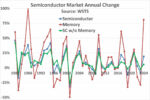
The December 2024 WSTS forecast called for strong 2024 semiconductor market growth of 19%. However, the strength is limited to a few product lines. Memory is projected to grow 81% in 2024. Logic is expected to grow 16.9%. The micro product line should show only 3.9% growth, while discretes, optoelectronics, sensors and analog … Read More