





One Year Later — September 2026
When this piece first ran a year ago, VSORA was the quiet outsider, a company with a bold architecture and no Silicon Valley address. One year on, the thesis has held up better than even its author expected. In January 2026, Sandra Rivera, former CEO of Altera and, before that, a two-decade Intel veteran who led its Data Center and AI Group, assumed the role of Chair of VSORA’s Board, bringing a Silicon Valley heavyweight to the French challenger’s boardroom. On the product side, Jotunn8, the company’s flagship inference processor, moved from architecture to silicon: taped out on TSMC’s 5nm process with CoWoS packaging, showcased alongside Global Unichip at the TSMC Europe Technology Symposium, and now entering manufacturing. In July 2026, Ardian Semiconductor, the semiconductor-dedicated arm of the €200bn private-markets firm, took a minority stake to accelerate Jotunn8’s go-to-market. And VSORA now sits among the named partners of AION, the roughly €10bn French bid to host one of the EU’s sovereign AI “gigafactories.” The disrupter 5,000 miles from the Valley didn’t just keep pace. It shipped, and drew the Valley to it.
Since the fall of the Roman Empire, France has played a defining role in shaping Western civilization. In the 9th century, Charlemagne, a Frank, united much of Europe under one rule, leaving behind a legacy so profound he is still remembered as the “Father of Europe.” While Italy ignited the Renaissance, it was 16th-century France that carried its torch across the continent, elevating the arts and laying the groundwork for broader cultural transformation.
The Age of Enlightenment and the subsequent Age of Reason, both rooted in French intellectual movements, revolutionized thinking across philosophy, science, and governance. The French Revolution helped dismantle aristocratic privilege and paved the way for the rise of the bourgeoisie. Even Napoleon, despite the chaos he unleashed across Europe, gifted the world the Napoleonic Code—an enduring foundation for modern legal systems.
In every domain, from science to medicine, philosophy to administration, France has left a deep and lasting imprint on the modern world.
So what happens when French intellectual rigor meets the fast-paced ecosystem of Silicon Valley?
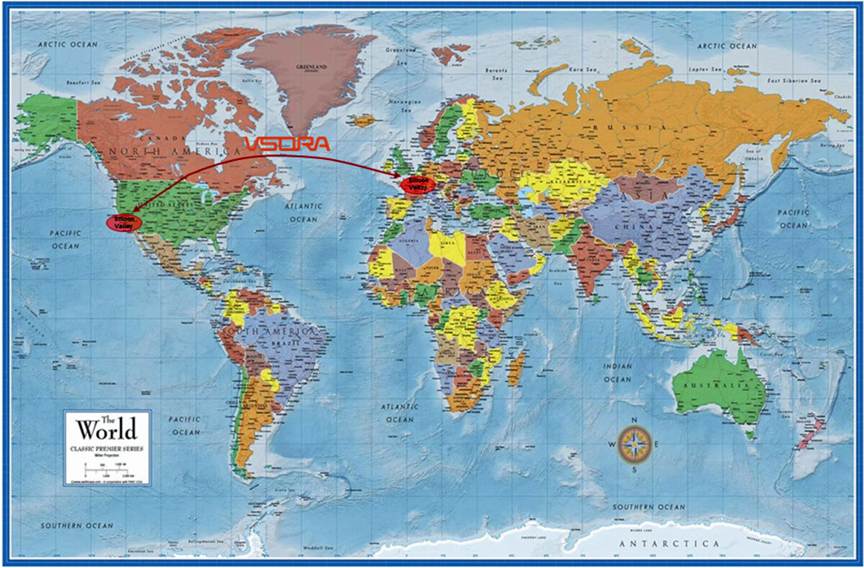
That question was answered, quietly but impactfully, by a French disrupter headquartered in Velizy, just outside Paris. With no presence in the United States and no built-in connections to the Valley’s tightly knit circles, the company, VSORA, could have easily been left behind. But instead, it charted its own path, and in doing so, emerged as the only viable European competitor in the AI processors landscape.
Silicon Valley is a unique environment. It’s a place where innovation buzzes in the air, where information flows freely—not in the form of stolen secrets, but through subtle signals: a parking lot that suddenly gets packed, alerting you that something is happening, a recruiter’s call to pitch new job openings, a whisper at a coffee shop. It’s a network-driven ecosystem that rewards proximity and speed. Simply being there can offer a six-month head start compared to companies based overseas, who rely on trade publications and conferences to stay informed.
This constant, near-invisible stream of information means that companies in the Valley evolve together, each pivot triggering a cascade of similar moves by competitors. Keeping up isn’t optional. It’s survival.
And yet, VSORA managed to not only keep up but lead—despite operating 5,000 miles away. How? By staying true to its own process of innovation. Without the distraction of Silicon Valley’s echo chamber, the engineers in France developed a breakthrough hardware architecture to accelerate AI inference in data centers and at the edge that set them apart.
Ironically, it was their outsider status that became their strength.
However, recognizing the importance of proximity to the U.S. market and the advantages of the Valley’s information network, VSORA is anticipating the opening of a design center in Silicon Valley to provide the company with a critical foothold in the region while preserving its basic engineering in France.
The result: a hybrid model that leverages the best of both worlds.
But managing transatlantic teams comes with challenges. With a nine-hour time difference, coordinating workflows demands more than just good intentions. By adopting a range of collaborative tools, such as instant messaging, conference calls for complex discussions, wikis for shared documentation, and periodic in-person meetings VSORA plans to strengthen team cohesion and aligns strategic goals.
Technology can bridge time zones, but it cannot replace trust and shared purpose. And it certainly can’t replicate the magic of Silicon Valley, unless you know how to channel it from afar.
A year on, the evidence is in. VSORA didn’t win by relocating to the Valley or borrowing its rhythms; it won by executing on its own: silicon in fabrication, tier-one manufacturing partners, institutional capital, and a seat at the table in Europe’s push for AI sovereignty. And in a telling reversal, the Valley came to it: one of Intel’s most senior former executives now chairs its board. The Silicon Valley foothold may still come, and proximity to the U.S. market will matter. But the past twelve months have made the deeper point unmistakable: with discipline, vision, and a bit of French-inspired finesse, it’s possible not just to compete with Silicon Valley from the outside, but to thrive, lead, and even shape it.
Also Read:
Rethinking AI Chips: How VSORA Redesigned the Hardware That Runs AI
An AI-Native Architecture That Eliminates GPU Inefficiencies
VSORA Board Chair Sandra Rivera on Solutions for AI Inference and LLM Processing
Share this post via:




Comments
There are no comments yet.
You must register or log in to view/post comments.