






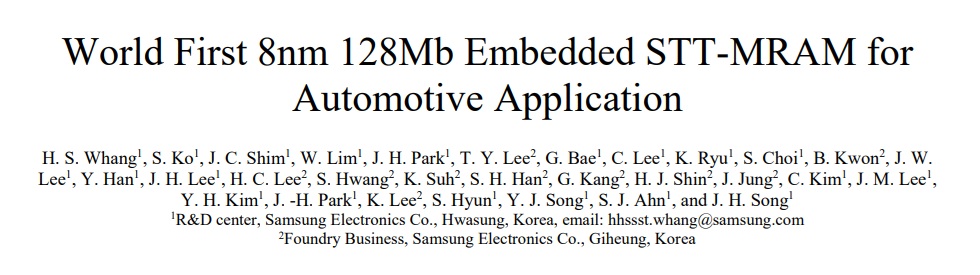
The rapid evolution of automotive technology has intensified the demand for highly reliable, high-performance semiconductor memory solutions. Modern vehicles increasingly rely ADAS driving features, and complex infotainment platforms, all of which require memory that can operate flawlessly under extreme environmental conditions. Among emerging memory technologies, embedded magnetic random access memory (eMRAM) stands out as a compelling candidate due to its non-volatility, high endurance, and fast read/write capabilities. The development of an 8nm 128Mb embedded STT-MRAM specifically tailored for automotive applications represents a significant technological milestone in this field.
One of the primary challenges in automotive memory design is ensuring reliable operation across a wide temperature range, typically from –40°C to 150°C. Unlike consumer electronics, automotive systems must maintain data integrity and functional stability even under prolonged exposure to high temperatures. This stringent requirement places considerable pressure on memory architectures, particularly when scaling down to advanced process nodes such as 8nm. Shrinking the technology node increases memory density and performance but also introduces heightened risks of failure mechanisms, including short defects, read margin degradation, and retention loss.
A major breakthrough in the 8nm 128Mb eMRAM development lies in the aggressive scaling of the memory cell to 0.017 μm². While this scaling enables higher density and improved integration with advanced logic nodes, it also intensifies process complexity. Higher bitcell density increases the probability of short failures due to redeposition and patterning challenges during fabrication. To address this, improvements in integration processes significantly reduced in-line defect counts, resulting in a substantial decrease in median short fail bit counts. Achieving sub-parts-per-million (sub-ppm) levels of short failure demonstrates that high-density scaling can coexist with automotive-grade reliability when supported by meticulous process optimization.
Another critical concern in scaled MRAM technology is maintaining sufficient read margin. As the back-end-of-line (BEOL) thermal budget increases in advanced nodes, thermal migration can degrade the magnetic tunnel junction (MTJ) properties, particularly the tunneling magnetoresistance (TMR). A lower TMR reduces the resistance gap between parallel (P) and anti-parallel (AP) states, narrowing the sensing window and increasing the risk of read errors. By optimizing the MTJ stack, especially through fine-tuning the free layer composition, the design achieved improved thermal tolerance. In fact, enhanced crystallization of the MgO barrier after thermal treatment led to an increase in TMR, thereby widening the read margin. Combined with patterning improvements that drastically suppressed inter-cell leakage, these advancements enabled ppm-level read failure rates even at elevated temperatures.
Write performance and data retention present another delicate trade-off. Automotive specifications demand both low write error rates (WER) and robust long-term retention, often exceeding 20 years at high temperatures. However, optimizing for easier write switching can compromise thermal stability, and vice versa. To balance this trade-off, pinned layer optimization was employed to tailor asymmetry between P and AP switching characteristics. By carefully adjusting the magnetic stack, engineers identified an optimal asymmetry point that minimized overall bit error rates while preserving retention strength. Furthermore, reducing the temperature dependence of switching current improved write reliability at low temperatures, where higher currents are typically required.
In addition to pinned layer refinement, enhancements in spin-transfer torque (STT) efficiency further reduced switching current requirements without sacrificing thermal stability. Improved MTJ engineering broadened the switching current window, lowering the voltage necessary to meet WER specifications while significantly improving distribution tail behavior. These refinements resulted in sub-ppm levels of both write error rate and retention bit error rate, effectively eliminating yield loss related to these failure mechanisms.
Finally, comprehensive chip-level validation confirmed full functionality of write and read operations across the entire automotive temperature range. Shmoo plot analyses demonstrated robust voltage and timing margins, with read speeds as fast as 8ns under worst-case conditions. This performance underscores not only reliability but also competitiveness in high-speed embedded applications.
Bottom line: The successful realization of an 8nm 128Mb embedded STT-MRAM for automotive use demonstrates that aggressive scaling and stringent reliability requirements can be achieved simultaneously. Through innovations in integration processing, MTJ stack engineering, and magnetic layer optimization, this technology meets sub-ppm failure targets while delivering high performance across extreme temperatures. Such advancements position eMRAM as a leading memory solution for next-generation automotive electronics, paving the way for safer, smarter, and more connected vehicles.
Also Read:
Memory Matters: Signals from the 2025 NVM Survey
Akeana Partners with Axiomise for Formal Verification of Its Super-Scalar RISC-V Cores
SiFive’s AI’s Next Chapter: RISC-V and Custom Silicon
Ceva IP: Powering the Era of Physical AI
Share this post via:



Musk’s Orbital Compute Vision: TERAFAB and the End of the Terrestrial Data Center