




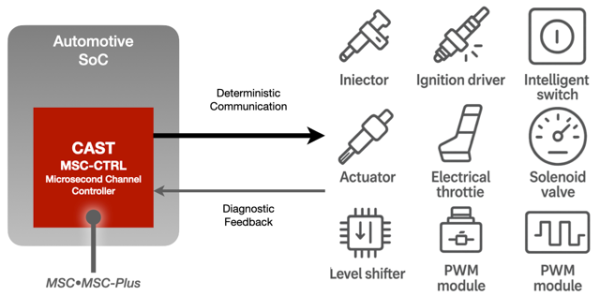

In a significant advancement for automotive electronics, Semiconductor intellectual property provider CAST has unveiled the MSC-CTRL Microsecond Channel Controller IP core. This new core empowers ASIC and FPGA designers with a deterministic, microsecond-precise serial interface for connecting to smart power and sensor devices. As vehicles evolve toward greater electrification and autonomy, the demand for custom SoCs that integrate advanced control and diagnostics has surged. Traditionally, designers relied on specific MCUs for such interfaces, but CAST’s offering provides a flexible, licensable alternative, enabling broader innovation in automotive subsystems.
The MSC-CTRL core stands out for its multi-protocol support, consolidating several variants of the Microsecond Channel technology into a single configurable block. This includes the standard Microsecond Channel (MSC), the enhanced Microsecond Channel Plus (MSC-Plus), and compatibility with the foundational Microsecond Bus (µSB) concept from early engine-control systems.
Peter Dumin, CAST’s senior product manager, emphasized the core’s role in modern designs: “Customers are pushing more control and diagnostics into their own SoCs, but still need the precise timing and rich feedback they get from MSC-based power and sensor devices.” By embedding this IP, engineers can create custom interfaces that rival those in proprietary MCUs, fostering competition and customization in the automotive sector.
From a technical standpoint, the core integrates seamlessly as a 32-bit AMBA APB peripheral on the system side. It features DMA-friendly triggers, interrupts, and configuration registers, making it straightforward to incorporate into platforms like AUTOSAR-based engine control units. This compatibility allows it to operate beneath the AUTOSAR Microcontroller Abstraction Layer or complex drivers, streamlining software development. The protocol’s heritage in short-reach, chip-to-chip links—connecting controllers to actuators like injector drivers, ignition coils, or sensor front ends—ensures low-latency communication essential for real-time applications.
What truly sets MSC-CTRL apart is its emphasis on deterministic timing, a critical factor in real-world actuator control. Unlike generic SPI or network buses, MSC technology guarantees microsecond-accurate actuation aligned with the controller’s timers. Latency and jitter are bounded and predictable, simplifying control-loop design and calibration. Additionally, a dedicated upstream channel delivers detailed status and diagnostics from external devices, eliminating the need for separate return lines per slave as in traditional PWM setups. This shared channel supports multiple slaves efficiently, reducing wiring complexity and enhancing system reliability. Engineers can thus confidently predict that “this injector, coil, or valve channel will switch at this time, every cycle,” even over a shared serial bus.
Functional safety is another cornerstone, with built-in features tailored for ISO 26262-compliant designs. These include communication-integrity checks like parity on critical paths, configurable glitch and spike filtering, timeout detection, and diagnostic flags with interrupts for error reporting. A hardware emergency-stop mechanism allows safe halting of outputs without CPU intervention, vital in safety-critical scenarios. For ASIL-classified systems, CAST offers an optional ISO 26262 ASIL-B safety package, comprising a Safety Manual, Failure Modes, Effects, and Diagnostic Analysis (FMEDA), and Failure Modes and Effects Analysis (FMEA). This package accelerates integration into SoC-level safety assessments, reduces the burden of treating the IP as a “black box,” and helps demonstrate compliance with functional-safety goals for timing-critical communications.
MSC-CTRL complements CAST’s broader automotive IP portfolio, including controllers for TSN, CAN, LIN, and SENT buses. This synergy enables engineers to construct end-to-end interfaces—from vehicle-level networks to the final actuator wiring—all sourced from one vendor, minimizing integration risks and accelerating time-to-market.
Available now royalty-free for ASIC and FPGA implementations, the core positions CAST as a key player in automotive innovation. Founded in 1993, CAST specializes in silicon IP, offering microcontrollers, processors, compression engines, and security modules for diverse applications. For details, interested parties can contact CAST at info@cast-inc.com or visit www.cast-inc.com.
Bottom line: This launch arrives at a pivotal moment, as the automotive industry grapples with the complexities of electric vehicles and advanced driver-assistance systems (ADAS). By democratizing access to high-precision interfaces, MSC-CTRL could accelerate the shift toward more integrated, efficient, and safe automotive electronics.
Also Read:
CAST Simplifies RISC-V Embedded Processor IP Adoption with New Catalyst Program
RANiX Employs CAST’s TSN IP Core in Revolutionary Automotive Antenna System
CAST Webinar About Supercharging Your Systems with Lossless Data Compression IPs
Share this post via:



Comments
There are no comments yet.
You must register or log in to view/post comments.