You are currently viewing SemiWiki as a guest which gives you limited access to the site. To view blog comments and experience other SemiWiki features you must be a registered member. Registration is fast, simple, and absolutely free so please,
join our community today!
WP_Term Object
(
    [term_id] => 6435
    [name] => AI
    [slug] => artificial-intelligence
    [term_group] => 0
    [term_taxonomy_id] => 6435
    [taxonomy] => category
    [description] => Artificial Intelligence
    [parent] => 0
    [count] => 948
    [filter] => raw
    [cat_ID] => 6435
    [category_count] => 948
    [category_description] => Artificial Intelligence
    [cat_name] => AI
    [category_nicename] => artificial-intelligence
    [category_parent] => 0
    [is_post] =>
)
Modern ASIC, SoC, CPU, and GPU development depends on verification processes that detect subtle functional defects before tapeout. SystemVerilog Assertions (SVA) are particularly important because they encode temporal design intent: how signals, states, and transactions must behave across clock cycles. Unlike conventional… Read More
Artificial intelligence performance is increasingly constrained by memory rather than arithmetic throughput. Scaling laws show that model quality improves when parameter count, training data, and compute grow together, but this balance fails when processors cannot obtain operands quickly enough. Contemporary accelerators… Read More
TSMC’s photonics strategy is centered on integrating optical input-output with advanced logic, rather than selling conventional optical transceivers as standalone products. The company is developing a silicon-photonics foundry platform and a packaging architecture called TSMC-COUPE, or Compact Universal Photonic … Read More
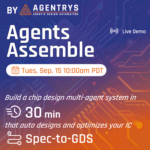
Agentrys believes that a purpose-built multi-agent system for chip design shouldn’t be a quarter-long project. Agentic AI systems are becoming quite popular to cut design time and increase quality for complex chip design projects. The challenge is finding the right agentic flow for a particular application. There are… Read More
The semiconductor industry doesn’t have a shortage of data. It has a shortage of ways to turn that data into useful manufacturing insights quickly enough to matter.
That is the problem PDF Solutions’ Exensio solution has addressed for years. Built specifically for semiconductor manufacturing, Exensio brings … Read More
DAC 2026 proved that agentic AI design flows are here to stay. The news was conveyed both by familiar companies who we’ve seen at DAC many times before as well as new entrants to the show and the industry. Many of the solutions that were presented focused on a specific part of the design flow. Others took a broader view of the problem and… Read More
Daniel is joined by Ed Nelson, Strategy Director and Co-Founder of AI Infra Summit. He co-leads the production team and specializes in product strategy and management, keynote speaker acquisition and VIP network development. Ed started the summit in 2018 and has spent nearly ten years as part of the team building AI Infra Summit… Read More
I believe this year’s DAC will be viewed as the time and place where EDA experienced a major shift. That is, the shift from the value of tools and methodology to the value of agentic design flows powered by highly trained agents. The design community will clearly need the tools and methodologies that have occupied DAC for years. But… Read More
Jerry Chen, CEO and Founder of Upbeat Technology, received his Master of Science in ECE from the University of Texas at Austin. Started working as an IC design engineer in Silicon Valley at Intel, Lucent, Apple, and Procket Network since 1995. Later transitioned into Technical Marketing roles, serving as Director of Marketing… Read More
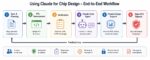
After speaking with dozens of semiconductor professionals at the Design Automation Conference in Long Beach about AI in the chip-design workflow, Claude emerged as the common denominator in every conversation. We’re still at the tip of the iceberg when it comes to using AI in the design flow. If management is pushing your team … Read More












ChipAgent Raises $134Million and Why it Matters