You are currently viewing SemiWiki as a guest which gives you limited access to the site. To view blog comments and experience other SemiWiki features you must be a registered member. Registration is fast, simple, and absolutely free so please,
join our community today!
            WP_Term Object
(
    [term_id] => 497
    [name] => Arteris
    [slug] => arteris
    [term_group] => 0
    [term_taxonomy_id] => 497
    [taxonomy] => category
    [description] =>
    [parent] => 178
    [count] => 177
    [filter] => raw
    [cat_ID] => 497
    [category_count] => 177
    [category_description] =>
    [cat_name] => Arteris
    [category_nicename] => arteris
    [category_parent] => 178
    [is_post] =>
)

WP_Term Object
(
    [term_id] => 497
    [name] => Arteris
    [slug] => arteris
    [term_group] => 0
    [term_taxonomy_id] => 497
    [taxonomy] => category
    [description] =>
    [parent] => 178
    [count] => 177
    [filter] => raw
    [cat_ID] => 497
    [category_count] => 177
    [category_description] =>
    [cat_name] => Arteris
    [category_nicename] => arteris
    [category_parent] => 178
    [is_post] =>
)
Rapid advances in medical technology prolong patients’ lives and provide them with a higher standard of living than years past. But the increased interconnectivity of those devices and their dependence on wired and wireless networks leave them susceptible to cyberattacks that could have severe consequences.
Whether… Read More
Atiq Raza, well known in the semiconductor industry, has observed that “there will be no simple chips below 16nm”. By which he meant that only complex and therefore high value SoCs justify the costs of deep submicron design. Getting to closure on PPA goals is getting harder for such designs, especially now at 7nm and 5nm. Place and… Read More
The semiconductor ecosystem consolidation continues with an interesting acquisition of an EDA company by an IP company. Having worked with both Arteris and Semifore over the past few years I can tell you by personal experience that this is one of those 1+1=3 types of acquisitions, absolutely.
Semifore was founded in 2006 by a team… Read More
Whenever a new partnership is announced, the natural question is, “why?” What will this partnership make possible that wasn’t already possible with those two companies working independently? I talked yesterday with Frank Schirrmeister of Arteris on the partnership. (Yes, Frank is now at Arteris). And I just got off an Arm press… Read More
Dan is joined by Michal Siwinski, Chief Marketing Officer for Arteris IP. Arteris provides network-on-chip interconnect semiconductor IP and deployment technology to accelerate SoC development and integration for a wide range of applications from AI to automobiles, mobile phones, IoT, cameras, SSD controllers, and servers.… Read More
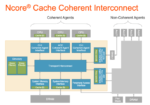
Ever wonder why coherent networks are needed beyond server design? The value of cache coherence in a multi-core or many-core server is now well understood. Software developers want to write multi-threaded programs for such systems and expect well-defined behavior when accessing common memory locations. They reasonably expect… Read More
Scalability – A Looming Problem in Safety Analysis
The boundless possibilities of automation in cars and other vehicles have captivated designers to the point that electronic content is now a stronger driver of differentiation than any other factor. It accounts for a substantial fraction of material cost in any of these vehicles.… Read More
It is common when a new type of analysis is introduced in almost any domain that it works well enough for a while. Until it begins to struggle with growing problem size, prompting refinements to the methodology to allow continued scaling. We see this routinely in analytics for SoC design, so it should not be a big surprise that safety… Read More
In the SoC world, we can’t believe our good luck. Every product maker now wants bespoke silicon solutions with the most advanced AI, communications, SLAM, etc. Which is fantastic for business, but this level of demand also drags us into a new level of accountability, especially in requirements traceability. Time was that only … Read More
It is difficult to imagine an SoC development team not using some form of automation to assemble their SoCs; the sheer complexity of the assembly task for modern designs is already far beyond hand-crafted top-level RTLs. An increasing number of groups have already opted for solutions based on the IP-XACT integration standard.… Read More