





Intel’s 18A process technology has become one of the most scrutinized semiconductor manufacturing nodes in the industry. It represents Intel’s introduction of two major innovations: RibbonFET gate-all-around (GAA) transistors and PowerVia backside power delivery (BSPD). These technologies are intended to improve transistor performance, power efficiency, and overall chip density while helping Intel regain process leadership. However, Intel’s roadmap does not stop with 18A. The company has introduced Intel 18A-P, an enhanced version of the 18A platform that offers significant improvements in performance, power, thermal behavior, and design flexibility.
At first glance, Intel 18A-P may appear to be simply a minor revision of Intel 18A. In reality, it is a strategically important process enhancement that allows Intel and its foundry customers to achieve better product performance without waiting for the next major node, Intel 14A. Similar to how TSMC has developed optimized versions of its process technologies such as N5P and N3P, Intel 18AP extracts additional value from the 18A technology platform while maintaining compatibility with existing designs.
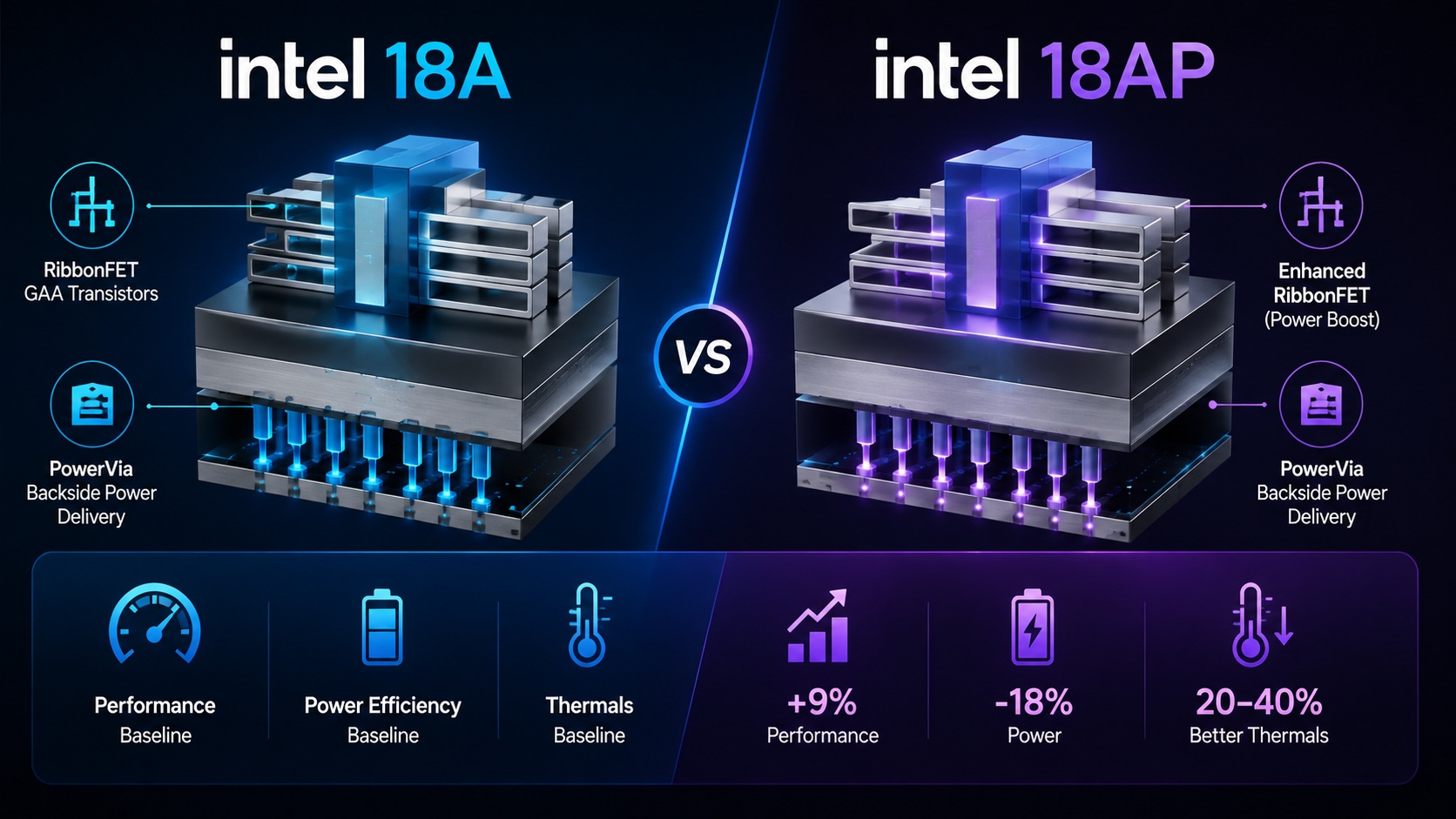
Both Intel 18A and Intel 18A-P utilize RibbonFET transistors and PowerVia backside power delivery. RibbonFET replaces the traditional FinFET structure with stacked nanosheets that provide improved electrostatic control of the transistor channel. PowerVia moves power routing to the backside of the wafer, reducing congestion on signal routing layers and improving overall performance. These innovations are foundational technologies shared by both nodes.
The primary difference is that Intel 18A-P incorporates several optimizations that improve power, performance, and thermal characteristics. Intel has disclosed that 18A-P can provide approximately 9% higher performance at the same power level or about 18% lower power consumption at the same performance level compared with standard 18A. These are substantial improvements, particularly in markets where energy efficiency and performance per watt are critical.
Intel 18A-P also introduces additional transistor options, including enhanced RibbonFET variants sometimes referred to as “Power Boost” devices. These allow designers to optimize different sections of a chip for maximum speed, lower leakage, or improved efficiency. The process also includes interconnect enhancements that reduce resistance, helping signals travel more efficiently through the chip.
Another significant improvement is thermal performance. Intel has indicated that 18A-P reduces thermal resistance by approximately 20% to 40% compared with 18A. Better thermal behavior means heat can be removed more effectively from the silicon, allowing chips to sustain higher performance levels without exceeding thermal limits. This is especially important for artificial intelligence accelerators, high-performance computing devices, and next-generation server processors.
From a design perspective, one of the most attractive aspects of 18AP is its compatibility with 18A. Customers that begin development on 18A can migrate to 18A-P with relatively limited redesign effort. This reduces risk while providing access to improved power and performance characteristics. For foundry customers, this compatibility can significantly shorten development cycles and lower engineering costs.
Why does this matter? The semiconductor industry is increasingly driven by performance-per-watt requirements rather than raw transistor scaling alone. Data centers, AI systems, and advanced computing platforms demand greater efficiency because power consumption and cooling costs are becoming major constraints. A process technology that delivers nearly double-digit performance gains and significant power reductions can directly affect product competitiveness and profitability.
For Intel Foundry, 18A-P is also strategically important because it demonstrates that Intel can offer customers not only breakthrough technologies but also a mature roadmap of optimized derivatives. The availability of 18A-P provides customers with confidence that their investments in 18A-based designs can continue to deliver improved results over time.
Bottom line: Intel 18A introduced the revolutionary technologies of RibbonFET and PowerVia, while Intel 18A-P refines and enhances those innovations. The result is higher performance, better energy efficiency, improved thermal behavior, and greater design flexibility. For both Intel and its foundry customers, 18A-P represents an important bridge between the initial 18A generation and future nodes such as Intel 14A, making it one of the most significant process enhancements in Intel’s recent manufacturing road map.
See More About Intel Process Innovation
Also Read:
The Yield Partnership: Intel and PDF Solutions Tackle Advanced Nodes
Intel: Pushing EMIB Forward: Design Methodology Insights with Synopsys Tools
Share this post via:



Comments
One Reply to “Intel 18A vs Intel 18A-P: What Is the Difference and Why Does It Matter?”
You must register or log in to view/post comments.