





One of the most difficult things to do in life is ask for help. This is inherently a big problem in the semiconductor industry dating back to the IDM days where silos of secrecy were established. As a result Intel has struggled with yield since the 14nm FinFET process nodes.
On the outside PDF Solutions is a publicly traded semiconductor analytics and manufacturing software company (NASDAQ: PDFS) headquartered in Santa Clara, California. The company helps chipmakers improve manufacturing yield, quality, reliability, and profitability by collecting and analyzing data from semiconductor fabrication, testing, assembly, and field operations.
On the inside PDF Solutions is the #1 yield expert working with the top semiconductor manufacturers in the world. 18 out of the top 20 semiconductor companies have worked with PDF. Founded in 1991 by John K. Kibarian and Kimon W. Michaels, the company was created to address semiconductor manufacturing yield and process-control challenges using data analytics, software, and engineering solutions.
In July of 2025, Intel and PDF Solutions announced a collaboration that redefines advanced semiconductor manufacturing. Lip-Bu Tan and John Kibarian shared a stage and clearly have an active executive-level business relationship through Intel Foundry and PDF Solutions. Given their long careers in the EDA and the semiconductor industry, they most certainly have known each other professionally for some time. From what I hear inside the ecosystem that relationship is quite close with both CEOs managing the projects directly.
Intel CEO Lip-Bu Tan has emphasized the importance of improving manufacturing execution and operational discipline as Intel works to strengthen its foundry business. Yield improvement sits at the center of that effort. While equipment suppliers, EDA vendors, and process technology teams all contribute to manufacturing success, data analytics providers such as PDF Solutions have become increasingly important partners in enabling advanced-node production.
Intel’s success with its 18A/P process technology has become one of the semiconductor industry’s most closely watched stories. After years of manufacturing challenges, Intel has made significant progress toward restoring confidence in its technology roadmap and foundry ambitions. A key element of that success is yield improvement, an area where Intel has increasingly collaborated with ecosystem partners such as PDF Solutions.
Yield learning has become exponentially more difficult at advanced process nodes. Technologies such as RibbonFET gate-all-around transistors and PowerVia backside power delivery, both introduced with Intel 18A, create new process integration challenges and dramatically increase the amount of manufacturing data generated throughout wafer fabrication. Traditional statistical process control methods are no longer sufficient to identify the subtle interactions that can impact yield at these levels of complexity.
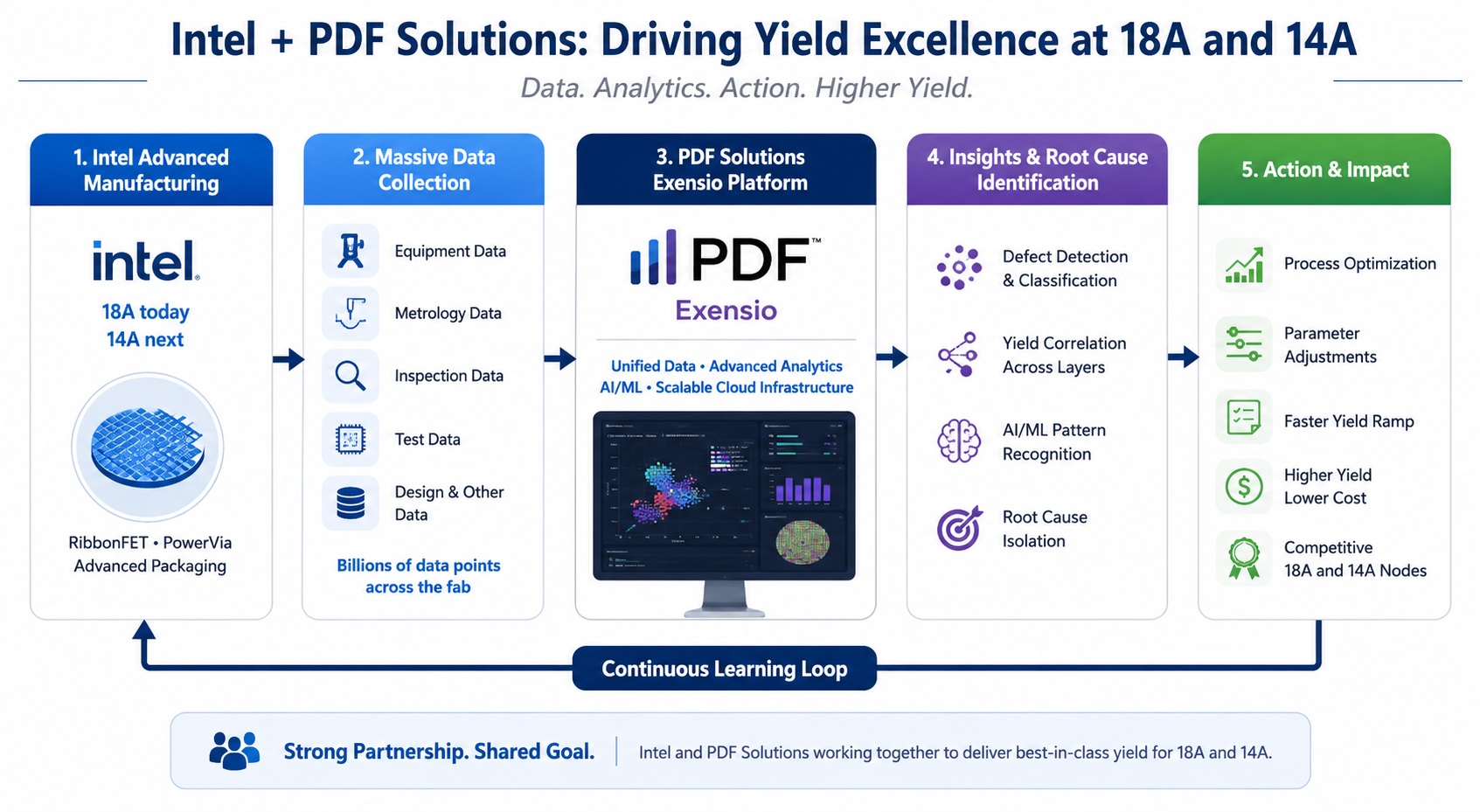
This is where PDF Solutions plays a strategic role. The company has spent decades developing yield management, process control, and manufacturing analytics technologies used throughout the semiconductor industry. Its Exensio platform combines data from equipment, metrology, inspection, test, and design sources into a unified analytics environment capable of identifying yield limiters and accelerating root-cause analysis.
For Intel 18A-P, yield learning is particularly critical because the node serves multiple strategic objectives simultaneously. It is expected to support Intel’s own products while also serving as a cornerstone technology for Intel Foundry customers. Achieving competitive yields is essential not only for cost reduction but also for demonstrating foundry credibility. Customers evaluating Intel Foundry require confidence that manufacturing processes can deliver predictable performance, quality, and volume production.
PDF Solutions’ analytics capabilities help address this challenge by enabling faster identification of defect patterns, process excursions, and systematic yield loss mechanisms. Modern fabs generate enormous volumes of data from thousands of process steps, and extracting actionable insights requires sophisticated software infrastructure. By leveraging advanced analytics and AI-driven methodologies, Intel can potentially shorten learning cycles and accelerate yield ramp timelines.
Why this Matters
The collaboration becomes even more important when considering Intel’s roadmap beyond 18A-P. Intel 14A is expected to introduce additional technology innovations and greater process complexity. Every new node increases the number of variables that must be monitored and optimized. As transistor dimensions shrink and manufacturing tolerances tighten, small variations can have significant impacts on yield and performance.
For 14A, data-driven yield optimization will likely become a foundational requirement rather than a competitive advantage. The combination of advanced process technologies, heterogeneous integration, advanced packaging, and increasingly complex customer designs will require a comprehensive approach to manufacturing analytics. Companies that can transform vast amounts of production data into actionable insights will be better positioned to achieve rapid yield ramps and maintain profitability.
Bottom line: As Intel moves from 18A-P into the 14A era, the partnership with PDF Solutions reflects a broader industry trend: semiconductor leadership is no longer determined solely by transistor innovation. Success increasingly depends on the ability to collect, analyze, and act upon manufacturing data at unprecedented scale. In that environment, yield management platforms and AI-driven analytics are becoming as critical to competitive advantage as the process technologies themselves.
Also Read:
Re-Spins Get You Fired, Says Intel CEO Lip-Bu Tan
ASML High-NA EUV is Not Ready for High-Volume Production
Share this post via:



Comments
One Reply to “The Yield Partnership: Intel and PDF Solutions Tackle Advanced Nodes”
You must register or log in to view/post comments.