Phillip Stanley-Marbell is the founder and CEO of Signaloid. Up until September 2025, he was a full Professor (Chair of Physical Computation) in the Electrical Engineering Division of the Department of Engineering at the University of Cambridge, where he led the Physical Computation Laboratory. He completed his PhD at Carnegie… Read More
Tag: intel
Intel Diamond Rapids: Building Xeon Up, Out, and Through Silicon
Akhilesh Kumar & Krishnakanth Sistla, Intel
Diamond Rapids is Intel’s next-generation Xeon processor, designed around the proposition that hyperscale performance increasingly depends on moving, processing, and protecting data as efficiently as executing instructions. The architecture replaces the conventional… Read More
Intel Wildcat Lake: Right-Sizing Silicon Without Sinking Performance
Lance Hacking, Intel
Intel Core Series 3, code-named Wildcat Lake, is a mainstream client system-on-chip derived from the Panther Lake-based Core Ultra Series 3 architecture. Its design objective is not maximum feature density, but broad deployment of current-generation CPU, graphics, AI, memory, security, and connectivity… Read More
The Twelve-Month Rule Does Not Describe a New Fab
By Nikhil Shah
Capital spending is often treated as if it becomes semiconductor capacity about twelve months later. That can be a useful rule for equipment installed in an existing fab. It is a poor description of a new fab built from the ground up.
I tested the distinction using five advanced-node projects in the United States where… Read More
Podcast EP360: IDA Ireland’s Role to Expand Ireland’s Footprint Across the Semiconductor Ecosystem with Anne-Marie Tierney
Daniel is joined by Anne-Marie Tierney, Divisional Manager at IDA Ireland. Anne-Marie has 24 years’ experience in the global investment environment with IDA Ireland, working across several key roles in Ireland and abroad, positioning Ireland for high impact investments, with a specific interest in semiconductors. Prior … Read More
Intel and TSMC Take Different Paths to High-NA EUV
Intel and TSMC are pursuing the same objective—manufacturing smaller, faster, and more energy-efficient semiconductors—but they have adopted different strategies for advanced lithography. Intel moved early to develop High-Numerical-Aperture Extreme Ultraviolet lithography, commonly called High-NA EUV, while TSMC… Read More
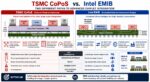
TSMC CoPoS Versus Intel EMIB Semiconductor Packaging
TSMC’s CoPoS, generally described as Chip-on-Panel-on-Substrate, and Intel’s EMIB, or Embedded Multi-die Interconnect Bridge, address the same strategic problem: integrating increasingly large, heterogeneous chiplet systems. However, they attack different physical constraints. CoPoS is an emerging panel-level … Read More
The Yield Partnership: Intel and PDF Solutions Tackle Advanced Nodes
One of the most difficult things to do in life is ask for help. This is inherently a big problem in the semiconductor industry dating back to the IDM days where silos of secrecy were established. As a result Intel has struggled with yield since the 14nm FinFET process nodes.
On the outside PDF Solutions is a publicly traded semiconductor… Read More
Intel: Pushing EMIB Forward: Design Methodology Insights with Synopsys Tools
As advanced packaging becomes a critical enabler for next-generation semiconductor products, Intel continues to drive innovation through its Embedded Multi-die Interconnect Bridge (EMIB) technology. EMIB has emerged as a foundational packaging solution for heterogeneous integration, allowing multiple chiplets and… Read More
Re-Spins Get You Fired, Says Intel CEO Lip-Bu Tan
Intel CEO Lip-Bu Tan’s statement that “re-spins get you fired” reflects the enormous pressure facing semiconductor companies as chip complexity, manufacturing costs, and competitive demands continue to rise. In the semiconductor industry, a “re-spin” occurs when a chip design must be revised and manufactured again because… Read More