




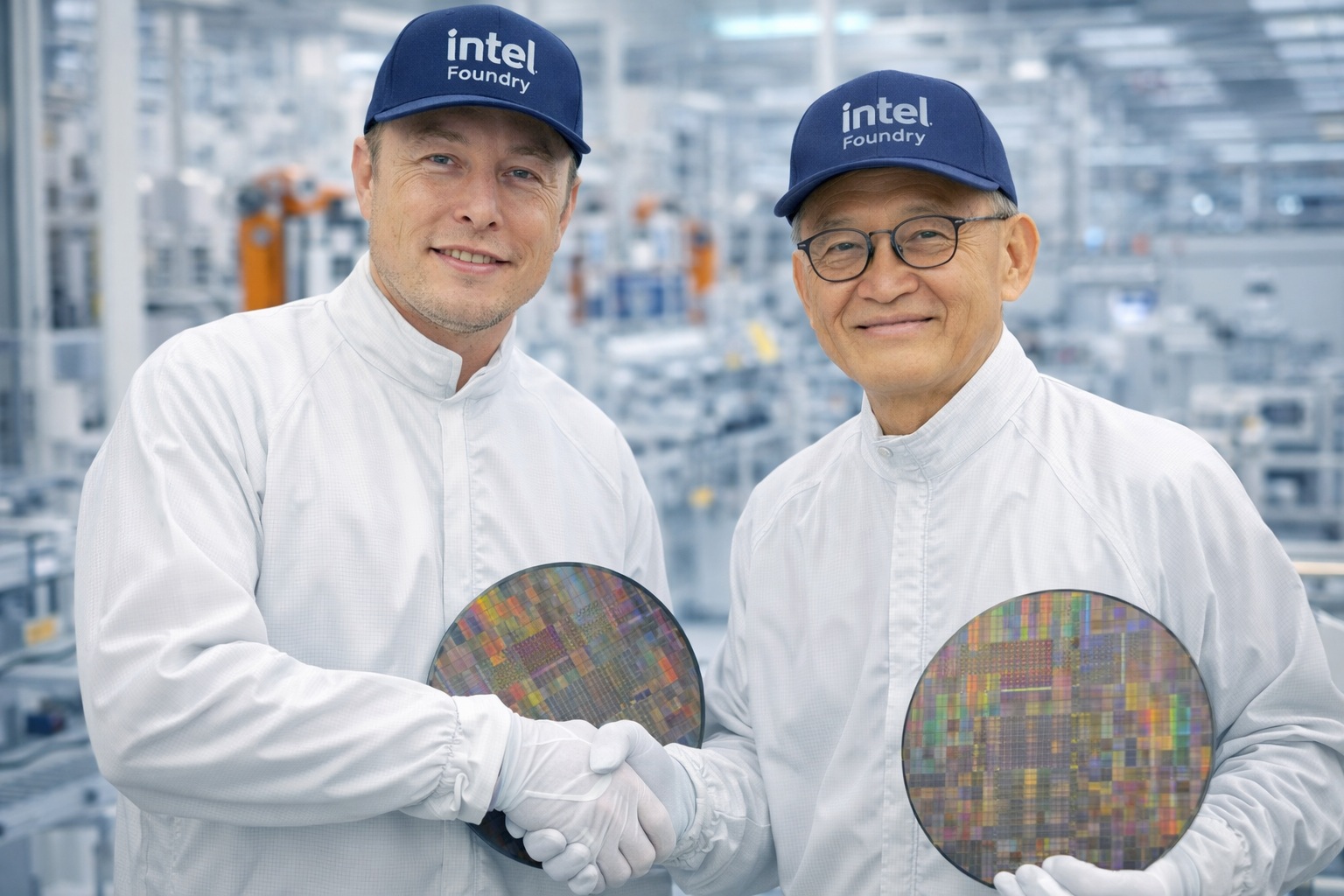

Intel has posted three consecutive years of falling revenue and an $18.76 billion loss in 2024 alone—and the U.S. government has handed it tens of billions of dollars to fix the problem. The government money isn’t fixing the real issue, which isn’t technical. It’s cultural. Intel got slow, political, and risk-averse—the kind of company where decisions take forever and nobody wants to be wrong in a meeting. Meanwhile TSMC, the company Apple relies on to make its iPhone chips, just keeps getting better because it runs its factories like a military campaign. That gap is the problem. And there’s only one guy who might be able to close it.
Elon Musk. Before you roll your eyes, hear the pitch first.
In 2010 Musk picked up the shuttered NUMMI plant—a sprawling East Bay facility that GM and Toyota had just abandoned—for $42 million, which was basically nothing for a five-million-square-foot factory. The workforce that had operated the place under GM was so dysfunctional that even their own union called them the worst in the American auto industry—drinking on the job, deliberate sabotage on the assembly line. The place had a long history of failure before Toyota briefly made it work and then walked away. Musk took the same buildings, retooled them, and built a car factory from scratch inside them. Today it produces nearly 560,000 vehicles a year—30 percent more than NUMMI ever managed at its peak—and it’s now the highest-volume car plant in North America. He didn’t inherit a working operation. He inherited a corpse and built it into the most American-made car company in the country by domestic parts content. The chip that runs it is the one thing he hasn’t figured out how to make in America.
What Musk fixed at Fremont wasn’t the technology. The technology was already there—the buildings, the basic equipment infrastructure, the workforce pool. What he fixed was the culture. The decision velocity. The intolerance for excuses. The willingness to surface problems instead of burying them. He took a factory that had failed under two of the most experienced automotive manufacturers in the world and made it the best in the business—not by inventing new manufacturing physics, but by running the place differently.
Ford, GM, and Toyota didn’t lose to Musk because they lacked engineers or capital or decades of manufacturing experience. They lost because their organizations had calcified. Decisions required consensus. Problems got smoothed over. The gap between what was happening on the floor and what leadership believed was happening grew until it became unbridgeable. Sound familiar? It should. Dylan Patel at SemiAnalysis documented the same process at Intel with analytical rigor—a company that under Andy Grove ran on what he called “constructive confrontation”: data-driven decision-making, extreme accountability, an engineering culture so intense that Pat Gelsinger once described meetings with Grove as “dentistry without Novocaine.” You came in with your numbers or you had no right to be there. That culture made Intel an unstoppable freight train. Then Grove stepped down, and Intel chose its first non-engineer CEO. From that point forward, Patel documents, technical decisions gave way to political ones, fiefdoms replaced accountability, and the organization that had once yelled its way to clarity became one where problems got buried to protect careers.
By the time Bob Swan—a professional CFO on his tenth such role—was running Intel, the company was spending as much on stock buybacks as on capital expenditures for its fabs. That’s not a manufacturing company. That’s a financial engineering operation wearing a semiconductor company’s clothes. Samsung’s own semiconductor leadership admitted the same disease in a staff memo—”the culture of hiding or avoiding problems to get through the moment”—as its best engineers walked out the door for SK Hynix and its customers walked out the door for TSMC. Three different companies—GM, Intel, Samsung. Same organizational failure. Same result.
There is one American industrialist who shares Grove’s essential operating philosophy—and it isn’t anyone running a semiconductor company. Grove ran Intel like a company perpetually one bad decision from irrelevance, even when it dominated the market. Problems surfaced fast because hiding them was more dangerous than fixing them. Decisions got made fast because slow decisions were a form of organizational decay. He’d survived Nazi occupation and Soviet rule before arriving in America with nothing. He knew what institutional failure looked like from the inside. He spent his career making sure Intel couldn’t repeat it.
Musk is a South African immigrant who built his companies in industries where entrenched incumbents had used decades of institutional advantage to avoid the hard work of genuine competition. Both men arrived as outsiders. Both built their credibility through manufacturing discipline rather than inherited position. Both are brutally intolerant of the gap between what leadership believes is happening and what is actually happening on the floor. Grove called it constructive confrontation. Musk calls it “delete the requirement“—if you can’t justify why something exists, remove it. Same philosophy. Different century.
Grove took a memory chip company being destroyed by Japanese competition and transformed it into the dominant microprocessor company in the world—by betting everything on manufacturing and architectural discipline when the old model was failing. Musk took a dead car factory and made it the highest-volume plant in North America—by betting everything on a new operating culture when the old one had failed twice. The semiconductor industry now has a vacancy that looks exactly like the one Grove filled in the 1980s. The question is whether Musk sees himself in that role—not just as a frustrated chip customer, but as the person who can rebuild American semiconductor manufacturing culture the way Grove built it the first time.
The question nobody in the semiconductor industry is asking out loud is: could Musk do to chipmaking what he did to car making?
Intel’s problem isn’t that making advanced chips is physically impossible for Americans. It’s that Intel can’t organize itself to do it with the speed and discipline the job requires. The engineers exist. The equipment exists. What’s missing is an operator willing to run the place like TSMC does—relentlessly, with zero tolerance for excuses and slow decisions. That’s not a technical skill. That’s an organizational one. And it’s exactly what Musk demonstrated he can build at Fremont—turning a production line two global giants had given up on into the most productive car factory in North America.
The obvious pushback is that Musk knows nothing about semiconductor manufacturing. That’s true. But TSMC’s edge is the culture of the people running the factories—how fast they make decisions, how seriously they take yield, how intolerant they are of the kind of bureaucratic drag that paralyzed Intel. You can hire process engineers. You can’t easily hire the operator mindset that makes them work as a unit. Musk had never run a high-volume car factory when he took over Fremont. He knew how to fix a broken manufacturing culture. That turned out to be the only thing that mattered.
And right now, the timing couldn’t be better. Intel is cutting its global workforce by nearly a third—from 109,000 people to a target of 75,000—with no severance packages and no buyouts, just a pink slip and nine weeks of benefits. Process integration engineers, yield development engineers, module technicians: the exact people you need to staff a world-class fab are hitting the job market in waves. Intel is, unintentionally, assembling Musk’s talent pool for him. The broader industry faces a projected shortage of 88,000 engineers by 2029, which sounds like a problem until you realize that the operator who can offer the most compelling mission and the best compensation will win that war. Musk did it at Fremont.
The rest of the world isn’t waiting around to see what America does next.
Jensen Huang just paid $20 billion for Groq—not the company, but its patents, software stack, and people, including founder Jonathan Ross, who built the Language Processing Unit as a purpose-built AI inference chip. The deal is structured as a licensing agreement, letting Nvidia sidestep antitrust review while absorbing a serious competitor in the inference market. The chip itself is already in production—Samsung is manufacturing the Groq 3 LPU on its 4-nanometer process, and Jensen thanked Samsung by name at GTC. Where exactly those wafers are being pulled is Samsung’s business. The irony is that the most strategically significant AI inference chip now being produced for the American market is being made by a South Korean company, designed by technology Nvidia just bought, for a market TSMC and Samsung have every intention of owning.
That’s the landscape. Not one American foundry in that picture.
Japan is making its own move. Rapidus—a government-backed foundry startup in Hokkaido—is racing to put 2-nanometer chips into mass production by 2027. Tokyo has committed $12 billion to the project so far, with Toyota, SoftBank, and Sony behind it. The technology was licensed from IBM. The fab is rising in Chitose, a dairy-farming town near Sapporo that is now home to some of the most advanced lithography equipment on the planet. Rapidus won’t beat TSMC on volume—analysts are clear about that. The pitch is fast turnaround, geopolitical safety, and a manufacturing address that isn’t Taiwan or Seoul. Japan watched its semiconductor industry collapse in the 1990s when Korean and Taiwanese competitors outmaneuvered it on cost and scale. It is not making that mistake again.
But there is a structural problem no amount of government funding solves. The founding keiretsu members—Toyota, Sony, NTT, SoftBank, and the others—aren’t just investors. They were meant to be the anchor customers. The logic was that Japan’s industrial giants would seed the demand that justified the fab. What they haven’t done is commit their chip designs to Rapidus’s unproven process, because doing so means staking their own product roadmaps on a foundry that hasn’t yet demonstrated commercial yield—and that decision has to work its way through the same consensus-driven corporate culture that governs everything else in a keiretsu. The customers and the investors are the same companies. And they’re still watching.
Now look at the playing field. TSMC is the dominant foundry and is not slowing down. Samsung is manufacturing the chips that Nvidia just spent $20 billion to control. Japan is spending $12 billion of public money to build a national foundry from scratch. Intel is firing engineers by the thousands and hoping the bleeding stops. And the United States—the country that invented the semiconductor industry, that created Silicon Valley, that still produces the best chip designers in the world—has no foundry operator with the culture, the speed, or the will to compete at the leading edge.
TSMC is building factories in Arizona right now. That sounds like it solves the problem—American soil, American chips. It doesn’t. It’s still TSMC running the place. It’s not an American company with an American manufacturing culture. It’s a Taiwanese company operating a satellite. And every advanced wafer Arizona can produce through 2027 is already spoken for by Apple, Nvidia, AMD, and Qualcomm. Tesla couldn’t even get in the queue.
Which brings us to the Samsung Taylor fab—and to understand Taylor, you have to understand Samsung’s history in Texas first.
The Austin fab opened in 1996 on what had been a cornfield on the northeast edge of the city—the first foreign-owned semiconductor fabrication plant ever built in the United States. It made chips for Apple’s first iPhones, Nvidia’s early GPUs, and Tesla’s first Autopilot computer. It turned a profit—the first time Samsung had ever done so at a fab outside South Korea. For three decades the Austin fab made money by doing what it was designed to do: mature nodes, established customers, competitive yields, steady execution.
The Taylor fab is a completely different bet. Samsung broke ground there in 2022 with $17 billion in capital and $6.4 billion in U.S. taxpayer money, planning to make 4-nanometer chips. Then AI exploded, the market moved to 2-nanometer, and Samsung pivoted mid-construction—turning a controlled build into chaos. By mid-2024 its 2nm yield was running between 10 and 20 percent, numbers that make chips commercially useless. Samsung pulled back to a skeleton crew and stopped installing equipment. The fab was 92 percent built and effectively dead. No customers. No production. No path forward.
Then Musk signed a $16.5 billion contract to manufacture Tesla’s AI6 chip there—the processor that will power its self-driving cars and Optimus robots. Samsung’s stock jumped nearly 7 percent the day it was announced. Analysts called it transformational. What actually changed was that Samsung had a customer on paper. The yield problem didn’t move. Mass production has since slipped to 2027 at the earliest. Tesla’s AI6 is now running at least six months late because Samsung can’t get its 2nm process stable.
The yield numbers at Taylor are the symptom. The disease runs deeper—and it’s the same disease Dylan Patel documented at Intel. Samsung’s own semiconductor leadership admitted in a staff memo that “the culture of hiding or avoiding problems to get through the moment, and reporting unrealistic plans based solely on hopeful expectations” had spread through the organization. There are credible reports that Samsung Foundry management concealed actual yield data not just from customers but from its own chairman. Qualcomm left over yield failures. Nvidia left. Google left—transferring its Tensor chip to TSMC after years with Samsung. The market share gap between Samsung and TSMC has widened from 35 percentage points in 2019 to nearly 60 points today. That’s not a process problem. That’s an organizational one—the same organizational failure Patel documented at Intel, playing out in a fab near Giga Texas, on chips Musk is waiting for.
The parallel to Fremont is exact. NUMMI failed under GM not because the technology was wrong or the workers were untrainable. It failed because the culture was broken—problems hidden, decisions avoided, accountability diffused across layers of management until nobody owned anything. Musk walked in, ripped out that culture, and replaced it with one where problems surface fast and get fixed faster. The Taylor fab is NUMMI with a cleanroom. The equipment is there. The building is there. The contract is there. The customer, Musk, is there. What’s missing is someone willing to run the place the way TSMC does—and intolerant enough of excuses to fix the yield problem that Samsung’s own leadership has been too hierarchical and too slow to address.
Which is precisely why Taylor is a more compelling entry point for Musk than Intel. Intel is America’s designated semiconductor champion—every move watched, litigated, and second-guessed by Washington. Samsung Taylor is a Korean company’s American asset. The politics don’t follow it. It’s sitting on American soil with American taxpayer money already spent. The fab is built. The equipment is going in. The process node is right. The only thing missing is an operator who can fix the culture and make the yields move.
Musk posted on X that the fab is “conveniently located not far from my house.” It’s 40 minutes from Giga Texas. He is sending his most critical AI chips—the ones that will determine whether Tesla’s autonomous vehicle program lives or dies on schedule—to a fab that can’t yet make them reliably, run by an organization that hid its problems until they became a crisis. Austin proved Samsung can run a profitable American fab. Taylor is proving that having the money to build one and knowing how to run one are entirely different things. And the only reason that fab exists at all is $6.4 billion in American taxpayer money.
That experience—his own supply chain held hostage to a foreign manufacturer’s yield problems, TSMC’s capacity locked out by Apple and Nvidia, the entire U.S. semiconductor strategy resting on companies that aren’t American—appears to have been the breaking point. Musk just announced Terafab: Tesla’s bid to build the chip supply chain America never built for itself. A vertically integrated facility. Logic, memory, and packaging under one roof. Two-nanometer process technology. The stated target is 100,000 wafer starts per month, scaling toward a million.
Nobody should mistake an announcement for a running fab. Semiconductor fabs take years to build and commission. Tesla has zero semiconductor manufacturing experience. Jensen Huang, who knows this industry as well as anyone alive, called the challenge “virtually impossible”—and Huang has every incentive to want more chip production capacity in the world. The skeptics are not wrong about the difficulty. But they said the same thing about the American car industry. That it was mature. That the incumbents were too entrenched. That nobody was going to walk into Detroit’s backyard and outmanufacture Ford, GM, and Toyota on American soil. Musk did it anyway. In Fremont. On a cornfield that became a car lot that became a corpse that became the highest-volume auto plant in North America.
The question no one is asking out loud: what’s the fastest way in?
Building a greenfield 2nm fab from scratch takes years and tens of billions of dollars. Hiring a team capable of running it takes years more. But there’s a 92-percent-complete, $44-billion fab sitting 40 minutes from Giga Texas, already contracted to make Tesla chips, struggling with yield problems that are fundamentally about manufacturing culture—exactly what Musk demonstrated he can fix at Fremont. Intel brings American political complexity, legacy obligations, and a workforce already demoralized by three years of decline. Samsung Taylor brings none of that. It’s a clean asset with a broken culture, a customer already in place, a contract running to 2033, and an operator who told Samsung he would walk the production line personally.
No acquisition has been announced. No takeover is confirmed. But the logic is identical to Fremont—a distressed manufacturing asset, underperforming against its potential, in exactly the right location, making the right product, failing for the reasons Musk has proven he can address.
He didn’t build a new car factory in 2010. He took over a dead one and made it the best in the business.
The vacancy is real. The asset is sitting there. Musk has seen enough—he just announced Terafab, his bid to build the chip supply chain America never built for itself. Whether he starts from scratch or starts 40 minutes from his front door is the only question left.
Also Read:
Intel Foundry: How They Got Here and Scenarios for Improvement
Things From Intel 10K That Make You Go …. Hmmmm
Global 2nm Supply Crunch: TSMC Leads as Intel 18A, Samsung, and Rapidus Race to Compete
Share this post via:



Comments
16 Replies to “Captain America: Can Elon Musk Save America’s Chip Manufacturing Industry?”
You must register or log in to view/post comments.