





Quadric®, Inc., headquartered in Burlingame, California, is accelerating its position as a leading provider of programmable AI inference processor intellectual property (IP) and development tools for on-device AI workloads. The company announced an oversubscribed $30 million Series C funding round, bringing total capital raised to $72 million. This round was led by the ACCELERATE Fund (managed by BEENEXT Capital Management), with participation from returning investors: Uncork Capital and Pear VC, as well as new investors: Volta, Gentree, Wanxiang America, Pivotal, and Silicon Catalyst Ventures.
According to Quadric and reporting by industry outlets, this Series C comes as product revenues more than tripled in 2025 compared to 2024, reflecting strong adoption of the company’s technology across multiple application areas including edge large language models (LLMs), automotive AI processing, and enterprise vision workloads. Executives point to “accelerating design-win momentum” as proof of increasing market traction for Quadric Chimera™ general-purpose neural processor architecture.
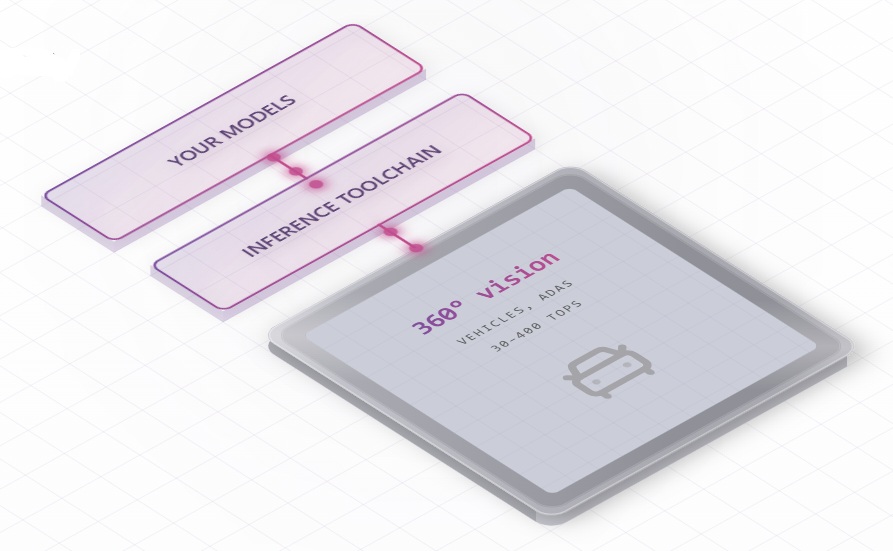
Quadric positions its Chimera™ IP as a fully programmable alternative to fixed-function NPUs that typically dominate the edge AI landscape. Chimera supports both traditional DSP and AI inference tasks on a unified architecture, enabling semiconductor designers to build chips capable of running vision models and on-device LLMs (including models up to ~30B parameters). The architecture is scalable from 1 trillion operations per second (TOPS) up to 864 TOPS, with automotive-grade, safety-enhanced options for ASIL compliance.
Management has emphasized that this software-centric, programmable approach helps shield customers from the risk of obsolescence as model architectures evolve— an advantage over rigid accelerators in a fast-changing landscape.
Strategic License Wins & Ecosystem Expansion
In conjunction with the funding announcement, Quadric also disclosed new licensing wins that underscore the diversity of its target markets. One new licensee is a leading Asia-based edge-server LLM silicon provider, reflecting demand for on-device language model inference at scale.
A second major engagement comes from TIER IV, Inc. of Japan, a leader in autonomous driving software. TIER IV has licensed the Chimera AI processor software development kit (SDK) to evaluate and optimize future iterations of Autoware®, the open-source autonomous vehicle software stack the company pioneers.
The TIER IV engagement illustrates Quadric’s push into automotive and autonomous system markets, where efficient, programmable AI compute is increasingly a differentiator. As AI workloads proliferate in next-generation vehicles—handling perception, planning, and control—Quadric’s SDK provides a pathway for developers to optimize inference for the specific needs of autonomous platforms.
Leadership & Organizational Developments
Quadric has been strengthening its leadership and engineering bench. In December 2025, the company announced the appointment of Ravi Chakaravarthy as Vice President of Software Engineering, a role focused on driving the development of the embedded AI software stack that underpins the Chimera IP and toolchain.
Around the same time, Quadric also added Joachim Kunkel as an independent member of its Board of Directors. Kunkel brings deep industry experience, particularly from his 18-plus years leading Synopsys’ semiconductor IP division. His participation signals Quadric’s intent to scale strategically and benefit from seasoned guidance as it expands its footprint in the AI processor IP ecosystem.
Market Context & Competitive Stance
Quadric’s progress comes against a backdrop of consolidation in the neural processing unit (NPU) IP market. According to industry reporting, the number of startups offering NPU IP has declined as competition intensifies and differentiation becomes more difficult. Quadric’s blend of programmable hardware and comprehensive software tooling is cited by some observers as a key competitive advantage that helps it stand out from both fixed-function accelerator vendors and other IP licensors.
Bottom Line: With this recent funding and expanding customer engagements, Quadric appears positioned to continue its strategy of licensing the Chimera IP and SDK to chipset designers tackling the diverse demands of edge AI, in areas ranging from smart devices and industrial systems to advanced driver assistance and autonomous vehicles.
Quadric also has a new website which, as a website connoisseur, I find quite clever. Click here and check it out.
Also Read:
Quadric: Revolutionizing Edge AI
Legacy IP Providers Struggle to Solve the NPU Dilemna
Recent AI Advances Underline Need to Futureproof Automotive AI
Share this post via:



Comments
There are no comments yet.
You must register or log in to view/post comments.