





Modern automotive electronics are undergoing a rapid transformation driven by increasing compute demands, functional safety requirements, and the shift toward scalable semiconductor architectures. One of the most significant technological developments enabling this transformation is the adoption of multi-die system integration. Multi-die design refers to integrating multiple semiconductor dies—either homogeneous or heterogeneous—into a single package to deliver improved scalability, performance, and reliability. This architectural evolution is particularly relevant for advanced driver assistance systems (ADAS), autonomous driving, and digital cockpit applications, where traditional monolithic system-on-chip (SoC) designs struggle to meet growing requirements.
Automotive environments impose some of the harshest operating conditions for electronics. Devices must withstand vibration, temperature extremes, humidity, and electromagnetic noise, all while maintaining functional safety. Additionally, vehicles are expected to operate reliably for 10–15 years with minimal maintenance. As automotive autonomy levels increase, the computational demand grows exponentially. Higher levels of automation require complex processing pipelines involving CPUs, GPUs, AI accelerators, digital signal processors, and high-bandwidth memory subsystems. These requirements often exceed the practical limits of monolithic chip fabrication, motivating the transition to modular multi-die architectures.
Multi-die design provides several technical advantages. First, it improves scalability by allowing designers to reuse proven dies and combine them in different configurations. This reduces development time and risk compared to designing a new monolithic chip for each product variant. Second, partitioning functionality across smaller dies can improve manufacturing yield. Large monolithic dies are more susceptible to defects, whereas smaller dies increase the probability of obtaining functional silicon. Third, multi-die packaging allows heterogeneous integration. Designers can combine components fabricated in different process nodes, such as advanced digital logic in a cutting-edge node and analog or I/O circuitry in mature technologies, optimizing power, performance, and cost.
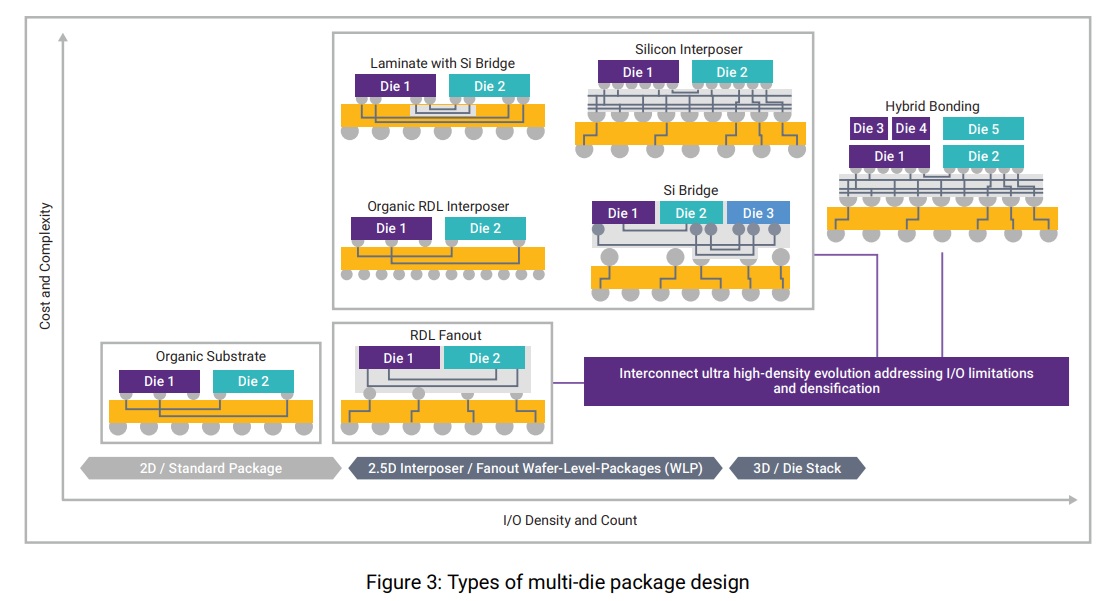
Another key benefit is improved interconnect performance. Die-to-die communication within a package provides significantly higher bandwidth and lower latency than traditional chip-to-chip communication over printed circuit boards. This is particularly important for AI inference workloads, sensor fusion, and high-resolution camera processing in autonomous vehicles. Advanced packaging technologies such as 2.5D interposers, 3D stacking, and microbump interconnects enable extremely high I/O density. These technologies allow designers to stack memory on top of compute dies or distribute functional blocks across multiple dies while maintaining high throughput.
Safety and reliability remain central considerations in automotive multi-die systems. Standards such as ISO 26262 require fault detection, redundancy, and fail-safe mechanisms. Multi-die architectures introduce additional challenges, including monitoring die-to-die interconnects, managing thermal hotspots, and ensuring package-level reliability. To address these challenges, designers incorporate silicon lifecycle management (SLM) techniques, including process, voltage, and temperature sensors, error-correcting codes, and health monitoring circuits. These mechanisms enable predictive maintenance and in-field diagnostics, ensuring that faults are detected early and mitigated before they compromise vehicle safety.
The adoption of multi-die architectures is also driven by emerging vehicle design trends such as zonal architectures and software-defined vehicles. Instead of distributing many small electronic control units across the vehicle, modern designs centralize compute resources in high-performance processors. Multi-die platforms provide the flexibility needed to scale compute resources across vehicle tiers, from entry-level driver assistance to fully autonomous systems. Manufacturers can create families of chips by combining base dies with optional GPU or AI accelerator dies, enabling efficient product differentiation.
Despite its advantages, multi-die design introduces engineering complexity. Designers must carefully partition functionality, optimize interconnect topology, and validate system-level behavior across multiple dies. Thermal management becomes more challenging due to higher power density. Verification flows must consider both die-level and package-level interactions. However, advances in electronic design automation tools and standardized interconnect protocols are making these challenges manageable.
Bottom line: multi-die semiconductor integration is becoming a foundational technology for next-generation automotive electronics. By enabling scalable compute architectures, improved yield, heterogeneous integration, and enhanced reliability, multi-die design addresses the limitations of monolithic SoCs. As vehicles continue to evolve toward autonomy and software-defined functionality, multi-die systems will play a critical role in delivering the performance, safety, and flexibility required for future automotive platforms.
Multi-Die Design for Automotive Applications
Also Read:
Podcast EP337: The Importance of Network Communications to Enable AI Workloads with Abhinav Kothiala
Synopsys Advances Hardware Assisted Verification for the AI Era
Scaling Multi-Die Connectivity: Automated Routing for High-Speed Interfaces
Share this post via:



Comments
There are no comments yet.
You must register or log in to view/post comments.