




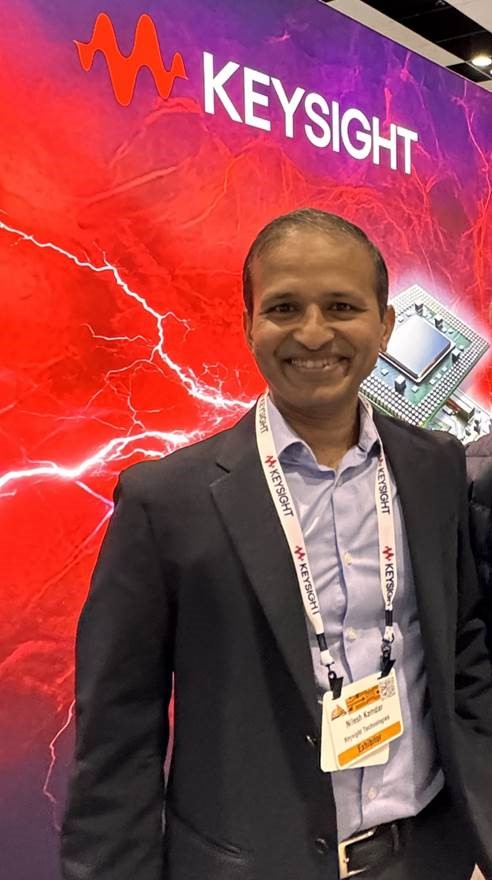

 Tell us a little bit about yourself and your company.
I’m Nilesh Kamdar, General Manager of the Keysight EDA business unit. Keysight is an S&P 500 company that provides design, emulation, and test solutions to help engineers develop and deploy faster with less risk. On the EDA side, we focus on RFMW, high-speed digital, systems, power and photonic design challenges. These are the problems that keep semiconductor and system designers up at night: multi-physics simulation, signal integrity, power consumption, and making sure complex designs work.
What was the most exciting high point of 2025 for your company?
Acquiring Synopsys’ Optical Solutions Group and Ansys’ PowerArtist were high points. Rather than just buying market share, these additions bring innovative optical design capabilities (CODE V, LightTools, RSoft) and leading RTL power analysis (PowerArtist) to our portfolio, addressing the multi-physics imperative. We’re bringing in decades of expertise in photonics, optics, and power analysis, enabling Keysight to deliver multi-domain system design in an open, vendor-agnostic ecosystem. As thermal and power constraints tighten, these capabilities are imperative.
What was the biggest challenge your company faced in 2025?
Helping our customers on their AI journey and ensuring that the technology is carefully and securely deployed. This is often at odds with some in the C-Suite who view AI as the answer to every problem, and that substantial cost savings are inevitable.
How is your company’s work addressing this challenge?
To help our customers, we’re building AI features to solve problems in design workflows – accelerating verification, prioritizing corner-case testing, and reducing manual iterations. Part of this is educating on where AI delivers value and where human expertise remains essential. At Keysight, we believe AI is about augmentation.
What do you think the biggest growth area for 2026 will be, and why?
Multi-physics simulation. As designs push against thermal and power limits, particularly in data centers, the ability to simultaneously analyze electrical, thermal, and mechanical properties has become essential. Every milliwatt matters when data centers consume billions of watts of energy. Tools that optimize across domains will be critical for next-generation designs.
How is your company’s work addressing this growth?
We’re continuing to develop our multi-physics capabilities to improve co-design and co-verification. This includes advancing photonics integration, enhancing thermal analysis capabilities, and ensuring that designers can understand trade-offs across electrical performance, thermal management, and manufacturing constraints within workflows.
Are you incorporating AI into your products?
Keysight has been at the forefront of integrating AI. From an EDA perspective, we’re focused on integrating capabilities that augment productivity in verification and design workflows. Our goal is to harness AI to help engineers work faster while utilizing their unique expertise to design complex semiconductors.
Is AI affecting the way you develop your products?
We’re using AI to accelerate our own development cycles and improve product quality. More importantly, we’re deploying AI judiciously to solve real problems our customers face, such as workflow bottlenecks.
What conferences did you attend in 2025 and how was the traffic?
We attended various industry events spanning DesignCon, DAC (Design Automation Conference), IMS (International Microwave Symposium), DVCon India, ECOC, and European Microwave Week. Traffic was robust across all of these. Conversations focused on detailed implementation discussions around AI-enhanced tools, multi-physics solutions, and chiplet design, where the technical challenges are most acute.
Will you participate in conferences in 2025? Same or more as 2025?
Events remain an important part of our strategy to connect and I don’t see that changing anytime soon. As design complexity increases, face-to-face technical discussions are invaluable!
How do customers normally engage with your company?
There are multiple ways we engage with customers, including direct sales, technical support teams, and field application engineers who work closely with design teams. We also connect through training programs, webinars, and technical content. Personally, I spend a lot of time on the road and engage regularly with customers to understand their perspective. Keysight is solving specific design challenges with our customers, not just selling licenses.
Also Read:
From Silos to Systems, From Data to Insight: Keysight’s Upcoming Webinar on EDA Data Transformation
An Insight into Building Quantum Computers
Podcast EP317: A Broad Overview of Design Data Management with Keysight’s Pedro Pires
Video EP11: Meeting the Challenges of Superconducting Quantum System Design with Mohamed Hassan
Share this post via:



Comments
There are no comments yet.
You must register or log in to view/post comments.