You are currently viewing SemiWiki as a guest which gives you limited access to the site. To view blog comments and experience other SemiWiki features you must be a registered member. Registration is fast, simple, and absolutely free so please,
join our community today!
WP_Term Object
(
    [term_id] => 386
    [name] => Semiconductor Services
    [slug] => semiconductor-services
    [term_group] => 0
    [term_taxonomy_id] => 386
    [taxonomy] => category
    [description] =>
    [parent] => 0
    [count] => 1191
    [filter] => raw
    [cat_ID] => 386
    [category_count] => 1191
    [category_description] =>
    [cat_name] => Semiconductor Services
    [category_nicename] => semiconductor-services
    [category_parent] => 0
    [is_post] =>
)
For three days in a couple of weeks time there is a crash of conferences, spread out all over the extended Bay Area.
Firstly, from 17-19th April at the Santa Clara Hyatt is the Linley Mobile Conference. This covers all things microprocessor in the mobile industry. Details of the conference including the full agenda are here. The conference… Read More
Every quarter GSA runs a webinar with Dan Niles of Alpha One Capital Partners on what the semiconductor outlook is. He doesn’t actually focus on the semiconductor industry itself, demand for chips is really driven by economic conditions in the major markets around the world. People who are unemployed, or in Cyprus, don’t… Read More
Worldwide electronics bounced back strongly in 2010 after the recession of 2008-2009. Every region experienced solid growth, ranging from high single-digit growth in the U.S. to over 20% in the key Asian countries. However in the last two years electronics has slowed down significantly. Several factors contributed to this … Read More
Moore’s Law has transcended computing expectations; however, its promise will eventually reach scalability limitations due to extraordinary consumer demands. Future technology encompasses breakthroughs capable of interaction with the outside world, which the More than Moore movement achieves. Through integrating … Read More
The above quote is attributed to both physicist Niels Bohr and baseball’s Yogi Berra. The statement certainly applies to predicting the semiconductor market. Semiconductors operate on physical principles. However the market for semiconductors is affected by numerous factors. The outcome of a baseball game can be determined… Read More
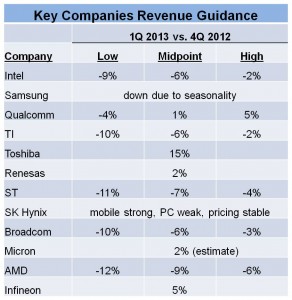
The world semiconductor market in 2012 was $292 billion – down 2.7% from $300 billion in 2011, according to WSTS. The 2012 decline followed a slight gain of 0.4% in 2011. Fourth quarter 2012 was down 0.3% from third quarter. The first quarter of the 2013 will likely show a decline from 4Q 2012 based on typical seasonal patterns and the… Read More
Over at the GSA Forum website I have an article on the history of the semiconductor industry. It is actually based on a couple of brief history of semiconductor blogs (here and here) I published here on SemiWiki last year but edited down a lot and tightened up.
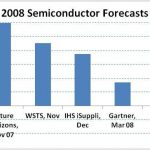
Since the start of the year seems to be the time for predictions, here are the… Read More
The Accellera Systems Initiative, most well-known for driving the standardization of various aspects of Verilog and SystemVerilog before handing the standards off to the IEEE, has announced that nominations are open for the 2013 Technical Excellence Award. This recognizes outstanding contributions in the creation of EDA… Read More
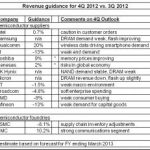
September WSTS data shows the 3Q 2012 semiconductor market increased 1.8% from 2Q 2012. The year 2012 semiconductor market will certainly show a decline. 4Q 2012 would need to grow 11% to result in positive growth for 2012. The outlook for key semiconductor companies points to a 4Q 2012 roughly flat with 3Q 2012. The table below shows… Read More
I’ve been digging around the Interwebs a bit trying to find out what the received wisdom is about how big a cost reduction can be expected if and when we transition to 450mm (18″) wafers from today’s standard of 300mm (12″). And the answers are totally all over the place. They vary from about a 30% cost reduction… Read More












Silicon Insurance: Why eFPGA is Cheaper Than a Respin — and Why It Matters in the Intel 18A Era