






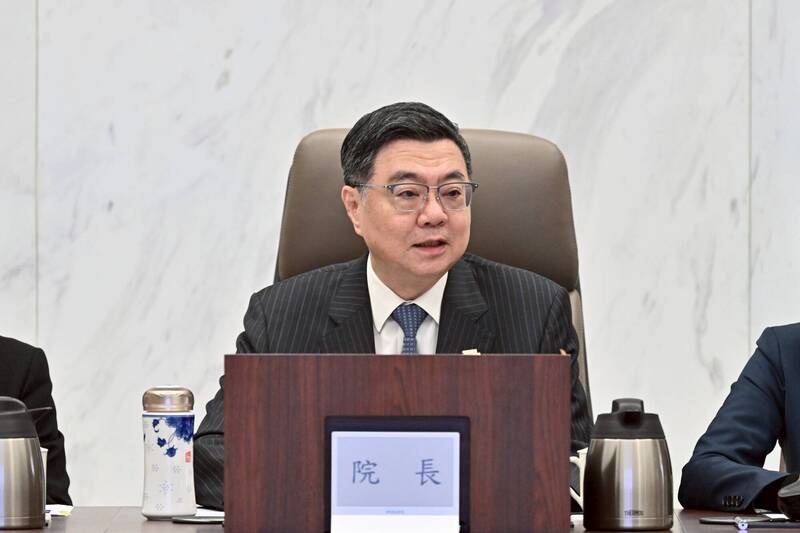
Premier Cho Jung-tai stated during the Executive Yuan meeting that rainfall in western Taiwan so far last winter has hit a 75-year low, with rainfall in the reservoir catchment areas south of Hsinchu ranging from 7% to 37% of the historical average for the same period. (Provided by the Executive Yuan)
The Water Resources Agency of the Ministry of Economic Affairs reported to the Executive Yuan today (26th) on the "Current Water Supply Situation and Countermeasures." Premier Cho Jung-tai stated at the meeting that since last winter, rainfall in western Taiwan has been the lowest in 75 years, with rainfall in the reservoir catchment areas south of Hsinchu being only 7% to 37% of the historical average for the same period. The latest water situation warnings are particularly important for the Hsinchu area, which is currently under a yellow warning for reduced water supply, while the Taichung area is under a green warning. Efforts are being made to ensure that by the end of June, domestic water supply will not be affected by regional water supply systems and that industrial production remains stable and unaffected.
Cho Jung-tai pointed out that water resources are a crucial foundation for national economic development. According to statistics from the Central Weather Administration, rainfall in western Taiwan last winter has hit a 75-year low, with rainfall in reservoir catchment areas south of Hsinchu falling between 7% and 37% of the historical average for the same period. Fortunately, various water resource projects have been effective in recent years, and water conditions in most areas remain stable.
Cho Jung-tai stated that the latest water situation warnings are particularly important for the Hsinchu area, which is currently under a yellow warning for reduced water supply, while Taichung is under a green warning. Given the uncertainty of future rainfall, the Ministry of Economic Affairs must continuously review the water situation in various regions, especially the Baoshan and Baoer Reservoirs in Hsinchu and the Liyutan Reservoir in Taichung, where water storage is low. It is crucial to maximize cross-regional support capabilities and utilize drought-resistant wells and underground water sources as backup water sources to ensure that by the end of June, domestic water use will not be affected by regional water supply systems and that industrial production remains stable and unaffected.
Cho Jung-tai emphasized that drought prevention requires the concerted efforts of the entire nation, including industrial, agricultural, and residential water use. In terms of industry, he asked the National Science Council and the Ministry of Economic Affairs to continue to urge science parks and industrial parks to improve the effectiveness of water conservation by industries themselves. He also asked the Ministry of Economic Affairs to strengthen public awareness campaigns on water conservation and to cherish every drop of hard-won water resources.
Regarding agriculture, Cho Jung-tai pointed out that spring plowing and field preparation have been completed. Since March 20, the Ministry of Agriculture has implemented systematic water conservation. In the Hsinchu area, where the water situation is more severe, the water supply for public use has been increased from 120,000 tons to 270,000 tons per day through the Touqian River. This has effectively extended the water supply period of the Baoshan-Bao'er Reservoir. He urged the Ministry of Agriculture to continue to use diverse water sources for water conservation and irrigation, and to strengthen irrigation management during the subsequent rice growing and heading stages to implement water conservation.
In addition, we also request that the Shihmen Reservoir in Taoyuan and the Yongheshan Reservoir in Miaoli provide cross-regional support of 240,000 tons per day. It is estimated that by June 1, the Baoshan-Baoer Reservoir should be able to maintain a reservoir storage of 2.51 million tons.
Cho Jung-tai emphasized that in the face of severe climate challenges, the water situation is currently stable, thanks to the forward-looking infrastructure projects in recent years, such as the "Reservoir Pearl String Project," which have played a role in emergency preparedness and have allocated a total of 390 million tons of water. At the same time, the Ministry of Economic Affairs has taken early and prudent measures, and all ministries have worked together to prevent drought. Since June of last year, they have implemented detailed management and control measures, and so far, the total water-saving allocation has reached 810 million tons.
水情拉緊報! 卓揆:拚6月底前民生用水不進入分區供水 - 生活 - 自由時報電子報
經濟部水利署今(26)日赴行政院會報告「當前供水情勢及因應措施」,行政院長卓榮泰在院會中表示,去年冬季迄今為止,台灣西半部降雨創下75年以來最少紀錄,新竹以南水庫集水區降雨量是歷年同期的7%至37%左右。目前最新的水情燈號,特別需要關注的是新竹地區,目前是減壓供水的黃燈、台中地區是水情提醒的綠燈。全力達成6月底前民生用水不進入分區供水、產業生產穩定不受影響的目標。
 news.ltn.com.tw