






A couple of folks have asked me to write on nuclear power. Nuclear offers additional sources for power generation, a pressing concern thanks to demand from giant data centers. Also, investment by Microsoft, Sam Altman and others signals their urgency to accelerate past slow moving utilities plans. I have some background in this technology given my graduate education, so I feel comfortable that I’m not entirely winging it, either in fission or fusion reactors. The topic of interest in this forum of course is what this area might have to do with design automation. I’m expanding that brief to include software design and mechanical and fluidic design, in addition to electronics design. I’ll start with a review of the core technologies.
Fission reactors
Classical nuclear has been around for a while, in the big fusion reactors which created so much anxiety around safety and nuclear waste. I was in Narita airport (Tokyo area) when the Tohoku earthquake hit in 2011. After we had been evacuated then let back into the arrivals area, everyone was glued to TV screens. All in Japanese of course but I’m pretty sure the coverage included the Fukushima nuclear power plant being swamped by the tsunami.
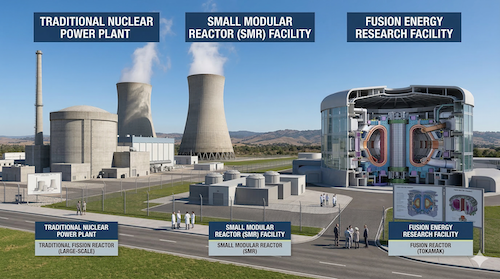
Concerning of course, but nuclear is very green compared to fossil fuel-based generation, now becoming a very important consideration. As a quick reminder, fusion reactors run on a chain reaction principle. A Uranium U235 nucleus emits a neutron, which hits another nucleus, which then re-emits a neutron and so on, creating a cascade of energetic neutrons. These neutrons heat up surrounding liquid, and that energy is converted to steam through a heat exchanger. Steam then drives turbines to create electricity. Very competitive with fossil-fueled generation, with no carbon dioxide waste though radioactive waste still requires geological disposal.
Fission reactor technologies continue to advance. Small Modular Reactors (SMRs) especially are very easy to scale up. One unit can produce about a third of the power of a traditional reactor, but new units can be added quite quickly (subject to regulatory review) since components can be mass-produced offsite. Regulations are being upgraded to speed review and approval, moving quickly in the UK with Rolls-Royce SMR expected to come on-line in early to mid-2030s at a cost in the range of $2.5B-$4B. Contrast that with $30B for a traditional full-size station. Regulatory processes are also being sped up in the US.
Molten Salt Reactors (MSRs) use liquid salt for heat exchange (conventional and MSRs use water) with a much higher boiling point (~1500oC) than water, allowing them to run much more efficiently than water-cooled systems and avoiding potential for steam-explosions under conditions of over-pressure. MSRs are still in in tech prove-out. China seems to be most advanced with a first test delivering an estimated 2MW, though the goal is to deliver 100MW by ~2035. The US, Canada and Europe all have projects under development.
Fusion reactors
Radioactive nuclei are naturally unstable, allowing us to tap energetic decay energy from that fission to generate electricity. At the other end of the nuclear mass scale, helium 4 (He4) is the most stable of all nuclei. If we fuse together lighter nuclei to create He4, that process will also release energy, ideally more than is required to initiate fusion, in theory with no radioactive waste.
Jamming together smaller positively charged nuclei must overcome the electromagnetic barrier, on the order of 0.1MeV, requiring temperatures around 108K in a plasma of (dissociated) atoms in which you aim to induce fusion. There are multiple technologies in development, all aiming to establish a high enough temperature in the plasma at high enough density for a long enough time to cross a point where more energy is produced than is put into the process. Commonwealth Fusion is aiming for first plasma in 2027. Helion Energy plans to meet a 2028 deadline to supply 50 MW of fusion-generated power to Microsoft’s data centers. Other technologies (hybrid, pulsed and inertial confinement) are still in R&D.
Extracting energy is another tricky step. Some plasmas like those for General Fusion emit high energy neutrons which are absorbed in a blanket layer around the plasma. These generate heating in the blanket, picked up via a coolant traveling through the blanket. That heat is exchanged to create steam and used to drive turbines, very much like the approach used in fission reactors. Helion Energy instead uses an induction method to extract energy directly from the plasma and (plausibly) claims to have much higher efficiency than the traditional cooling ->steam->turbine approach. There are also other methods.
There is little info so far on power generation capability. All methods still seem to be working towards first sustainable power.
Where does design automation fit?
Fission reactors
Electronics in containment chambers must be very radiation tolerant, apparently pushing complex designs towards FPGAs rather than processor-based architectures, though sensors and actuators may be built on rad-hard SOI with error correction logic.
Digital twin modeling is used to model control software against physics models of neutron-based heating to ensure control always reacts quickly to pump failures across edge cases (to avoid meltdown).
Mechanical/electrical Place and Route (coolant pipes, electric conduits) has become very important in SMR design to manage routing through tight spaces while maintaining separation rules for safety.
Thermal analysis modeling, along with stress modeling of the reactor core is extremely important, to assess potential overheating possibilities.
Formal verification is a requirement for proving software, also for FPGAs inside the containment vessel.
Fusion reactors
Managing a plasma stream is an immensely complex magneto-hydro dynamic fluidics problem. Plasma at a hundred million degrees or more cannot touch the sides of the containment vessel, since the plasma would collapse and do untold damage to the vessel. Containment methods depend on electric and/or magnetic fields which must respond incredibly quickly to variations. This is accomplished through high-speed control loops, also through reinforcement learning to proactively sense and correct for disruptions. (Mach42 is one company I know of in this space.)
Similar place and route requirements apply here, for cryogenic lines, high voltage lines, and fuel lines (to keep fueling the plasma).
I know that energy extraction in systems directly generating power requires very advanced power electronics. Technologies include wide bandgap semiconductors and inductive coupling techniques. I am not at all expert in this area.
Here also, digital twin modeling is important, for example to model plasma disruption to check if control responds fast enough. And again, formal verification is essential in any “cannot fail” circuits.
In summary: nuclear power as a source of energy in the near term will depend on SMR reactors, with MSRs expected to come on-line somewhat later. Fusion is still a future. Perhaps investment being pumped into fusion might accelerate prototypes which can sustainably generate energy. Meantime there are applications for design automation-like technologies, in mechanical place and route, in safety and in digital twin modeling. This area will be interesting to watch.
Share this post via:



Silicon Insurance: Why eFPGA is Cheaper Than a Respin — and Why It Matters in the Intel 18A Era