





I recently covered what Samtec was doing at DesignCon 26. Samtec has a tendency to dominate any show it attends in multiple dimensions. The prior post focused on the company’s contributions to the technical agenda and the high-profile experts in attendance. While all that is interesting and valuable, attending a large show like DesignCon is also about seeing products in action on the show floor. Samtec was quite active in this area as well, and this post will explore some of that work. Let’s examine how Samtec blazes a trail to 224/448 Gbps at DesignCon 26.
Why 224/448 Data Rates are Important
224/448 Gbps data rates represent lane-rate inflection points. That is, they determine how much bandwidth a system can move per SerDes lane, optical wavelength, connector pin, package escape, cable, or backplane path. This is particularly important for the electrical/optical interconnect level in AI, switch, and multi-die systems. To dig just a bit deeper, here are some of the benefits of getting this technology right:
- Enable 1.6T and 3.2T systems without exploding lane count. There are many standards at work that cover chip-to-module, chip-to-chip, die-to-die, and backplane/copper-reach use cases.
- Reduce the number of lanes, traces, fibers, connectors, and retimers. Moving from 112G to 224G roughly doubles bandwidth per lane. That can mean fewer SerDes lanes for the same port bandwidth, or twice the port bandwidth with the same number of lanes.
- Alleviate the I/O bottleneck in AI and HPC systems. AI training and inference clusters are increasingly limited by moving data between GPUs, memory, switches, NICs, and storage, not just by raw compute.
- Reduce power per bit. It is well-known that interconnect power is a major system constraint.
Achieving these data rates is NOT easy as these rates push very close to the limits of the electrical channel. So, there are many choices to consider – copper, flyover cable, LPO, CPO, or optics. As lane rates rise, conventional PCB reach becomes harder and more power-hungry. These are significant areas of focus for Samtec, so what was shown at DesignCon has meaningful impact on future systems. Let’s look at what Samtec showed for 224/448 Gbps at DesignCon.
130 GHz Test Platform
Samtec showed two versions of its new Samtec BE130 Bulls Eye® test point system. The BE130 brings 130 GHz of coaxial test cable bandwidth for boards, packages, and substrates for emerging device characterization. This level of performance is critical to enable evaluation of new 224/448 systems. The test hardware is shown below.
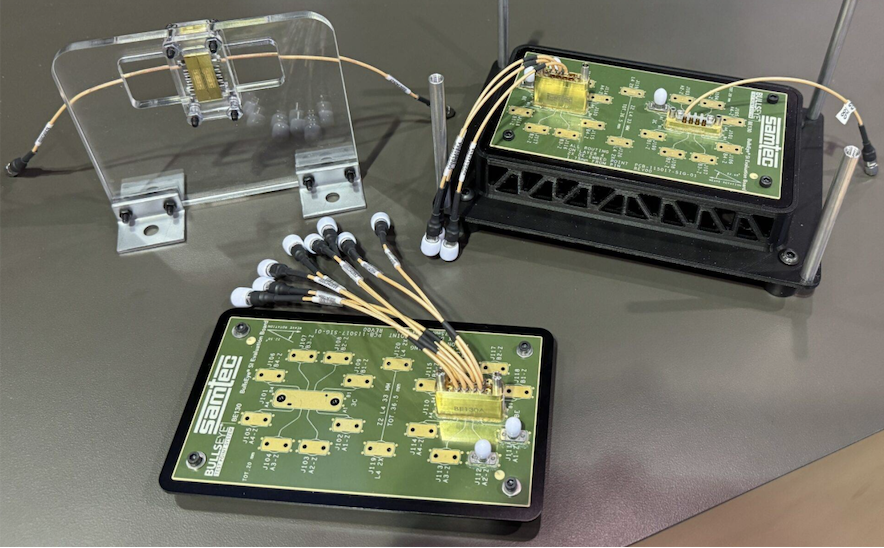
Applications for this hardware include characterization for emerging 400 G-class devices and substrate characterization that supports it, high-speed digital testing, AI/ML computing, wafer probing, phased-array antenna systems, and satellite communications, among others.
The Bulls Eye high-performance test assembly featured a high-density space-saving design that enables smaller evaluation boards and shorter trace lengths in test and measurement applications. All this helps to open a path to the advanced, high-speed channels that are so critical for future products.
224/448 Gbps Test Platforms with Keysight
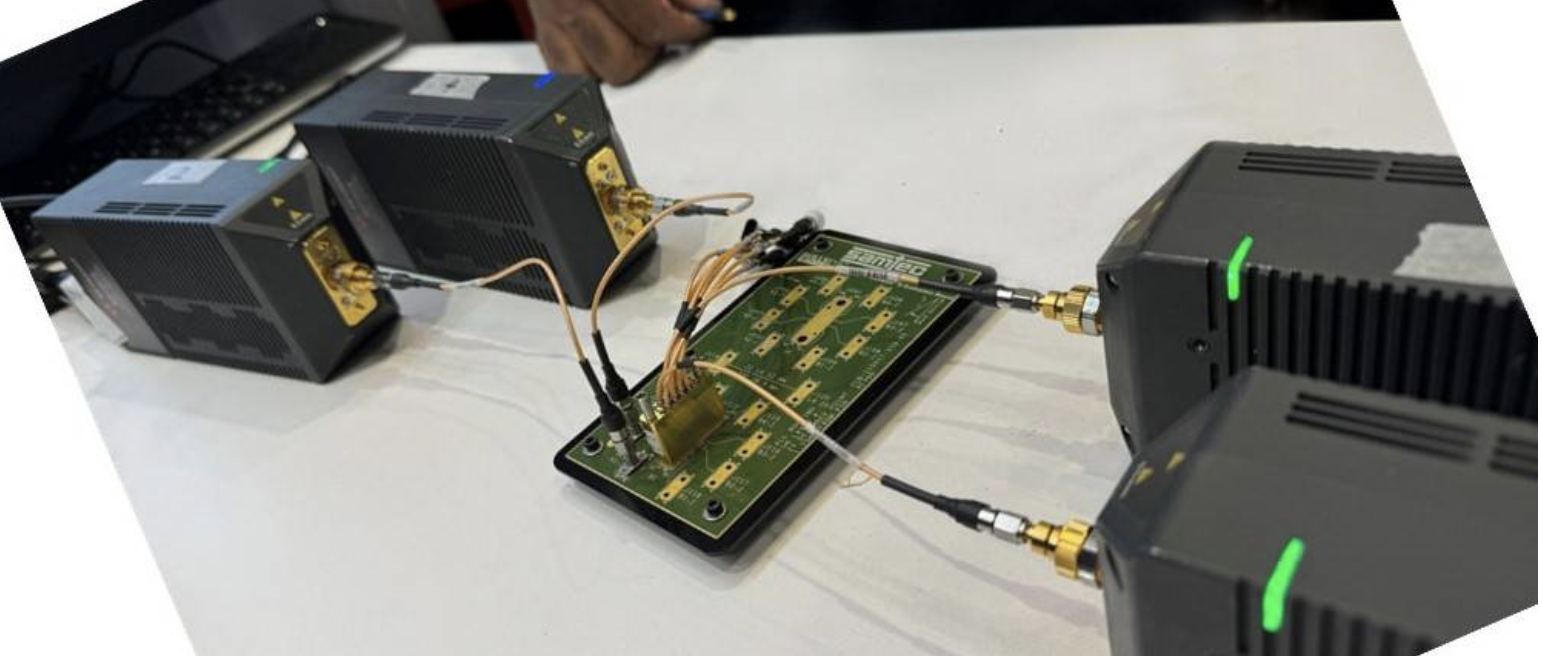
This demo with Keysight illustrates the path to building more comprehensive systems. In this demo, it was shown how Keysight’s new 250 GHz Vector Network Analyzer (VNA) and the previously mentioned Samtec BE130 can be combined to push the limits of channel performance. Details about Keysight’s 250 GHz VNA can be found here.
Keysight explained how digital engineers performing signal integrity analysis want the best time domain resolution between adjacent impedance discontinuities. As designs move to higher frequencies (in the frequency domain), the Keysight VNA provides 150-micron resolution in the time domain. This is especially important when analyzing very small features, such as co-packaged optics, IC package characterization, or BGA packages.
The demo showed that Samtec’s BE130 and Keysight’s 250 GHz VNA were able to reach beyond 130 GHz. So, the combination of Keysight test and measurement capabilities with Samtec’s interconnect technology demonstrated a validated test platform for next-generation testing, especially at 448 Gbps over copper or optics. The demo hardware is shown below.
A 448 Gbps Co-Packaged Copper Channel
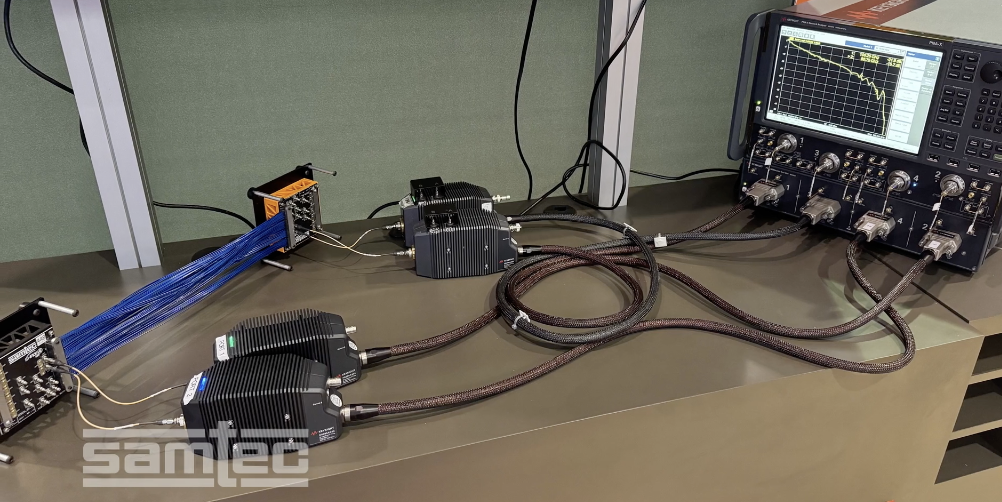
For this live demo, Samtec developed a prototype cable system representing a chip-to-chip, intra-tray GPU-to-GPU interconnect running at 448 Gbps. A Keysight VNA (N5295AX03) measured the loss up to 125 GHz in the next-generation prototype Samtec Si-Fly® HD co-packaged copper system, or CPC. Information about the Keysight VNA can be found here.
As we follow the signal path for this demo, the 448 Gbps signal passes through a Samtec Nitrowave® LL130 premium RF metrology cable, to 1 mm compression-mount precision RF connectors, and into the PCB routing of 13 mm. It then routed through the Si-FLY HD 448 Gbps connector systems that are linked by 400 mm of Samtec EyeSpeed® Hyper Low Skew cables, and back to the VNA for analysis.
The photo of this unique demo is shown at the top of this post. The 400 mm EyeSpeed Hyper Low Skew cables are shown in blue on the left of the photo.
To Learn More
Samtec provided several live demonstrations at DesignCon 26 that brought 224/448 channel performance closer to reality. Seeing the goal posts move is one of the reasons we all attend trade shows, and Samtec did not disappoint.
You can learn more about the Samtec technologies mentioned here:
- Bulls Eye® RF High-Performance Test
- BE130 Test Assembly
- Si-Fly® HD 224 Gbps PAM4, Co-Packaged & Near Chip Systems
- High-Performance RF Microwave Cable Assemblies
- Eye Speed® Cable Technology
And you can always reach out to the Samtec RF Group here. And that’s how Samtec blazes a trail to 224/448 Gbps at DesignCon 26.
Also Read:
Samtec’s Strong Presence at embedded world 2026
Samtec Ushers in a New Era of High-Speed Connectivity at DesignCon 2026
2026 Outlook with Mathew Burns of Samtec
Share this post via:



Comments
There are no comments yet.
You must register or log in to view/post comments.