






Non-volatile memory choices are becoming more complex as SoC designs push into advanced nodes, and new requirements driven by AI, new sensor technologies and stringent quality standards.
The second annual 2025 NVM Survey, completed in December, captures a market that still hangs on established technologies but is increasingly testing alternatives in response to these new design and production constraints.
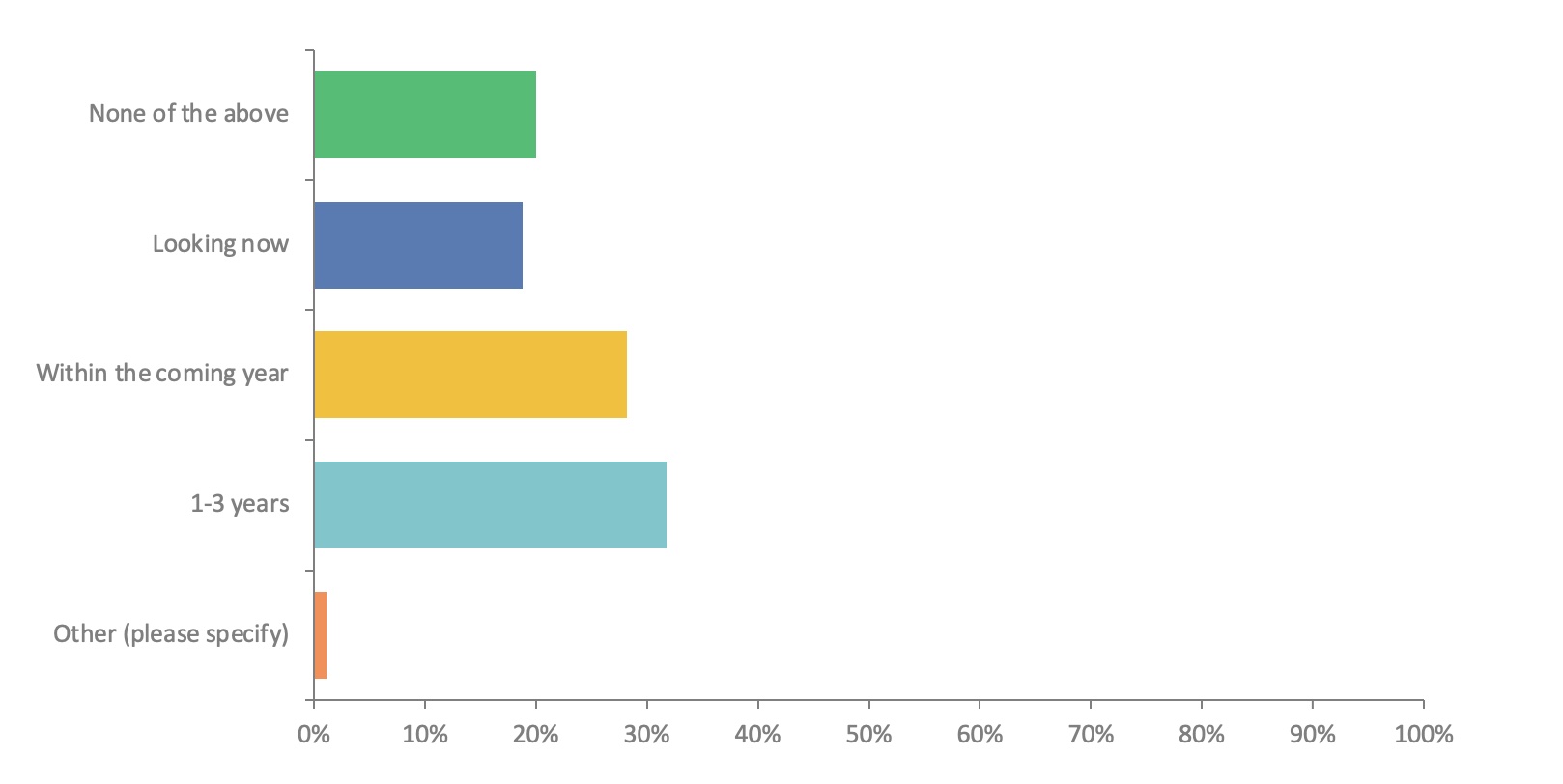
More than 80% of respondents say they use or evaluate embedded non-volatile memory technologies. 20% are looking for an NVM now, and just under 30% expect to choose NVM IP within the coming year. Taken together, this points to a market that is both experienced and active. A meaningful proportion of near-term decisions are yet to be made, leaving a lot to play for among the competing technologies.
Embedded flash continues to dominate in terms of technology recognition, with awareness exceeding 80% of respondents, reflecting its long-standing role as the default choice. That said, the survey shows a broadening of familiarity beyond flash. FRAM, MRAM, and ReRAM are each recognized by more than a quarter of respondents, indicating that alternative NVM technologies are now part of mainstream awareness.
Vendor recognition follows a similar pattern. A small group of suppliers stand out in terms of familiarity, led by SST (embedded flash), Infineon (SONOS), and Weebit Nano (ReRAM), in that order.
When respondents were asked to weigh the importance of embedded NVM selection criteria, the results emphasize practicality. Reliability, endurance, and data retention all score at the top of the range, each with weighted averages well above 3.0 out of 4.0, confirming that they remain foundational requirements for embedded NVM selection. Process scalability follows closely, also scoring above the 3.0 mark, reflecting the growing difficulty of extending traditional embedded NVM into advanced geometries that embedded flash cannot scale to. Power efficiency scored over 3.0 too. Integration risk and long-term predictability sit only marginally behind, indicating that manufacturing readiness and lifecycle stability are now considered nearly as important as raw technical performance. This shows that the market is maturing; people understand that the raw technical capability of new NVMs is there, but the risk and cost of integration are becoming real concerns, especially for advanced nodes where flash integration is not an option.
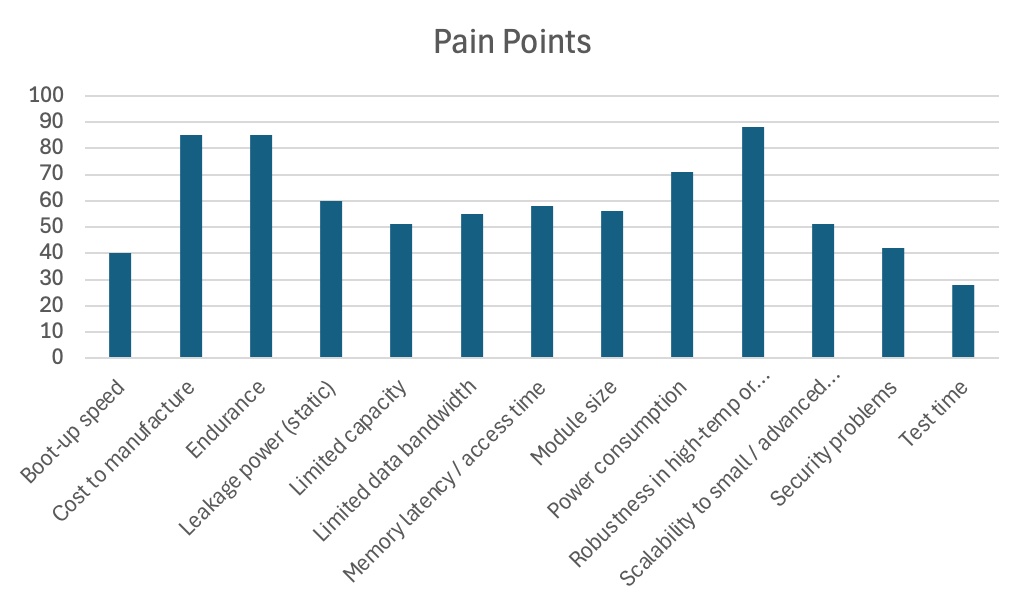
The risk and pain-point data reinforce this view. Scalability limitations and power-performance trade-offs rank highest, both scoring with weighted averages above 3.0 out of 4.0, indicating that they are seen as critical constraints in current NVM deployments, especially in advanced process nodes. Reliability concerns and cost uncertainty follow closely behind, also clustering in the upper end of the scale, suggesting that long-term predictability and economic risk remain unresolved issues for many designs. Taken together, these pressures help explain why awareness of alternative NVM technologies is increasing, even where adoption remains cautious.
Design pressure seems to be increasing faster than legacy memory can adapt. What has changed since last year’s survey is not a collapse in confidence in embedded flash, but a clear acceleration in the pressures acting upon it. More teams are now evaluating alternatives not out of curiosity, but because scaling, power, and long-term predictability are becoming binding constraints on future designs.
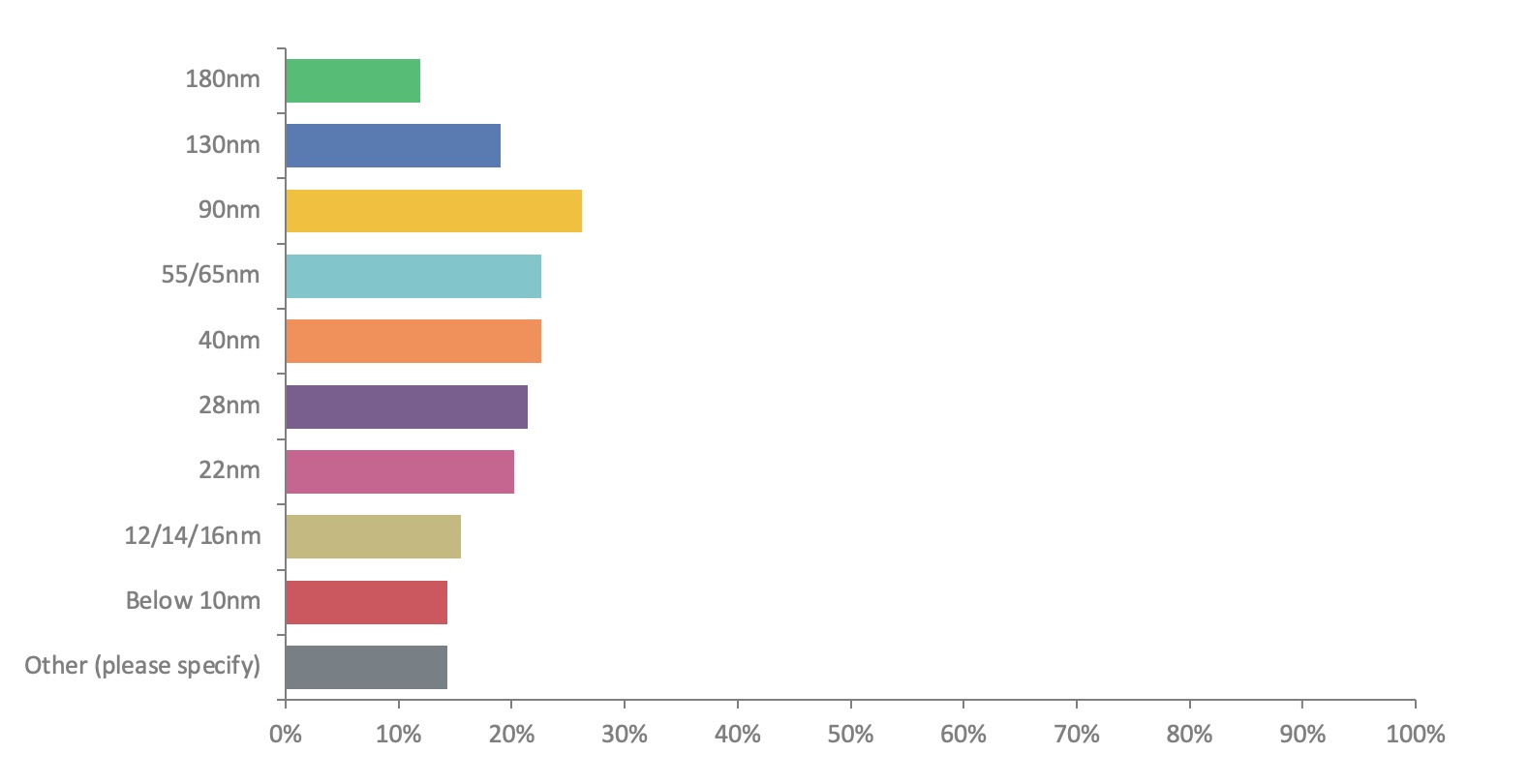
Overall, the 2025 survey does not point to an abrupt abandonment of embedded flash, but it does suggest that the transition away from traditional memory technologies is entering a more decisive phase and might be likely to accelerate as design starts transition to nodes where new NVMs are required for technical reasons. Awareness of alternative NVMs is rising, evaluation is broadening, and a significant share of teams expect to make concrete IP choices within the next year.
External forecasts point the same way: Yole Group’s outlook suggests embedded emerging NVMs could reach $3.3B by 2030, driven by adoption of technologies such as MRAM, PCM and ReRAM in next-generation MCUs and SoCs.
Compared with last year’s results, the direction of travel is clearer: the question is no longer whether embedded flash can be extended further, but how long it can continue to meet the combined demands of scaling, power efficiency, reliability, and cost predictability.
Bottom line: For many SoC teams, NVM selection is shifting from a background assumption to an urgent architectural decision that will shape product viability in the next generation of designs.
Also Read:
Weebit Nano Reports on 2025 Targets
Relaxation-Aware Programming in ReRAM: Evaluating and Optimizing Write Termination
SiFive’s AI’s Next Chapter: RISC-V and Custom Silicon
Ceva IP: Powering the Era of Physical AI
Share this post via:



Musk’s Orbital Compute Vision: TERAFAB and the End of the Terrestrial Data Center