




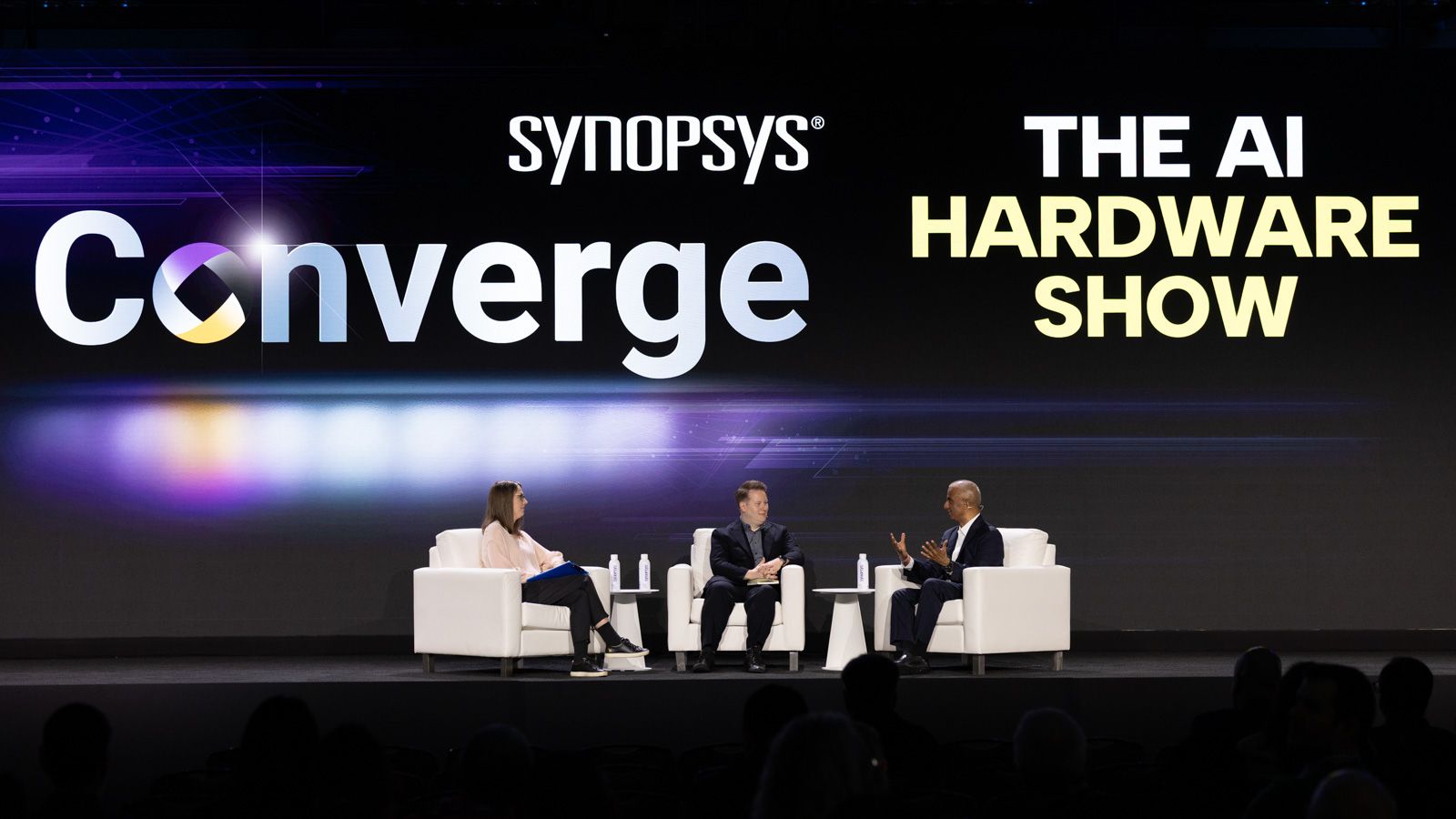

Right before the Synopsys Converge Keynote I caught an interview with Ravi Subramanian, Chief Product Management Officer at Synopsys, which highlights several important trends shaping the future of AI, semiconductor technology, and engineering. His discussion focuses on how the worlds of silicon design and system engineering are converging, driven largely by the rapid growth of AI and the need for more efficient computing infrastructure. The conversation provides insight into the technological, economic, and engineering challenges that will define the next decade of innovation.
Ravi and I are well acquainted. I worked for him at Berkeley DA advising him on foundry strategy and specifically how best to work with TSMC. I held a similar position with Solido Design and was hoping to merge the two companies. Mentor interceded and purchased both Berkley DA and Solido and the rest is as they say history. Interesting enough, the former CEO of Solido Amit Gupta now runs AI Strategy at Siemens EDA. Small world indeed. Two old friends are now competitors, I will comment on that in another article, you will not want to miss this one.
One of the first ideas Ravi discusses is the meaning of the event called “Converge.” This event represents the merging of two traditionally separate engineering communities: silicon engineers and systems engineers. Silicon engineers focus on designing semiconductor chips, while systems engineers design complete products such as cars, medical devices, and industrial machines. In the past, these fields operated somewhat independently. However, modern technologies, especially those powered by AI, require both disciplines to work closely together. For example, autonomous vehicles, robotics, and smart devices rely on specialized chips, complex software, sensors, and physical systems all working together. As a result, the boundaries between hardware and systems engineering are becoming less clear.
Another major theme of the interview is how performance in AI systems is measured. Traditionally, the industry focused on metrics like “tokens per second,” which measures how quickly an AI system can process information. However, Ravi explains that the industry is now paying more attention to efficiency-based metrics such as “tokens per dollar” and “tokens per watt.” These metrics evaluate how much useful AI computation can be performed relative to the cost and the amount of energy consumed. This shift is important because running large AI systems is extremely expensive and energy-intensive. For instance, Ravi mentions that an AI-assisted search query can require four to six times more energy than a traditional search query. As AI becomes more widely used, improving energy efficiency will become one of the most critical challenges in the technology industry.
Ravi also connects AI technology to global economic growth. He explains that the global economy currently produces about $117 trillion in annual output. Of this total, around $41 trillion comes from physical products that require engineering to design and manufacture, while about $60 trillion comes from services. Many economists believe that global GDP could double to around $250 trillion over the next 25 years. According to Ravi, much of this growth will be driven by productivity gains made possible by AI. However, these AI systems rely heavily on advanced semiconductors and computing infrastructure, meaning that the semiconductor industry will play a central role in enabling future economic expansion.
To understand how AI hardware will evolve, Ravi identifies four critical components that determine AI system performance: compute, interconnect, storage, and power. Compute refers to the processors, such as GPUs and specialized AI accelerators, that perform the calculations needed to train and run AI models. Interconnect refers to the technologies that move data between chips and computing nodes. Efficient data movement is crucial because transferring data often consumes more power than performing the computations themselves. Storage, particularly high-bandwidth memory, is another major challenge because modern AI models require enormous amounts of data to operate effectively. Ravi warns that shortages in memory supply could even disrupt certain industries if AI data centers consume most available memory resources. Finally, power consumption is a major constraint because large AI systems require vast amounts of electricity to operate.
The interview also highlights the possibility of significant changes in the semiconductor supply chain. Ravi suggests that the industry is entering the first decade of a major reconstruction as companies adapt their manufacturing processes, design methods, and infrastructure to support the growing AI economy. This transformation will affect everything from chip architecture to memory production and data center design.
Bottom line: Ravi emphasizes that future engineers will need broader knowledge across multiple disciplines. Systems engineers must understand semiconductor technology, while chip designers must understand real-world physics and system behavior. As AI continues to expand into robotics, autonomous systems, and other forms of “physical AI,” the integration of software, hardware, and physical systems will become increasingly important. The convergence of these fields will ultimately define the future of technological innovation.
Also Read:
Efficient Bump and TSV Planning for Multi-Die Chip Designs
Reducing Risk Early: Multi-Die Design Feasibility Exploration
Building the Interconnect Foundation: Bump and TSV Planning for Multi-Die Systems
Share this post via:



Comments
There are no comments yet.
You must register or log in to view/post comments.