





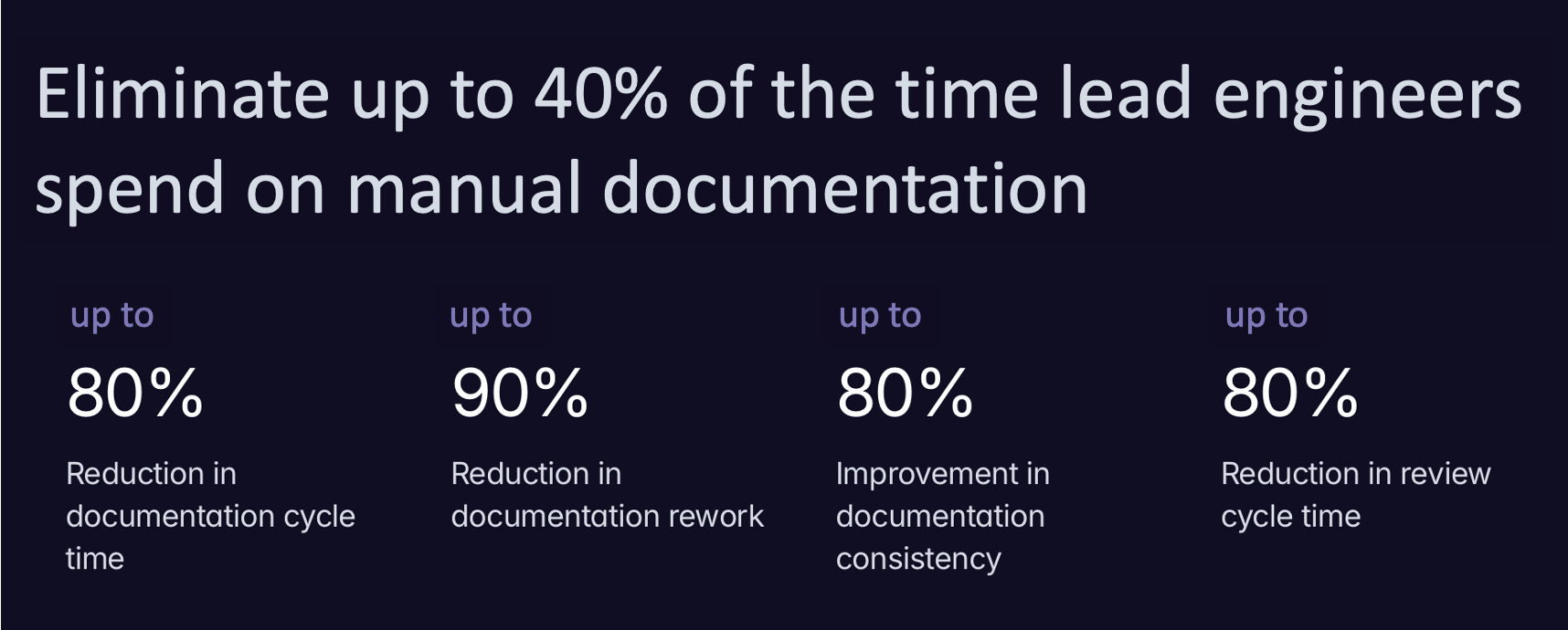
Accurate, complete, and consistent technical documentation is a critical element of success for any embedded system design project. This includes IP, SoCs, and the associated hardware and software infrastructure. When documentation contains errors, the consequences go beyond engineering inefficiency. Errors that drive the development, testing and use model of the system can manifest as late-stage bugs that are costly and time-consuming to fix. Or worse, issues arise after the system is in production. Beyond the cost of repair, problems like this can damage customer confidence and weaken a company’s brand.
You can get your copy of this important new white paper here.
The process to address this important problem has typically involved a lot of manual work by design team members that should really be focusing on design and not documentation. llmda.ai solves this latent flaw in system design with a new approach. One that employs AI and agentic technology to flatten the problem with minimal human overhead. The company recently issued an informative white paper on the approach. Learn how llmda uses agentic AI to generate hardware docs & keep them consistent. A link to this white paper is coming. Let’s first examine some of what it covers.
The Problem
Developing accurate technical documentation can become a major time and resource drain that diverts engineering effort, slows execution, and directly impacts time-to-market. Some of the drivers of this situation include:
- Time constraints: Documentation often competes with other high-priority engineering tasks and is typically due alongside major project milestones and deliverables.
- High-cost resource drain: Creating accurate documentation requires significant time from the most critical and expensive project resources—design engineers, architects, and domain experts.
- Distributed collaboration: Documentation is frequently a multi-stakeholder effort, and geographically dispersed teams make coordination, review cycles, and alignment difficult.
- Content duplication: Many documents share the same foundational technical content, yet teams repeatedly rewrite and reformat similar material across specifications, manuals, and guides.
- Product configuration complexity: Modern products often ship in multiple variants, requiring documentation to be tailored, maintained, and validated across numerous configurations.
The Solution – llmda Spectra™
llmda Spectra is a product that addresses these documentation challenges head-on. It leverages advanced LLM technology to intelligently extract, synthesize, and structure content from internal engineering artifacts, transforming fragmented technical information into clear, accurate, and production-ready documentation.
The white paper will help you understand how this is achieved. Some of the topics covered include:
- Intelligent information extraction
- Contextual technical understanding
- Automated structuring and formatting
- User-friendly guided workflows
- How the platform is collaboration-ready
- How section-by-section build and lock is achieved
- How transparent sources and traceability are delivered
- The impact of human-in-the-loop GenAI
- How hardware description language awareness is achieved
- How IP-XACT and metadata extraction is achieved
- The impact of automated block diagram generation
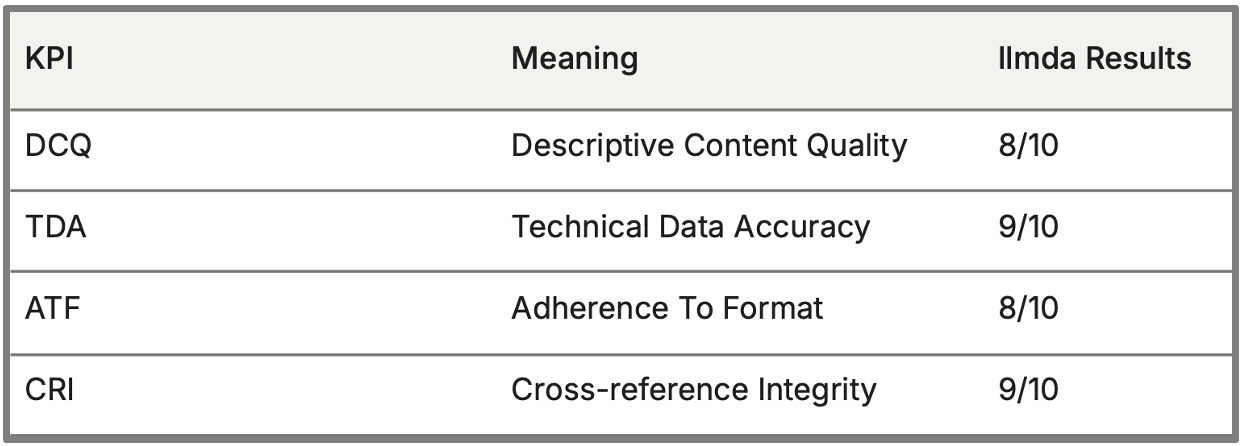
The documentation quality key performance indicators (KPIs) that llmda Spectra tracks are also discussed. You will learn how these KPIs transform documentation from an “afterthought deliverable” into an engineered output that can be tracked, improved, and validated over time.
To whet your appetite, here is a summary of some of the KPIs llmda Spectra tracks and the results achieved.
Case Studies
The white paper also presents the details of two case studies that illustrate how llmda Spectra delivers measurable outcomes by accelerating documentation cycles, improving quality, and reducing engineering burden.
The first case study examines the details associated with high-volume IP user guide generation. It shows how a semiconductor design team delivered IP user guides for 20 new IP blocks in under one month, despite having limited access to dedicated technical writing resources.
The second case study examines the details of rapid application note updates for new silicon revisions. This one shows how an application engineering team at a major semiconductor company quickly updated application notes to reflect new silicon features and design changes, without rewriting the documents from scratch.
In each case study, details of the business challenge, how llmda Spectra was applied, and the outcome and impact achieved are presented.
To Learn More
Poor quality documentation can have a dramatic negative impact on any embedded system design project. llmda.ai has a solution to this problem that substantially reduces the effort required to achieve the best outcome.
You can get your copy of this important new white paper here. And that’s how llmda uses agentic AI to generate hardware docs & keep them consistent.
Also Read:
CEO Interview with Nagesh Gupta of llmda.ai
Webinar: How Agentic AI Keeps Documentation Consistent and Accurate
llmda Emerges From Stealth with llmda Spectra™, bringing Agentic AI to Embedded Systems Development
Share this post via:




Comments
There are no comments yet.
You must register or log in to view/post comments.