You are currently viewing SemiWiki as a guest which gives you limited access to the site. To view blog comments and experience other SemiWiki features you must be a registered member. Registration is fast, simple, and absolutely free so please,
join our community today!
WP_Term Object
(
    [term_id] => 14433
    [name] => X-Subscriber
    [slug] => x-subscriber
    [term_group] => 0
    [term_taxonomy_id] => 14433
    [taxonomy] => category
    [description] =>
    [parent] => 0
    [count] => 0
    [filter] => raw
    [cat_ID] => 14433
    [category_count] => 0
    [category_description] =>
    [cat_name] => X-Subscriber
    [category_nicename] => x-subscriber
    [category_parent] => 0
    [is_post] =>
)
Although MEMS devices in various forms are now found in most electronic devices, predominantly in mobile, automotive, aerospace and many other applications, their major revolution, I believe, is yet to happen. We are seeing rapid innovation in MEMS reflected by their improvements in precision, performance, size reduction,… Read More
Every SoC team uses libraries of cells to get their new product to market quicker: Standard Cells, IO Cells and Hard IP blocks. One immediate question that comes to my mind is, “How clean are these cells?” Validating your cell libraries first makes sense, and will ensure that there are fewer surprises as your chip gets… Read More
Quicklogic was founded in 1988 as a fables semiconductor company supplying anti-fuse devices. In fact VLSI Technology, where I was working at the time, was their foundry.
Although today anti-fuse is often used as a generic word for one-time-programmability, the origins of the name are grounded in reality. In a fuse, like the things… Read More
One of the challenges with the internet of things (IoT) is that many devices are both always on and battery powered (and not with a large battery). The responsibilities need to be split so that the device senses when it needs to wake up without requiring the application processor to be waking up all the time to make the decision since… Read More
MEMS Update from DACby Daniel Payne on 06-11-2014 at 11:32 amCategories: Coventor, EDA
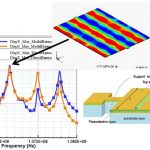
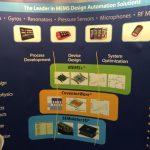
DAC has an interesting mix of vendors each year, and some of them are outside of the expected digital, analog or IP space. Last Tuesday at DAC I visited a company called Coventor that has three product lines:
…
Read More
So what was the overall theme of DAC this year? Usually there seems to be some trend that is hot. A few years ago it was power, then more recently all the stuff associated with 20nm and 16nm such as FinFETs and double patterning. Those things are still around, of course, and there are new generations of tools.
One theme is that more design… Read More
First thing at DACtoday I met with Greg Lebsack of Tanner EDA to ask about what’s new in the past year for his EDA company. Here are my meeting notes, so there’s not much prose for my DAC blogs this year.
… Read More
Maybe I’ve spent too many years whiffing solder flux fumes and absorbing doses of X-band radiation in anechoic chambers, but I’m a firm believer in the axiom: “Give me enough engineers, and I can get 10 of anything to work right, once.” We have to make this … fit into this … using only this stuff … is what legends are made of.… Read More
In the EDA world we use hyphens quite often to describe our technical approaches, like: DFM-aware, Power-aware, Variation-aware. I just read a white papertoday on the topic of Quality-Aware IP Design Flows, written by Fractal Technologies. If your group creates IP or re-uses IP, then there’s always the question about … Read More
Exactly a year ago Sage Design Automation launched its revolutionary iDRM product, enabling for the first time to graphically capture design rules and compile them into checks automatically – no programming required. Using the graphical design rule editor, users could draw the layout topology that describes the design… Read More