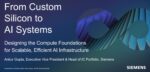
Right before the Synopsys Converge Keynote I caught an interview with Ravi Subramanian, Chief Product Management Officer at Synopsys, which highlights several important trends shaping the future of AI, semiconductor technology, and engineering. His discussion focuses on how the worlds of silicon design and system engineering… Read More
Qnity and Silicon Catalyst Light a Path to Success at the Chiplet Summit
The Chiplet Summit recently concluded. Multi-die heterogeneous design is a hot topic these days and chiplets are a key enabler for this trend. The conference was noticeably larger this year. There were many presentations and exhibits that focused on areas such as how to design chiplets, what standards are important, how to integrate… Read More
The Evolution of RISC-V and the Role of Andes Technology in Building a Global Ecosystem
During my frequent trips to Taiwan as a foundry relationship professional I remember meeting Frankwell Lin, CEO of Andes, in Taiwan 15+ years ago. As I walked to TSMC HQ from the Hotel Royal (my second home for many years) Andes was about mid point and Frankwell’s door was always open. Sometimes just tea, sometimes technology,… Read More
Keynote: On-Package Chiplet Innovations with UCIe
In the rapidly evolving landscape of semiconductor technology, the Universal Chiplet Interconnect Express (UCIe) emerges as a groundbreaking open standard designed to revolutionize on-package chiplet integrations. Presented by Dr. Debendra Das Sharma, Chair of the UCIe Consortium and Intel Senior Fellow, at the Chiplet… Read More
Perforce and Siemens Collaborate on 3DIC Design at the Chiplet Summit
The recent Chiplet Summit at the Santa Clara Convention Center was buzzing with many enabling technologies for chiplet-based design. Collaboration was also on display during many parts of the show. A presentation in the Siemens booth was a perfect example of both of those trends. In the Siemens booth, Perforce presented an excellent… Read More
Advancing Automotive Memory: Development of an 8nm 128Mb Embedded STT-MRAM with Sub-ppm Reliability
The rapid evolution of automotive technology has intensified the demand for highly reliable, high-performance semiconductor memory solutions. Modern vehicles increasingly rely ADAS driving features, and complex infotainment platforms, all of which require memory that can operate flawlessly under extreme environmental… Read More
Designing the Future: AI-Driven Multi-Die Innovation in the Era of Agentic Engineering
At the 2026 Chiplet Summit, Synopsys presented a bold vision for the future of semiconductor innovation: AI-driven multi-die design powered by agentic intelligence. As the semiconductor industry shifts rapidly toward chiplet-based architectures and 3D stacking, the complexity of design, verification, and system integration… Read More
Intelligent Networks: Power, Reliability, and Maintenance in Telecom — Webinar Preview
The upcoming webinar “Intelligent Networks: Power, Reliability, and Maintenance in Telecom” will focus on how telecommunications networks are adapting to growing demands for efficiency, resilience, and scalability. As telecom operators expand 5G deployments, integrate cloud-native architectures, and prepare for AI-driven… Read More
SiFive’s AI’s Next Chapter: RISC-V and Custom Silicon
In the rapidly evolving world of artificial intelligence and semiconductor design, open-standard processor architectures are gaining unprecedented traction. At the center of this shift is SiFive, a company founded by the original creators of the RISC-V ISA, which champions an open, extensible, and license-free alternative… Read More
A Century of Miracles: From the FET’s Inception to the Horizons Ahead
The Field-Effect Transistor (FET), a cornerstone of modern electronics, marks its centennial in 2025, tracing back to Julius Edgar Lilienfeld’s groundbreaking invention in 1925. Born in 1882 in what is now Lviv, Ukraine, Lilienfeld was a prolific physicist who earned his PhD from Berlin University in 1905. His early … Read More


Silicon Insurance: Why eFPGA is Cheaper Than a Respin — and Why It Matters in the Intel 18A Era