




Artificial intelligence is moving beyond the screen. The attached presentation describes a shift from systems that generate text, images, and code to systems that can perceive their surroundings and take action. These systems could guide robots, vehicles, factory equipment, medical devices, and critical infrastructure.… Read More

Tag: nvidia
From Simulation to Deployment: Why Physical AI Matters

TSMC’s CoWoS Capacity to Double by 2028—and Rivals Will Still Win Orders

TSMC reportedly plans to double its Chip-on-Wafer-on-Substrate capacity from approximately 130,000 300mm-equivalent wafers per month at the end of 2026 to 260,000 by 2028. The estimate is not formal company guidance and should be treated as a supply-chain projection. Nevertheless, the direction is consistent with TSMC’s… Read More
Rethinking AI Chips: How VSORA Redesigned the Hardware That Runs AI
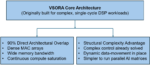
Instead of tweaking existing designs, VSORA built an AI chip from scratch to fix the real bottleneck: moving data fast enough to keep the math circuits busy.
There’s a version of the AI hardware story that everyone in the chip industry has heard a hundred times. A startup raises money on a clever chip design, promises to topple… Read More
NVIDIA Vera: Rebuilding the CPU for Agentic AI

Source: Jonathon Evans and Polychronis Xekalakis, “NVIDIA Vera CPU,” Hot Chips 2026. Performance figures are NVIDIA claims, and several results were based on preproduction or unofficial testing.
NVIDIA’s Vera CPU is a server processor designed specifically for agentic AI, where language models repeatedly observe, reason,… Read More
Podcast EP364: The Broad Impact of Advanced Mask Solutions, Today and Tomorrow with Dr. Germain Fenger
Daniel is joined by Dr. Germain Fenger, Senior Director of Product Management at Synopsys where he leads advanced mask solutions and computational lithography technologies. With a background spanning semiconductor manufacturing, lithography research, engineering, and product leadership, Germain has held roles at imec,… Read More
Explosive Semiconductor Growth in 2026
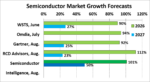
The global semiconductor market in the second quarter of 2026 was $368 billion, according to WSTS. 2Q 2026 set records for growth: up 35% from 1Q 2026 and up a phenomenal 104% from 2Q 2025. The previous record growth was set in 1Q 2026: up 25% from the prior quarter and up 79% from a year earlier.
Growth continues to be driven by AI. Memory… Read More
What Hot Chips 2026 Tells Us About What Silicon Valley Is Actually Building

Here’s what the presentations selected for the 2026 Hot Chips Conference tell us about what Silicon Valley companies are doing these days.
The conference, running this week at Stanford’s Memorial Auditorium, doesn’t publish detailed abstracts ahead of time, but the program itself, just the lineup of who’s presenting what, … Read More
NVIDIA Brings Agentic AI Toolkit to EDA

NVIDIA’s expansion of the NVIDIA Agent Toolkit with PhysicsNeMo and CUDA-X libraries marks a shift from general-purpose AI assistants toward autonomous engineering systems. Instead of limiting agents to document retrieval, code generation, or workflow automation, the expanded toolkit lets developers connect reasoning… Read More
Previewing FMS 2026: The Next Frontier of Enterprise Memory, CXL, and AI-Era Storage

For anyone tracking enterprise infrastructure, the storage landscape is moving at a breakneck pace. The explosive growth of generative AI, multi-million token context windows, and massive data-centric workloads have pushed traditional memory and storage architectures to their absolute limits.
This August, the industry… Read More