




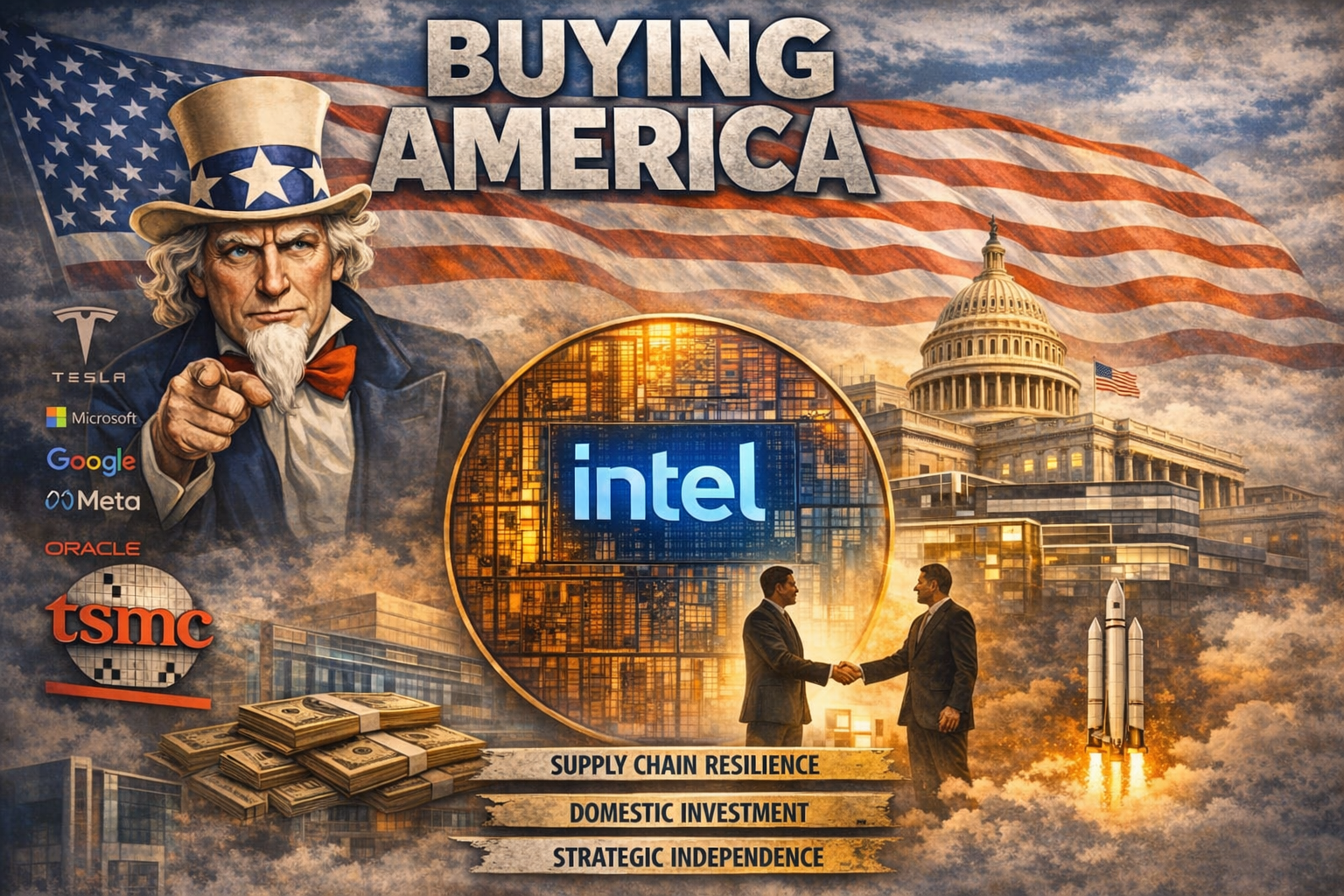

Everyone has been treating Intel as a turnaround story. What if it’s not a scheduled airline — but a charter, and Musk is the one filing the flight plan? Not just Tesla. Companies like Microsoft, Google, Meta, and Oracle are all designing their own silicon now, and their AI infrastructure depends on it. And yet they remain dependent on TSMC for leading-edge supply — one choke point, and it’s tightening. They need a second source. They just haven’t had a credible one.
Then comes the Intel–Musk signal, a short statement with volumes left unsaid. But the direction it points is interesting. It doesn’t look like a supplier building capacity and then going out to find customers. It looks like a customer moving to shape his own supply.
It’s something more like Jensen Huang and NVIDIA committing to capacity at TSMC ahead of availability, aligning their roadmap to future supply rather than waiting for it. TSMC built to that demand, and NVIDIA’s access to leading-edge capacity became a competitive moat. The brilliance people celebrate today is work someone else perfected earlier — and better.
Around 2010, Apple began quietly shifting its foundry strategy away from Samsung and toward TSMC, committing volume and roadmap alignment in exchange for process priority. By most accounts, Apple pushed for more aggressive node transitions and committed to significant volume, giving TSMC the confidence to invest heavily in new capacity and process technology. Apple was securing priority.
From that point forward, Apple consistently had first access to new nodes and, at times, the ability to ramp at scale ahead of other customers. Its volume and cadence helped shape TSMC’s roadmap, influencing both process transitions and advanced packaging technologies. Apple’s relationship with TSMC evolved into a partnership rather than a traditional supplier arrangement. They helped shape the factory.
Intel had its own opportunity in that moment. Under Paul Otellini, Intel chose not to pursue the foundry relationship on Apple’s terms. While TSMC built foundry and roadmap for customer demand, Intel did not. Intel’s decline began when it drifted away from the manufacturing-centric leadership that once defined it. Under Andy Grove and Craig Barrett, Intel’s fabs were the company’s identity. When that lineage ended, leadership shifted toward sales, finance, and product thinking.
Manufacturing moved off center and investments lagged. The 10nm collapse epitomized both. The culture that treated process technology as sacred began to erode. TSMC’s ascent wasn’t a symptom of Intel’s leadership drift, but its consequence. By the time Intel acknowledged it had fallen behind, the damage was deep. The broader ecosystem had aligned around TSMC’s design flows and packaging standards. Intel became increasingly isolated.
When Lip-Bu Tan arrived, the definition of the problem changed. Tan isn’t a fab operator, but he understands the semiconductor ecosystem in a way Intel hadn’t seen in decades. His experience spans EDA, IP, venture investment, and deep relationships across TSMC, Samsung, and the fabless world. Under him, the foundry effort shifted to manufacturing execution.
That made Kevin O’Buckley’s exit inevitable. The role he was hired for, making foundry a customer-facing business, no longer matched the one that emerged. When he moved on, Tan used the transition to reset the foundation — elevating Naga Chandrasekaran, a manufacturing veteran, and beginning the work of rebuilding credibility.
The focus now is making Intel’s fabs relevant. Tan is trying to rebuild the manufacturing discipline Intel walked away from. Musk is offering him a reason to move faster: a committed domestic customer whose roadmap depends on execution and has no patience for excuses — exactly when geopolitical pressure is making U.S. foundry capacity a strategic imperative.
Like Apple before him, Musk isn’t just buying chips. He’s filing the flight plan. Intel has lived with the consequences of saying no once before. If Musk moves first, he likely won’t be alone for long. Any hyperscaler watching a credible U.S.-based foundry being pulled forward by a major customer will want exposure to that model. Each can commit independently — through capacity agreements, co-development, or direct investment — and align it with broader strategic and political priorities.
None of this works if Intel can’t execute. A bilateral deal is not a subsidy, and signaling does not fix a process node. The deal would force execution into the open, accountable to customers whose roadmaps depend on results. It forces execution into the open market to customers whose roadmaps depend on results. TSMC thrived under that pressure because it was built for it. Intel is being asked to become something it has historically resisted being, a foundry for hire.
If AI demand continues to outpace supply — and if control over silicon becomes as strategic as control over data centers — the question becomes who moves first to shape what semiconductor manufacturing becomes. Intel put out a single tweet. But did it get the business?
Also Read:
Intel, Musk, and the Tweet That Launched a 1000 Ships on a Becalmed Sea
Agentic AI Demands More Than GPUs
Captain America: Can Elon Musk Save America’s Chip Manufacturing Industry?
Share this post via:



Comments
There are no comments yet.
You must register or log in to view/post comments.