






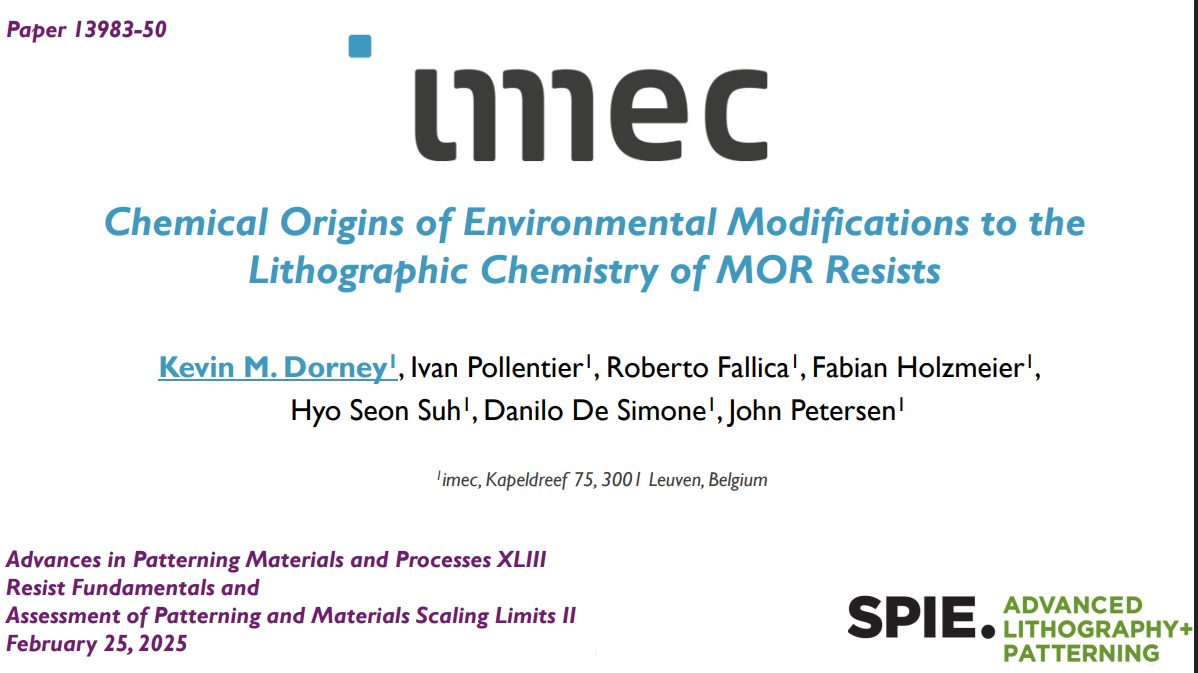
In the pursuit of advanced extreme ultraviolet (EUV) lithography for high-NA patterning, metal oxide resists (MORs) offer significant promise but face challenges like critical dimension (CD) variation due to atmospheric interactions. Presented at SPIE Advanced Lithography + Patterning 2025 by Kevin M. Dorney and colleagues from imec, this study delves into the chemical mechanisms behind environmental modifications during exposure and processing, emphasizing the role of gases like O₂, CO₂, and H₂O in post-exposure delay (PED) and bake (PEB).
MORs, such as tin-based systems, undergo ligand loss upon EUV exposure, leading to condensation and pattern formation. However, post-exposure atmospheric exposure can cause CD drift, linked to airborne molecular contaminants (AMCs) and humidity. Literature reviews highlight mechanisms: Kenane et al. propose CO₂ and H₂O forming Sn-O-C=O-Sn bridges; Frederick et al. suggest O₂ enhancing ligand loss in Keggin clusters; Zhang et al. outline air/N₂ pathways yielding oxygenated Sn sites; and Castellanos et al. attribute CD drift to H₂O and AMCs cleaving ligands faster.
To probe these, imec’s BEFORCE platform, integrating EUV exposure, FTIR spectroscopy, outgassing measurements, and controlled environments—enables precise studies. The tool allows MOR coating, dosed EUV exposure, PED/PEB in custom atmospheres (e.g., varying O₂, N₂, CO₂, RH), and offline development/ellipsometry.
Initial FTIR on an open-source MOR (OSMO) reveals post-exposure ligand loss, PED-induced H₂O uptake, and PEB-driven further loss, counter-ion departure, and SnO formation. Notably, a new ~1700 cm⁻¹ peak (C=O) emerges post-PEB in air but not vacuum or N₂, indicating an air-specific, thermally stable product.
Investigating origins, CO₂ variations show no chemical change, ruling it out. H₂O isolation via RH skew in N₂ vs. clean air (CA) PEBs (35 mJ, 220°C, 60s) yields faint or absent C=O in N₂, consistent presence in CA regardless of RH. Peak ratio (1700/1550 cm⁻¹) offsets suggest O₂’s role, possibly forming esters.
Focused DOEs confirm O₂ drives C=O: at fixed 220°C PEB, intensity rises non-linearly with O₂% (diluted in N₂); at fixed O₂%, it emerges ~200°C and sharpens with temperature. Thus, O₂ and PEB temp dominate oxygenated carbon formation; CO₂/H₂O show no dependence.
Kinetics reveal O₂ amplifies ligand cleavage: at fixed temp, loss follows first-order rate law, suggesting unimolecular O₂-MOR reaction. Rate constants (k) scale with O₂ (e.g., 4.18×10⁻³ s⁻¹ at 21%, 6.11×10⁻³ at 50%), yielding activation energies ~58 kJ/mol. Temp dependence shows exponential cleavage increase, non-catalytic.
Contrasting exposed vs. unexposed films, O₂ enhances cleavage only post-EUV, implying radicals or active sites from exposure enable O₂ reaction. Proposed: EUV cleaves ligands, creating radical Sn for O₂ insertion, forming Sn-O-Sn or peroxides, unlike unexposed thermal processes.
Quantitatively, 50% O₂ yields ~3x ligand loss enhancement at high temps, potentially lowering EUV doses by amplifying sensitivity without resolution loss. Companion work (Pollentier et al., SPIE ALP 2026) links this to dose-to-gel reductions up to 30%.
Bottom Line: This reveals O₂-dependent chemistry in model MORs, requiring EUV activation. Outlook includes in-situ PEB studies, PED O₂ effects, and H₂O+O₂ synergy. Funded by EU’s Chips Joint Undertaking and partners, these insights enable co-optimized environments for stable, sensitive MOR processes, advancing semiconductor scaling.
Acknowledgments thank imec teams, Intel, and suppliers for materials and discussions.
Also Read:
Beyond Moore’s Law: High NA EUV Lithography Redefines Advanced Chip Manufacturing
Accelerating Computational Lithography Using Massively Parallel GPU Rasterizer
Unraveling Dose Reduction in Metal Oxide Resists via Post-Exposure Bake Environment
Share this post via:



Captain America: Can Elon Musk Save America’s Chip Manufacturing Industry?