




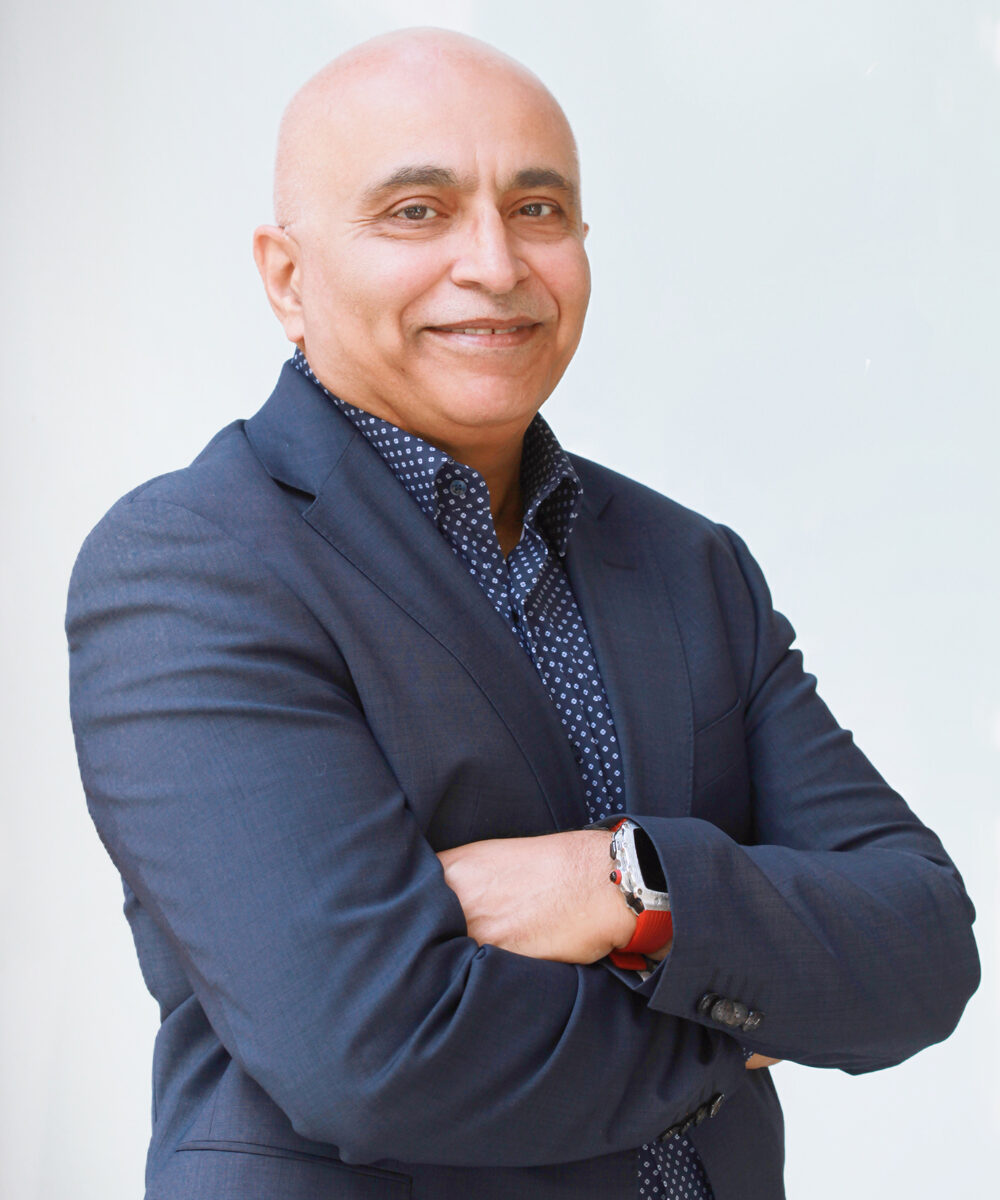

 Aftkhar Aslam is the Co-Founder and Chief Executive Officer of yieldWerx and a semiconductor industry veteran with more than 30 years of experience spanning manufacturing, test engineering, yield management, IP strategy, and enterprise digital transformation.
Under his leadership, yieldWerx has become a trusted data and yield analytics platform supporting semiconductor companies across fab, assembly, test, advanced packaging, photonics, and AI-driven device manufacturing. The platform enables organizations to unify fragmented manufacturing data into scalable, actionable yield intelligence.
Prior to founding yieldWerx, Aftkhar held senior leadership roles at Texas Instruments, where he served as Worldwide Director of Test & Yield Management Solutions & Director of Digital Transformation in the space of Design and Delivery systems and solutions across HW and SW.
He also served as a Director within Accenture’s Industry X (IX) practice, where he advised leading global technology organizations including Intel, GlobalFoundries, Qualcomm, Lam Research, Microsoft, STMicroelectronics, and Skyworks. His consulting work focused on bridging the Design-to-Manufacturing divide — architecting Digital Thread and Digital Twin strategies that connected product design, IP management, manufacturing execution, test, and enterprise systems into unified operational frameworks.
Aftkhar holds patents and possesses deep expertise in intellectual property management and protection. His experience spans semiconductor IP lifecycle governance, secure data architectures, and protecting high-value design assets across complex global supply chains.
Tell us about your company.
yieldWerx is a semiconductor-focused data and enterprise yield analytics platform. We help manufacturers unify data across fab, assembly, test, inspection, and advanced packaging into a single environment where engineers can extract real insight — not just generate reports.
What makes us different is that we tend to operate where the problems are hardest. We work with highly specialized, niche products and manufacturing flows — whether that’s heterogeneous integration, chiplets, co-packaged optics, MicroLED with billions of pixel-level data points, or silicon photonics requiring optical and electrical correlation. These aren’t simple wafer-yield problems; they’re multi-domain, multi-stage challenges that traditional tools struggle to handle.
We’re purpose-built for semiconductor manufacturing at extreme scale and extreme complexity. Our platform is designed to manage unconventional data models, massive datasets, and deep traceability requirements without breaking performance or usability.
At a high level, we help companies move from fragmented data silos to a connected digital thread — accelerating yield learning, reducing ambiguity, and enabling smarter, faster engineering decisions in some of the industry’s most advanced and specialized product environments.
What problems are you solving?
The biggest problem in semiconductor manufacturing today isn’t lack of data — it’s fragmentation.
Data lives in MES systems, testers, inspection tools, spreadsheets, homegrown databases, and separate analytics platforms. Engineers spend enormous time manually stitching it together before they can even begin root-cause analysis.
We solve that by unifying the data model and enabling cross-domain correlation — electrical + optical, wafer + module, socket + silicon, defect + yield, and so on.
Another major problem is scale. Modern devices generate massive datasets. Traditional tools weren’t designed for billions of data points. Ultimately, we reduce the time from anomaly detection to root cause — and that directly impacts yield, cost, and time-to-market.
What application areas are your strongest?
We’re strongest in environments where complexity is high and data volumes are extreme.
That includes:
- Advanced packaging (2.5D/3D, chiplets, CPO)
- Silicon photonics
- MicroLED and display technologies
- AI and high-performance compute devices
- Automotive and high-reliability semiconductor manufacturing
Anywhere there’s multi-stage manufacturing with complex traceability requirements — that’s where we add the most value.
What keeps your customers up at night?
Three things:
- Yield ramp speed — especially for new technologies. Every week of delay is expensive.
- Escapes or overkill at test — failing good parts or shipping marginal ones.
- Lack of traceability when something goes wrong.
They worry about whether they truly understand where yield loss is originating — is it the wafer, the packaging step, the bonding process, the socket, the test program?
If the answer takes weeks to figure out, that’s a problem. Our goal is to make that answer visible in hours or days.
What does the competitive landscape look like and how do you differentiate?
There are traditional yield tools, BI tools, and homegrown systems.
Traditional yield tools often focus on wafer-level analysis but struggle with cross-domain traceability. BI tools are flexible but require heavy customization and don’t inherently understand semiconductor manufacturing.
We differentiate in three ways:
- Semiconductor-native data model — we understand wafers, panels, bonding, pixel maps, optical lanes, serialized modules.
- Extreme scalability — billions of records without performance degradation.
- Closed-loop capability — we don’t just visualize data; we enable correlation across design, manufacturing stages to drive actionable decisions.
We’re not just another dashboard — we’re the infrastructure layer for yield intelligence.
What new features or technology are you working on?
We’re expanding heavily into:
- Pixel-level and device-level analytics for MicroLED and advanced displays
- Optical + electrical unified analysis for photonics and CPO
- Advanced spatial analytics and pattern recognition
- AI-assisted anomaly detection and predictive yield modeling from the start of design
- Deeper integration with test hardware and equipment for closed-loop optimization
We’re also strengthening genealogy and digital-thread capabilities to support next-generation packaging and heterogeneous integration.
The industry is moving toward system-level understanding, not just wafer-level — and that’s where we’re investing.
How do customers normally engage with your company?
Most engagements start with a specific pain point — slow yield ramp, fragmented data, lack of traceability, or scaling a new technology.
We typically begin with a focused pilot or proof-of-value around a real manufacturing dataset. Once customers see how quickly we can unify and analyze their data, the engagement expands into a broader enterprise deployment.
We also work closely with equipment providers, OSATs, and ecosystem partners, because yield today is collaborative — not isolated.
At the end of the day, we’re a long-term partner. Once we’re embedded in the manufacturing data flow, we become part of the operational backbone.
Also Read:
CEO Interview with Elad Raz of NextSilicon
VSORA Board Chair Sandra Rivera on Solutions for AI Inference and LLM Processing
CEO Interview with Dr. Raj Gautam Dutta of Silicon Assurance
Share this post via:



Comments
One Reply to “CEO Interview with Aftkhar Aslam of yieldWerx”
You must register or log in to view/post comments.